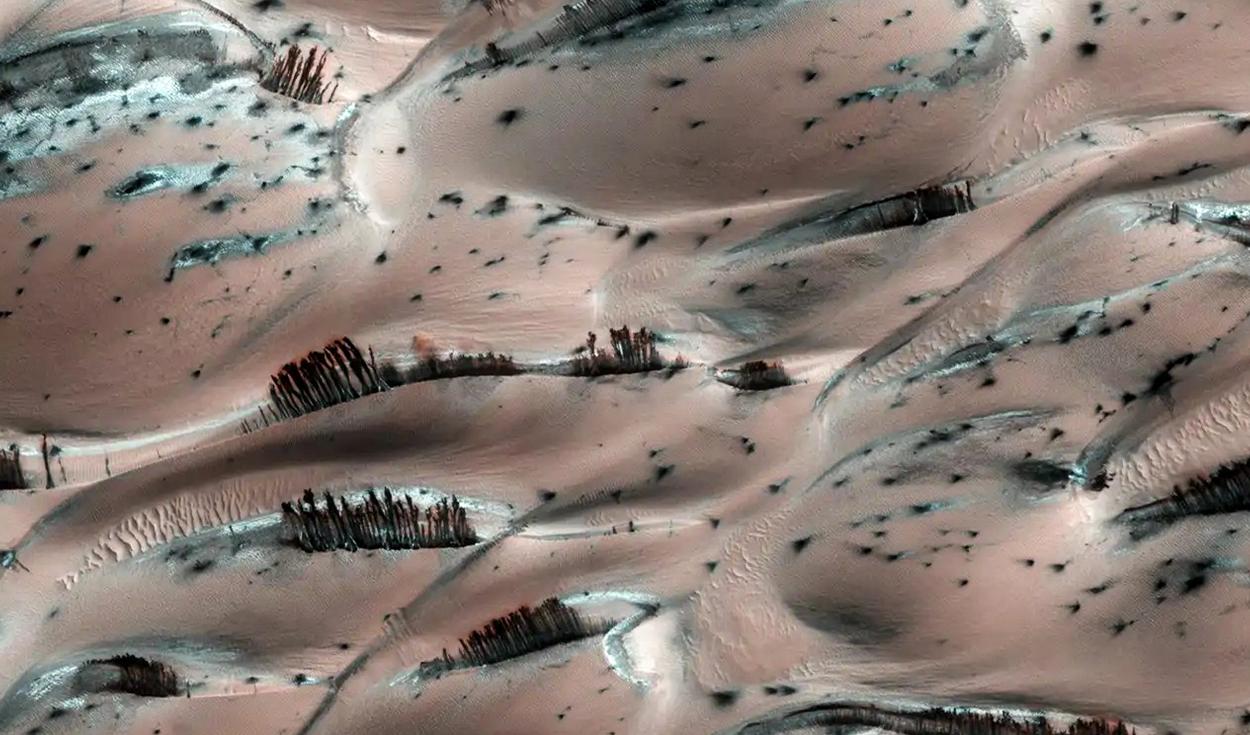
NASA's Mars Reconnaissance Orbiter has captured images of Martian dunes that mimic a shadowless forest and curved rows of stones that resemble a human fingerprint, the US space agency said.
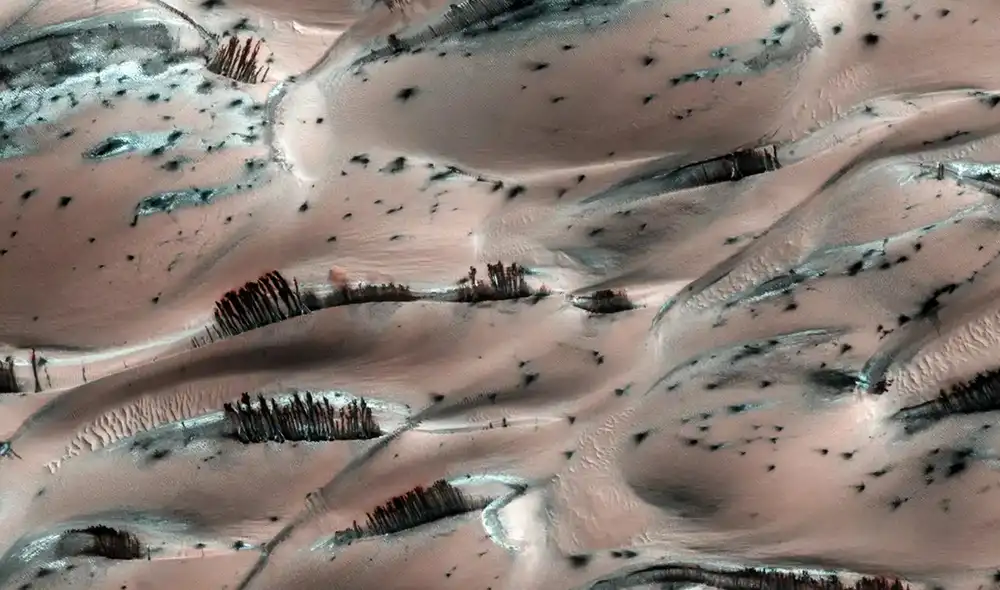
The spacecraft, known as MRO, launched on August 12, 2005, and has orbited Mars ever since, studying the planet's climate and geology with a suite of instruments including HiRISE, a high-resolution camera managed by the University of Arizona. In April 2008, MRO found a field of pink dunes near Mars's north pole, where dark streaks crossed frost-covered ridges and resembled small trees, in an area where an active landslide was also recorded.
Then, on August 28, 2024, the orbiter photographed curved rows of stones in a region called Daedalia Planum, a vast volcanic plain in Mars's southern hemisphere formed by ancient lava flows, that look like a fingerprint. HiRISE also revealed, in the nearby Tharsis plateau, thick stones set apart from finer dust through a geological process that has not yet been confirmed, according to NASA. Tharsis is a huge volcanic region on Mars that hosts some of the largest volcanoes in the solar system.
What causes the shadowless forest effect
During the Martian winter, carbon dioxide freezes and covers sand mounds in a blanket of dry ice. At the start of spring, sunlight warms the crust and causes the solid to sublimate directly into gas.
In some areas, the icy layer cracks and releases dark dust trapped underneath. The loose grains then roll down from the peaks and leave dark trails on the slopes.
The color contrast between the dark trails and the pale frost creates the appearance of tree trunks, although NASA notes in its description of the images that the shapes do not cast shadows. Planetary researcher Candy Hansen also observed a faint trail of particles as the material collapsed, a detail reported by NASA Science.
Hansen and her team described the process in a paper published in the journal Science in 2011. Comparing orbital images, they found that channels and debris had built up at the base of several slopes after a single Martian year. Winds later rearranged that debris, forming ripples and erasing older grooves.
What explains Mars's fingerprint-like rock rows
On the slopes of Tharsis, at an altitude of 5,455 meters, light-colored stones stand out against darker ground in strips spaced between five and ten meters apart, a pattern recorded in an image NASA titled "Zen Gardens on Mars" (ESP_084798_1550).
Paul Geissler, who co-authored the report on the stones, said that explaining the origin of this sorting by grain size remains a baffling puzzle.
One proposed explanation links the pattern to temperature swings, since freeze-thaw cycles seen on Earth can move grains and group them according to size. Geissler suggested that the high elevation of Daedalia Planum could support similar dynamics under extreme cold.
A second hypothesis attributes the movement of larger rocks to underground vibrations, a mechanism similar to the so-called Brazil nut effect, in which shaking a container of mixed nuts pushes the larger ones to the top. For that explanation to hold in this part of Mars, the hypothesis would require continuous internal activity stirring the surface, according to the report.
Test yourself
Which spacecraft captured the Mars images described in the article?
What causes the dark 'tree trunk' trails on the Martian dunes?
Where were the fingerprint-like rows of stones photographed?
Have your say
Which explanation do you find more convincing for Mars's fingerprint-shaped rock rows?