

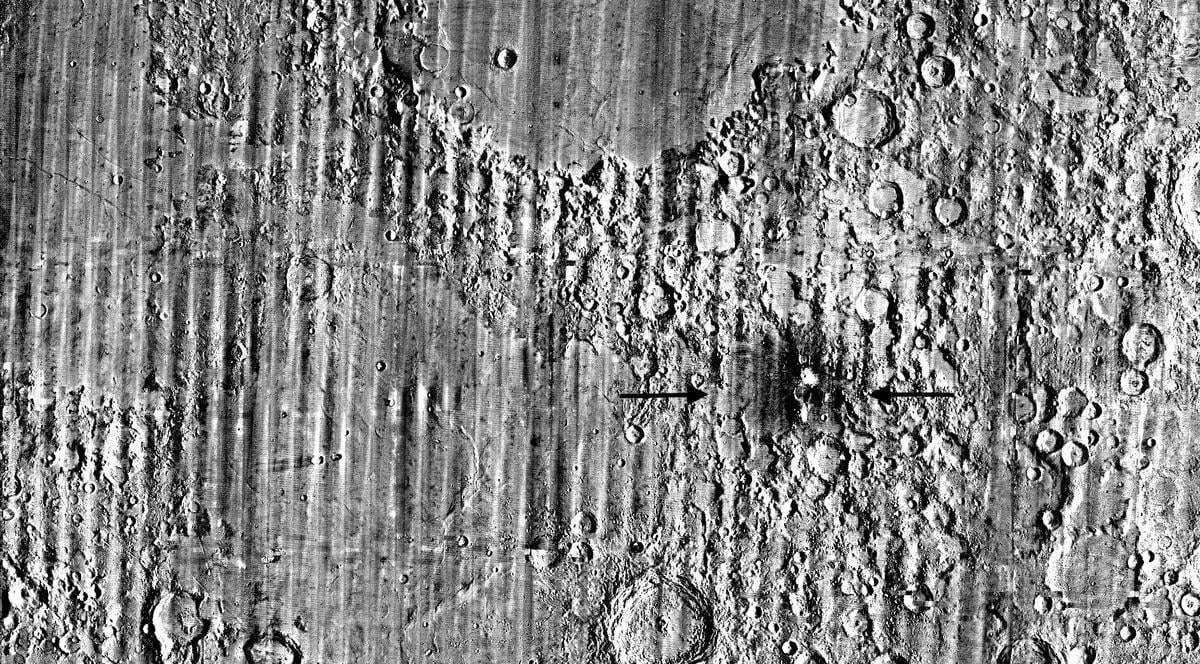
NASA's Lunar Reconnaissance Orbiter has detected a massive 222-metre impact crater near the eastern edge of the Moon.
The feature, named McGetchin crater, was created when a comet or asteroid measuring between three and six storeys tall struck the lunar surface at high speed, carving a cavity 43 metres deep into the terrain.
Image processing expert Robert Wagner first spotted the collision site on October 24, 2025, while examining photographic data returned by the orbiting probe. Wagner identified the feature using automated software that systematically compares historic and modern images of the lunar surface.
On the satellite imagery, the crater appeared as a prominent bright spot enclosed by a dark halo of ejected debris. Because of the substantial scale of the impact trace, Wagner was able to detect it more readily than smaller surface strikes. According to estimates published by researchers in the journal Science Advances, impacts of this size occur on the Moon at most once per century.
Comparative orbital data established that the impact took place between April 11 and May 22, 2024. Following Wagner's initial observation, scientists targeted the coordinates with the Lunar Reconnaissance Orbiter's higher-resolution camera system to determine the exact geometric dimensions and shape of the new crater.
Temperature anomaly and regolith disruption
Beyond the physical crater, sensors aboard the spacecraft recorded an unusual thermal footprint surrounding the site. Readings from the onboard Diviner temperature sensor revealed that an area extending roughly 6.4 kilometres across the crater becomes markedly colder at night, dropping approximately 9 degrees Celsius below the surrounding lunar terrain.
Researchers determined that the nighttime chilling stems from severe physical disruption to the lunar regolith, the layer of loose dust and fragmented rock covering the Moon's solid crust. The violence of the impact agitated the topsoil and significantly reduced its overall density, causing the material to retain heat poorly and cool rapidly following lunar sunset.
Unlike Earth, which relies on a dense protective atmosphere to slow down and burn up incoming space debris through friction, the Moon possesses virtually no atmosphere. Celestial bodies consequently strike the airless lunar surface at full velocity without losing speed or mass prior to impact.
Orbiter background and lunar origin models
The discovery highlights the ongoing mission of NASA's Lunar Reconnaissance Orbiter, a robotic spacecraft launched by the United States space agency in 2009 to map the Moon's topography and monitor active surface changes. Equipment such as the Diviner radiometer allows planetary scientists to measure thermal emissions and track fine structural alterations across the lunar environment.
The finding follows recent theoretical modeling highlighted by UNIAN regarding how the Moon initially formed. That separate study indicated that following a collision between the early Earth and a Mars-sized planet named Theia, the Earth's natural satellite may have coalesced in a matter of hours rather than over millions of years.


