

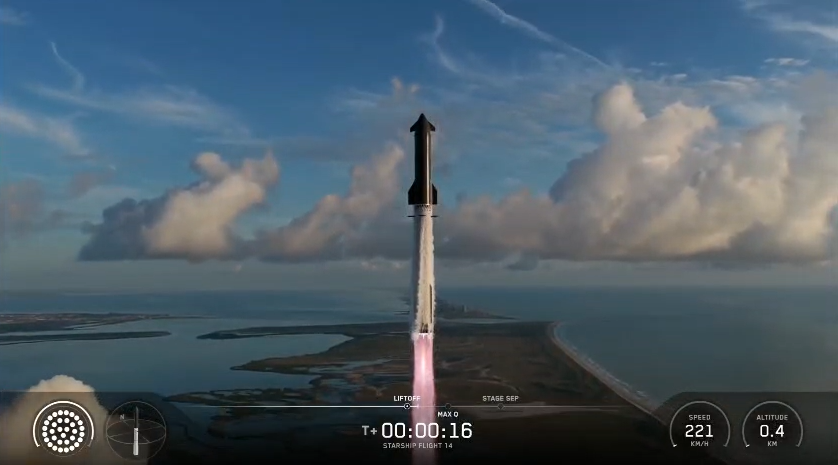
SpaceX's Starship rocket reached Earth orbit for the first time on Monday after launching from southern Texas on its 14th test flight. The upper-stage spacecraft achieved low Earth orbit roughly 27 minutes after liftoff, marking a long-awaited milestone for Elon Musk's commercial space company after 13 previous test missions failed to reach orbit.
The test vehicle launched at 9:48 am Brasilia time from SpaceX's southern Texas facility, with the spacecraft successfully reaching orbit at approximately 10:15 am. During its time in space, Starship deployed a payload of 26 Starlink V3 satellites before mission controllers brought the test to an early conclusion.
After separating during the initial flight stages, Starship executed a burn using a single Raptor engine to enter a low Earth orbit at an altitude of about 275 kilometers. Reaching this stable orbit was one of SpaceX's primary goals for the mission. Following the orbital burn, Starship completed its payload deployment by releasing all 26 Starlink V3 satellites, and SpaceX confirmed that its Starlink team established radio contact with every satellite shortly after release.
SpaceX spokesperson Dan Huot said the deployment of 26 satellites on a single flight equaled roughly 20 launches of the company's Falcon 9 rocket in terms of total network bandwidth. The Falcon 9 is SpaceX's primary reusable workhorse rocket used for commercial satellite deployments, while Starlink is the company's global satellite internet network designed to provide high-speed internet access worldwide.
Engine reliability issues during flight
Despite reaching orbit, the test flight encountered technical complications, particularly regarding engine reliability. During Starship's ascent, at an altitude of around 22 kilometers, one of the central ring engines shut down unexpectedly. The mission was permitted to continue because SpaceX did not require that specific engine for subsequent flight phases, allowing Starship to fire its remaining Raptor engines to reach orbit.
Engine issues also affected the Super Heavy booster rocket during its return maneuver toward Earth. The massive booster reignited only 31 of its 33 engines while guiding itself back for landing, even though engine reignition is critical for achieving a safe touchdown. Following the orbital burn, SpaceX chose to terminate the mission early, keeping Starship in orbit for only a few hours instead of the 10 hours originally scheduled.
Starship is a super heavy-lift launch system developed by SpaceX, the commercial space transportation company founded by billionaire Elon Musk. The system consists of two main components: the Super Heavy first-stage booster and the Starship upper-stage spacecraft, both powered by SpaceX's methane-fueled Raptor engines. Designed to be fully reusable, Starship is intended to carry heavy payloads and crew into space at significantly reduced costs.
Pacific splashdown and future exploration goals
Starship re-entered Earth's atmosphere at more than 20 times the speed of sound before performing a controlled touchdown at a designated target area in the Pacific Ocean. SpaceX noted that the water landing was less smooth than the controlled splashdown achieved during flight 13 in July, with the impact resulting in a large fireball visible over the water.
SpaceX intends to use Starship's massive payload capacity to accelerate the expansion of its Starlink internet constellation. The vehicle is also central to NASA's Artemis program, which aims to return American astronauts to the surface of the Moon, with long-term plans to use Starship for human missions to Mars. SpaceX has not yet confirmed when Starship will make its next test flight or what specific objectives the next mission will involve.


