


An animal welfare network coordinated by Colectivo Animalista del Condado has launched emergency rescue operations in Niebla following a 33,000-hectare wildfire. The forest fire, which broke out on August 6 in the Andalusian province of Huelva in southern Spain, left local wildlife in a state of extreme vulnerability.
Four animal protection groups have joined forces to distribute food and water across the scorched countryside. The coalition includes Colectivo Animalista del Condado, Paterna Animalista, Valverde Animal, and the Seville-based organization Latidos Gatunos.
Delia Naranjo, president of the Hinojos-based Colectivo Animalista del Condado, explained that while Valverde Animal covers the Valverde-Niebla sector and Paterna Animalista manages its local area, the network is concentrating its main efforts on the municipality of Berrocal. Over 95 percent of Berrocal territory, amounting to more than 12,000 hectares, was destroyed by the blaze.
Reaching Berrocal poses significant logistical challenges for volunteers. Naranjo noted that Berrocal is the most remote and inaccessible site in the region, requiring even the closest volunteers at least two hours of travel time to reach.
Unlike nearby municipalities such as Niebla or Valverde del Camino, where local hunting clubs and anonymous volunteers actively feed surviving animals, Berrocal lacks local animal shelters. The local hunting club in Berrocal consists of older men with limited physical capacity, prompting the rescue network to focus its resources on the town.
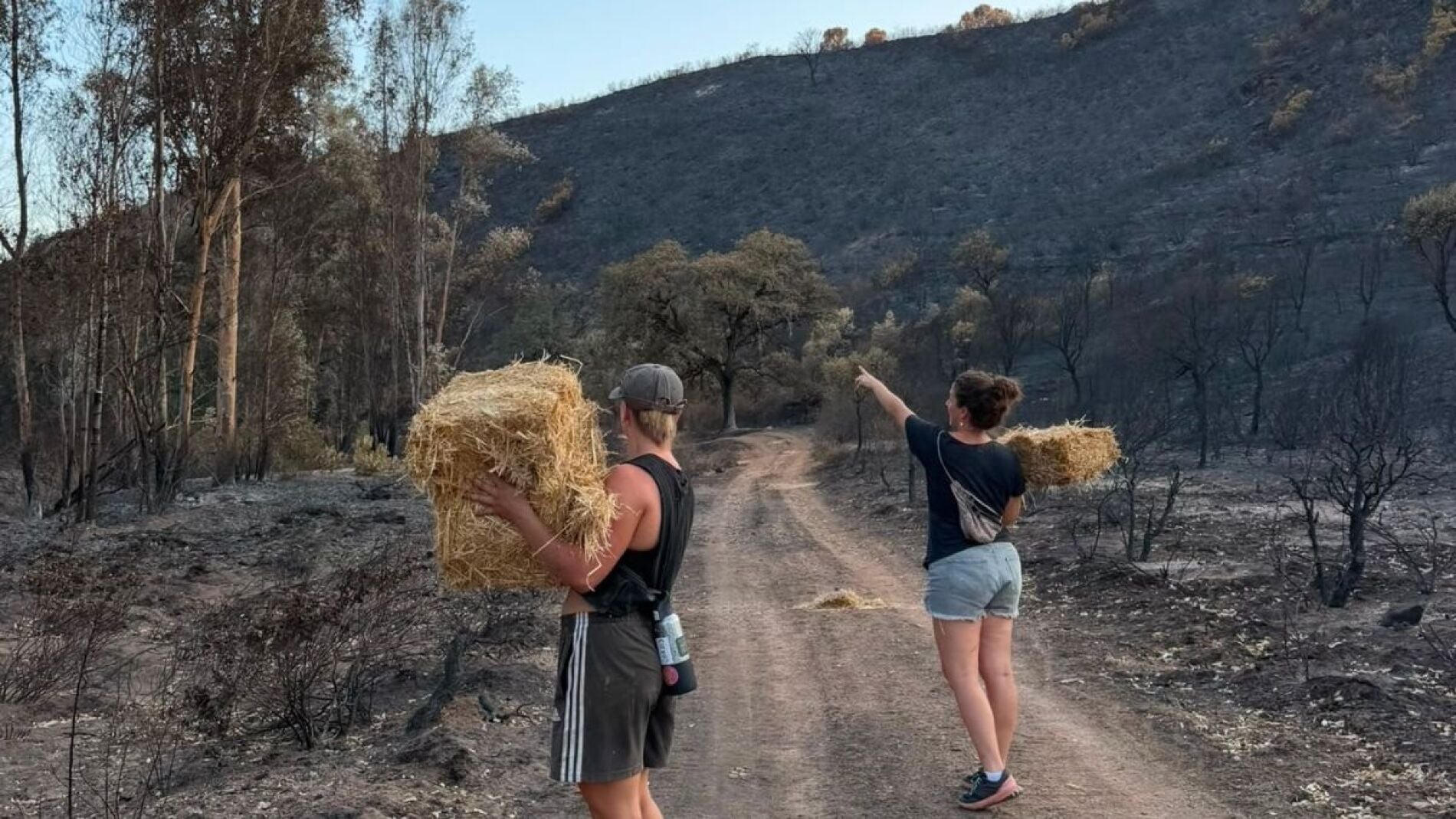
Emergency Relief Operations in Berrocal
Describing the initial arrival in Berrocal, Naranjo reported finding absolute devastation across the landscape, noting that there were no birds, orchids, or insects remaining. To ensure their intervention was scientifically sound, the volunteers sought guidance from conservation experts.
The network consulted Juan Romero of Ecologistas en Acción, alongside specialists from the conservation group Asociación Rastrea and volunteers from WWF Spain. Ecologistas en Acción and WWF Spain are prominent environmental organizations in Spain that focus on habitat protection and wildlife conservation.
Naranjo emphasized that the feeding operations are guided strictly by ecological and conservation criteria. In Berrocal, the animal welfare groups coordinate directly with the local Town Hall, Civil Protection services, and regional Environmental Agents.
Tailored Diets for Scorched Species
The feeding strategy is tailored specifically to the biological needs of each species. Naranjo explained that while hay would be the ideal food for herbivores, only 500-kilogram bales are available at this time of year, which volunteers cannot physically move.
In place of large hay bales, the volunteers purchase straw and supplement it with sacks of oats and wheat. On each trip to Berrocal, teams distribute roughly 300 kilograms of oats and wheat at strategic points identified by local residents who know the terrain well.
Naranjo noted that ruminants require food 24 hours a day to survive, but the wildfire destroyed all natural pasture. Spreading straw across the terrain allows ruminants to graze in a manner that mimics their natural feeding habits.
Diets differ depending on animal biology. Wild boars are supplied with fruit and corn, though Naranjo cautioned that while corn is beneficial for wild boars, it causes severe stomach problems for deer.
For deer, mouflons, and wild boar piglets, volunteers deliver fresh fruit, primarily apples and pears. To prevent spoilage and digestive issues, the fruit is dropped off within 24 hours of collection.
The rescue network also feeds local rodents, recognizing their critical role in the broader ecosystem. Naranjo explained that rodents serve as the primary food source for birds of prey, warning that raptors will not return to the area if rodent populations die out.
Carnivorous species receive high-quality cat food. This diet supports foxes, stone martens, Egyptian mongooses, and native otters inhabiting the waterways of Berrocal.
Water Supplies and Artificial Shelter
In areas devoid of natural streams or gullies, volunteers install discarded bathtubs obtained from scrap yards. These bathtubs are buried in the ground and filled with water to create stable drinking points.
To prevent birds and small mammals from drowning, volunteers place large stones inside the submerged bathtubs. Teams have also deployed biodegradable bird feeders for passerines, while Asociación Rastrea has pledged to supply nest boxes for nocturnal birds of prey.
The emergency aid campaign is designed as a mid-term plan expected to run through December. However, organizers acknowledge that volunteer numbers and resource availability will likely decline over the coming months.
To sustain operations, collection points have been established in Paterna, Hinojos, Valverde, and Seville city. Needed items include grains such as oats, wheat, and corn, fresh apples and pears delivered within 24 hours, and transport vehicles capable of moving water and feed across difficult terrain.
Community Funding and Hunting Restrictions
To maintain transparency, the rescue groups do not accept direct cash donations. Instead, members of the public can purchase feed directly at Hermanos Ruiz, a seed store located in Hinojos.
A sack of oats at the store costs 12.50 euros, and donors can also contribute amounts starting from 5 euros toward an open store fund. Volunteers only collect the physical sacks of feed from the store and handle no monetary transactions.
Naranjo called for strict legal protection for surviving wildlife, invoking legal disaster provisions known as dias de fortuna that prohibit hunting following natural disasters. Local hunters, animal rights groups, environmentalists, and residents have mutually agreed to respect a four-year hunting ban across a 50-kilometer perimeter to allow ecological recovery.
The coalition has urged the Andalusian Regional Ministry of Environment and Spain's central government to enforce strict surveillance by hiring additional Environmental Agents and Seprona officers, the nature protection arm of the Civil Guard.
Naranjo stressed that surviving animals are currently defenseless, crowding into small islands of unburned vegetation out of fear. She added that while animal groups and hunters are cooperating harmoniously to divide feeding zones, authorities must crack down on illegal poachers operating in the region.


