

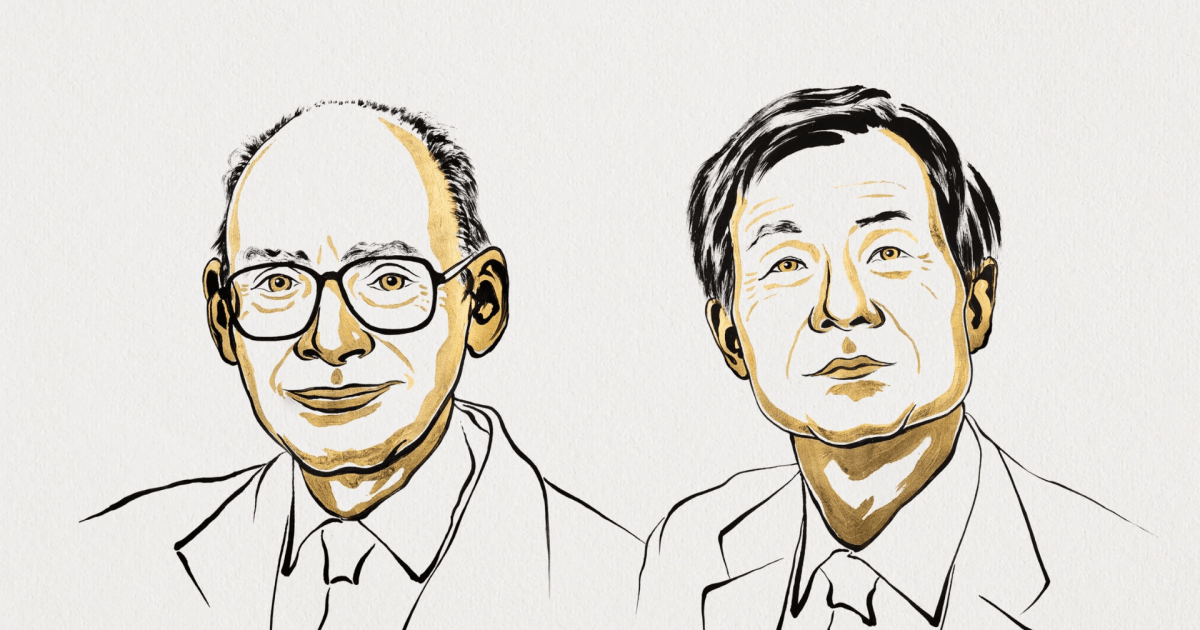
French chemist Henri Kagan and Japanese researcher Kenso Soai have won the 2026 Nobel Prize in Chemistry for discovering non-linear effects and autocatalysis in asymmetric organic synthesis.
The Royal Swedish Academy of Sciences announced the award on Wednesday morning in Stockholm, Sweden.
The two scientists will share the 1.2 million US dollar prize, which equates to slightly more than 6 million reais, alongside the recognition of winning the world's most prestigious scientific award.
Understanding molecular handedness
Some molecules, including amino acids, exist in two variants that are mirror images of each other. However, living organisms contain only one of these mirrored forms.
In chemistry, this phenomenon is called chirality, a term derived from the Greek word for hand. Many molecules essential for life exist in these two symmetrical forms, known as enantiomers.
The Academy used human hands to explain the concept. A left hand and a right hand appear identical but are mirrored images, meaning they cannot be perfectly superimposed on each other regardless of how they are rotated.
Nature made a strict choice in its chemistry, a preference for one side known as homochirality. All proteins in human cells exclusively use left-handed amino acids, while DNA structures use only right-handed sugars.
The lock and key mechanism
To explain the everyday importance of the project, the Swedish Academy used the analogy of a key and a lock.
In a typical manufacturing process, half of the keys produced might have teeth facing right and the other half facing left. Only one side will successfully open the lock, while the mirrored key will fail and could jam or damage the mechanism.
A similar process occurs in medicine, where human cell receptors function as precise locks. When a medication is developed, only one side of the molecule delivers the desired therapeutic effect, while the mirrored side can be useless or cause adverse side effects.
Kagan's non-linear effect
When chemists attempted to manufacture these molecules in a laboratory using neutral ingredients, they consistently produced a mixture of 50 percent of each side. For over a century, science sought a way to force a chemical reaction to manufacture only the desired side.
In the 1980s, Kagan, working at Paris-Sud University, overturned a long-held chemical belief. Scientists previously thought that using a catalyst, which is a substance that accelerates reactions, with 70 percent purity for one side would result in a final product with exactly 70 percent purity in a direct and linear proportion.
Kagan discovered that the reaction functioned differently. He found that the catalyst's metal atom can bind to two chiral molecules simultaneously, creating three possible combinations: right-right, left-left, and a mixed left-right pairing.
He realized that the mixed combination is slow and inefficient, acting as a trap that locks and neutralizes the unwanted molecules. As a result, starting with a catalyst of low initial purity produced a final product that was much purer than expected, a phenomenon named the non-linear effect.
Soai and the origins of life
In the 1990s, Soai, a researcher at the Tokyo University of Science, advanced Kagan's project by designing a reaction where the formed product acts as a catalyst for itself. The process became known as asymmetric autocatalysis.
In experiments concluded in 2003, Soai proved that mixing substances with no initial chirality allowed small, casual statistical fluctuations to generate a microscopic advantage for one side.
Due to the multiplying effect of the reaction, known as the Soai Reaction, an initial microscopic advantage of just 0.0005 percent was amplified exponentially at each step. This achieved a purity of over 99.5 percent for the product of a single side.
It was the first time science managed to create chiral purity from scratch in a laboratory setting, imitating the process that allowed life to emerge on Earth.
Industrial and medical applications
In addition to answering questions about how life developed on the planet, the discoveries by Kagan and Soai have revolutionized modern industry.
Their contributions have led to modern, safer medications that are free from contamination by harmful mirrored molecules. They have also contributed to more effective agricultural pesticides with a lower environmental impact, aromas and fragrances for cosmetics and foods, and new materials and advanced technologies.
Through their discoveries, the 2026 Nobel laureates have provided humanity with the tools to master the molecular mirror, ensuring more precise and safer products and treatments.
The Nobel Prize
The Nobel Prizes were established by the will of Alfred Nobel, a Swedish inventor and businessman who built part of his fortune through the invention of dynamite.
First awarded in 1901, the prizes honor achievements in science, literature and peace. An economics prize was later added by Sweden's central bank.
Although sometimes overshadowed by famous laureates in physics, literature and peace, the chemistry prizes have recognized many influential discoveries, including nuclear fission and genetic sequencing techniques.
The previous year's chemistry prize was awarded to scientists Susumu Kitagawa, Richard Robson and Omar Yaghi for developing metal-organic frameworks, which are molecular structures that can help address challenges such as climate change and fresh water scarcity.
The laureates will receive their medals from King Carl XVI Gustaf of Sweden at a ceremony in Stockholm on December 10, the anniversary of Alfred Nobel's death. The award presentation will be followed by a sumptuous banquet at Stockholm City Hall.


