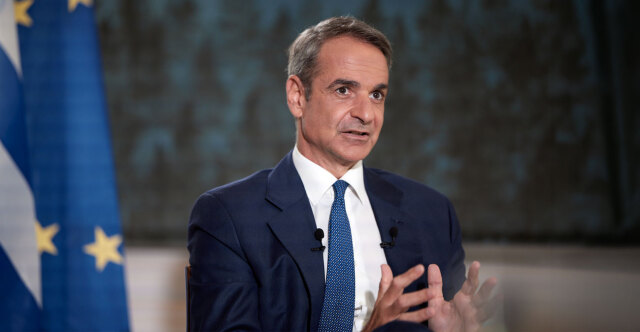
Three firefighters died on duty as wildfires swept Greece under extreme summer weather conditions, Prime Minister Kyriakos Mitsotakis said, pledging immediate state support for people whose property was destroyed.
Mitsotakis made the remarks in his weekly Sunday review post, noting that winds had reached Beaufort 10 in some areas and had repeatedly grounded the country's aerial firefighting fleet. He said there were cases where aircraft could not safely carry out water drops or take on water because extreme turbulence made flying prohibitive, leaving ground crews to bear almost the entire burden of the fight.
He said the three firefighters gave everything they had to save lives, property, and forests, and expressed what he called his unlimited gratitude to all firefighters, volunteers, civil protection officers, security forces, armed forces, and municipal workers. Assessment teams from the fire service and the state relief agency would work alongside affected residents immediately to record and verify damage so that state support could be delivered quickly, he said.
He said the government had invested more than ever in civil protection in recent years, acquiring more aerial and ground assets, adopting new technologies, hiring personnel, and reorganising the state mechanism. But he acknowledged that there are moments when the intensity of weather events exceeds every human plan and every operational capacity.
Immigration
Turning to migration, Mitsotakis pointed to events in Ceuta, Spain, as a reminder that irregular migration remains one of Europe's biggest challenges. He said Greece had pursued a strict but fair migration policy since 2019, which he described as now broadly aligned with the common European approach.
He cited what he called measurable results: sea arrivals in the first seven months of 2026 were down more than 35 percent compared to the same period the previous year, while forced returns had risen by 40 percent. The number of people housed in island reception facilities had fallen from roughly 51,000 in 2019 to 3,197, with organised facilities operating at just 22 percent of capacity. He also said the European Commission was positively assessing Greece's readiness to implement the Migration and Asylum Pact.
Healthcare and labour
On health, the government reached an agreement with Airbnb.org, the non-profit arm of the platform, to provide free accommodation for public health service workers on five Greek islands, Santorini, Paros, Ios, Rhodes, and Tinos, for two months, addressing what Mitsotakis described as an acute housing problem at the height of the tourist season.
He also reported on an upgrade of the hospital on Leros, funded through the Recovery Fund, covering the emergency department, four wards, operating theatres, a radiology laboratory, and a ten-seat dialysis unit. A patient experience digital tool deployed across 114 hospitals and 706 clinics nationwide has collected more than 75,000 completed questionnaires, yielding an average satisfaction score of 4.09 out of 5 and a trust-in-staff rating above 85 percent. The tool is now being extended to paediatric and oncology patients.
On labour, Mitsotakis said the government was raising the tax-free threshold for card-paid tips from 300 euros a month to 6,000 euros a year, with the calculation now done on an annual rather than monthly basis. He said the change was fairer to seasonal workers and those with more than one employer in a year. A separate measure extends maternity leave and benefits to mothers in seasonal or parallel employment, adoptive mothers, and women who worked as self-employed before becoming salaried employees.
Infrastructure and culture
In Thessaloniki, the TIF-HELEXPO fairground site has been put out to tender for redevelopment, including a 120-stremma metropolitan park and a new exhibition and conference centre, with work expected to be completed by 2030. In Alexandroupolis, two port projects have been completed: a deepening that allows the harbour to receive larger vessels, and a road connection linking it directly to the Egnatia motorway.
On road safety, fatal accidents in the first half of 2026 were down 31 percent from the same period in 2019 and nearly 12 percent from the previous year. Some 388 cameras in the Attica region are being brought fully online, with 1,000 AI cameras and 250 more on buses to follow in the next six months.
In culture, about three million euros in upgrades to the Ancient Agora in Athens have been completed, including new visitor routes, disability access ramps and a lift, and LED lighting. Mitsotakis also defended a new Ministry of Culture legislative initiative to create a wholly state-owned company called Hellenic Heritage, saying antiquities are not being sold and cultural heritage is not being privatised; all ticket revenues will go to the state and be returned to culture, he said.
UNESCO unanimously voted to add Mount Olympus to its World Heritage List, making it Greece's 21st World Heritage site and placing the country among the top five EU member states by number of UNESCO-listed properties.