José Luis Gargurevich, executive director of Peruvian anti-corruption organization Proética, has called for Peru to establish a unified social protection system to overcome fragmented public administration.
Writing in an opinion piece published by 247 News Agency, Gargurevich argued that Peru's current state model splits social services across isolated ministries. This structural division leads to duplicated beneficiary lists, inefficient spending, and inadequate support for vulnerable citizens.
Gargurevich, a former Peruvian vice minister of education, stated that social protection must accompany citizens continuously across their entire life cycle rather than through disconnected bureaucratic interventions.
Proética operates as the official Peruvian chapter of Transparency International, a global non-governmental coalition working against corruption. Gargurevich is a sociologist with a master's degree in public policy management from the Autonomous University of Barcelona, and he currently lectures at the Pontifical Catholic University of Peru and the Antonio Ruiz de Montoya University.
Economic Development and Social Risk
The analysis grounded its main argument in the work of Indian economist Amartya Sen, who won the 1998 Nobel Memorial Prize in Economic Sciences. In his 1999 book Development as Freedom, Sen wrote that societal progress is measured not by accumulated capital, but by the real freedoms citizens possess to live lives they value.
Gargurevich noted that genuine development requires an enabling state environment that actively mitigates risks such as illness, unemployment, violence, and disaster damage. He stated that when state institutions fail to manage these risks effectively, citizens are exposed to poverty and social exclusion at multiple points in their lives.
Bureaucratic Fragmentation in Rural Peru
To illustrate the systemic failure of Peru's public sector, Gargurevich presented the life path of a girl growing up in rural Puno, a high-altitude department in southern Peru facing high rates of poverty.
He explained that during early childhood, her risk of malnutrition and anemia falls under the separate jurisdictions of the Ministry of Development and Social Inclusion and the Ministry of Health. As an adolescent exposed to gender violence, her support shifts to the Ministry of Women and Vulnerable Populations.
In later years, unpaid family care duties may force her to compromise her education under the Ministry of Education, leaving her without financial autonomy. Gargurevich added that she eventually faces informal employment without pension or health coverage under the Ministry of Labor, leaving her family exposed to private healthcare costs that force asset sales and deepen poverty.
Life-Cycle Architecture and International Models
Gargurevich clarified that his proposal does not call for creating new cabinet ministries or eliminating existing ones. Instead, he proposed establishing an integrated architecture that forces existing institutions to generate mutual value across rigid organizational charts.
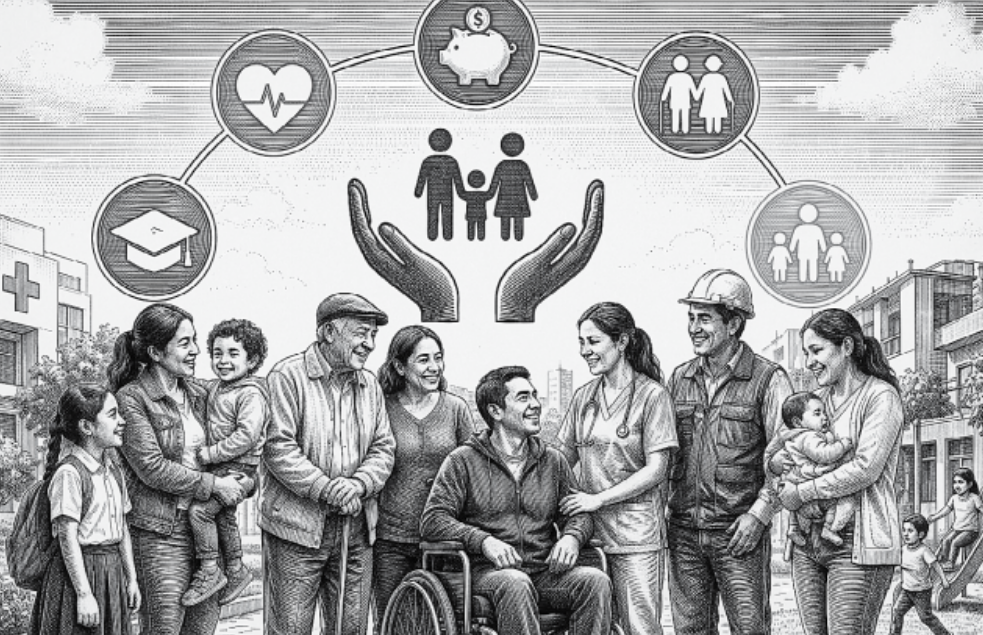
The proposed framework combines a non-contributory component offering cash transfers and solidarity programs for impoverished citizens with a contributory component covering unemployment insurance, health insurance, pensions, and labor rights protection.
This life-cycle protection would cover early childhood care, educational rescue programs for youth who are neither in education nor employment, vocational training, financial scholarships, formal employment guarantees, and dignified pensions for older adults.
Gargurevich cited regional precedents in Latin America to demonstrate that governance reform can succeed without dissolving institutions. He highlighted Chile's Social Protection Law and its Chile Crece Contigo child protection framework, alongside Uruguay's National Integrated Care System.
Both Chile and Uruguay established statutory governance frameworks requiring cross-departmental budgeting and shared performance indicators among social development, gender, childhood, and labor authorities. Gargurevich emphasized that coordination in these countries is a legal obligation rather than a voluntary invitation to collaborate.
A Three-Step Plan for Implementation
To execute this reform in Peru, Gargurevich outlined a three-step implementation plan. First, cabinet ministries must strengthen their policy-steering role while shedding operational functions and overstaffing to local territorial institutions.
Second, the government must restore joint decision-making by reviving the Interministerial Commission for Social Affairs. Gargurevich stated that restoring this platform would allow the cabinet to orchestrate comprehensive social policy rather than accumulating bureaucratic patches.
Third, national policy must be delivered through local territorial entities, including the Roundtables for Poverty Reduction, grassroots groups, and multi-stakeholder collectives. This would allow public services to be delivered complementarily under unified management rather than separate banners from 19 individual ministries.
Democratic Deliberation and Governance Reform
Gargurevich stressed that reforming social protection must not be treated as a routine administrative exercise, a cost-cutting calculation, or a directive imposed by central bureaucrats.
He concluded that institutional redesign must emerge as the culmination of broad democratic deliberation, public legitimacy, and active participation by affected populations, reflecting a shared national vision committed to a welfare state, equal rights, and democratic recovery.