President Luis Abinader acknowledged on Monday that public safety remains a central concern for Dominican families as he presented a national security strategy in Santo Domingo.
Speaking at the Monday afternoon edition of his weekly press briefing, LA Agenda Semanal, the Dominican head of state stated that the government would outline key actions to fight crime and improve security across the nation.
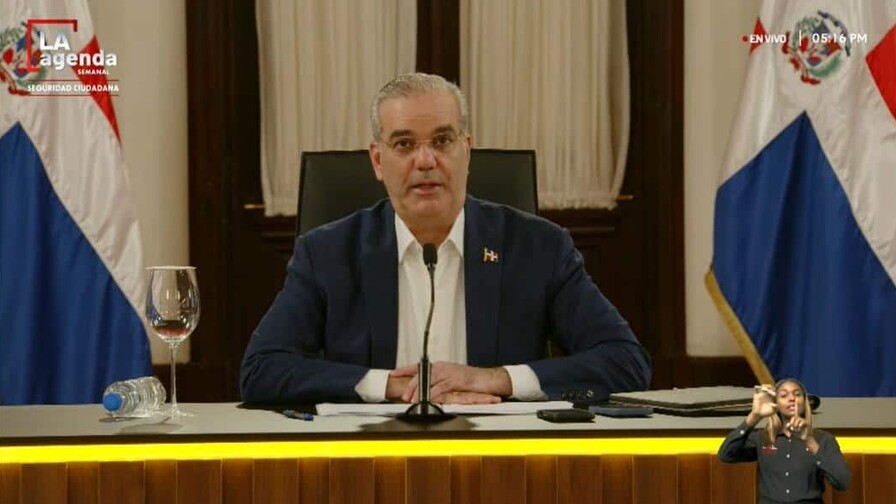
Abinader recalled that when he launched his political career in 2008, public opinion surveys consistently identified citizen security as the primary worry of the Dominican population. He admitted that public safety continues to hold that position today, explaining that it is a daily reality affecting mothers watching their children head to schools and universities, fathers protecting their families, and the general public.
Because of the ongoing impact of crime on society, Abinader indicated that the administration would detail its current security actions across four main communication and operational axes during the session.
The Dominican Republic, a Caribbean nation sharing the island of Hispaniola with Haiti, has faced persistent challenges regarding urban crime and policing. Abinader, who assumed office as president in 2020, regularly uses LA Agenda Semanal at the National Palace in Santo Domingo to brief journalists and the public on major policy initiatives.
Four strategic pillars of the security plan
Abinader explained that the government security presentation was structured around four core axes. These pillars comprise the Strategic Citizen Security Plan, community building and prevention, police reform and response, and drug trafficking and organized crime.
The Strategic Citizen Security Plan serves as the master framework for crime reduction, neighborhood policing, and tactical field operations. Community building and prevention initiatives focus on social development, local engagement, and preventive programs to stop criminal activity before it occurs.
Police reform remains a long-standing national priority focused on restructuring the National Police force, enhancing professional training, improving officer salaries and working conditions, and establishing modern oversight mechanisms. Meanwhile, anti-narcotics efforts target international drug smuggling cartels and organized crime syndicates operating within Dominican territory.
Cabinet ministers and senior security commanders
A broad delegation of cabinet ministers and senior security officials accompanied President Abinader during the presentation at the National Palace.
The panel included Minister of Interior and Police Faride Raful, National Police Director General Major General Ernesto Rafael Rodriguez Garcia, and Vice Admiral Jose Manuel Cabrera Ulloa, who serves as president of the National Drug Control Directorate.
The Ministry of Interior and Police oversees internal security policies, public administration, and civilian law enforcement oversight in the Dominican Republic. Faride Raful, a former senator who took office as minister in 2024, plays a central role in coordinating civil order and law enforcement policy.
Primary authority over domestic policing belongs to the National Police, the primary law enforcement body responsible for maintaining order across the nation's 31 provinces and the National District. Counter-narcotics operations are spearheaded by the National Drug Control Directorate, known as the DNCD, which conducts joint interdiction efforts against illicit maritime trafficking across the Caribbean basin.
Emergency response and youth prevention leadership
The security briefing also featured Executive Commissioner for Police Reform retired General Luis Ernesto Garcia Hernandez and Omar Alejandro Perez Rubiera, director of the Data Analysis Center for Citizen Security.
General Garcia Hernandez coordinates the advisory committee tasked with modernizing institutional structures and police training. The Data Analysis Center for Citizen Security, known locally as Caecesi, processes statistical data, crime mapping, and incident reports to guide strategic law enforcement planning.
Additional officials attending the presentation included Laura Rodriguez, director of public policy at the Ministry of Interior and Police, and Colonel Pilot Randolfo Rijo Gomez, executive director of the 911 National Emergency and Security Care System.
The 911 emergency system integrates centralized call centers, emergency medical dispatching, and urban surveillance camera networks across the country. Victor Alexander Mordan, executive director of the Opportunity 14-24 program, also joined the meeting. The Opportunity 14-24 initiative provides technical education, vocational training, and social support to vulnerable youths aged 14 to 24 to reduce youth crime involvement.
Guest journalists Ruddy Gonzalez and Jose Luis Mendoza participated in the session to question officials on the implementation of the security plan. The briefing sets the stage for detailed government reports on each of the four strategic axes in upcoming sessions.