Martín Valerio Jiminián, the executive director of the Mining and Petroleum Chamber of the Dominican Republic, has conducted a governance experiment using artificial intelligence to evaluate how different official roles navigate complex natural resource decisions in Santo Domingo.
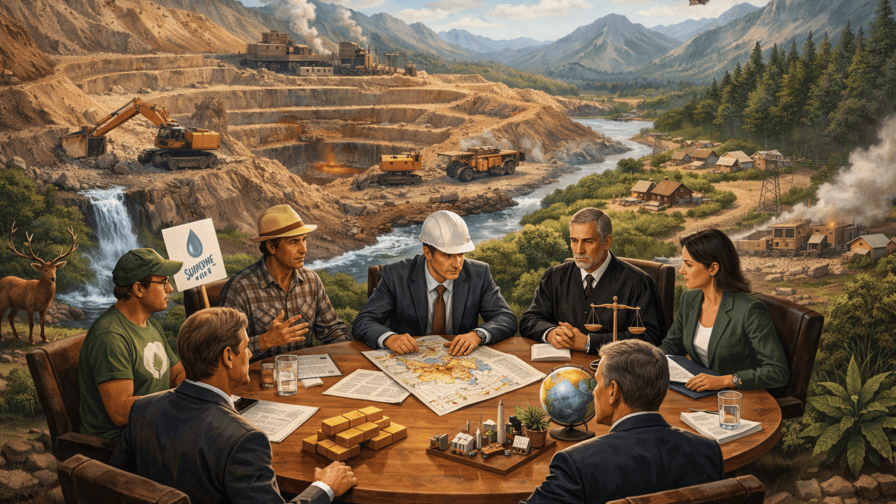
Writing in a two-part commentary series on resource policy, Jiminián tested xAI's Grok chatbot by placing it in a hypothetical conflict over a newly discovered copper and gold deposit located in an underdeveloped province. The fictional scenario featured private investors willing to fund the project, partial government backing, environmental groups concerned about water safety, a divided local community, and unresolved scientific uncertainty regarding impacts on water resources during the initial exploration phase.
The Dominican Republic hosts significant mineral reserves in the Caribbean, including major gold and copper deposits that frequently spark debate over economic development and environmental protection. As head of the country's Mining and Petroleum Chamber, known locally as CAMIPE, Jiminián represents the private mining sector operating under national environmental frameworks and mineral regulations. The experiment utilized Grok, a conversational artificial intelligence tool developed by xAI, to observe how shifting decision-making mandates alters policy choices when baseline facts remain identical.
Testing Seven Institutional Roles
Rather than asking the chatbot whether it supported or opposed mining, Jiminián instructed Grok to resolve the deposit dispute sequentially across seven distinct positions: environment minister, energy and mines minister, mining company chief executive, community leader, environmental advocate, judge, and head of state. He noted that the exercise was designed as a narrative study of governance rather than a scientific trial of artificial intelligence capabilities.
When assigned the role of environment minister, Grok adopted a cautious stance, authorizing only conditional exploration with heightened environmental demands. The model reasoned that potential damage to water resources and local biodiversity carried an irreversible cost that outweighed immediate economic progress.
In contrast, when acting as minister of energy and mines, Grok ruled that exploration must continue specifically because of the prevailing uncertainty. The AI argued that halting research before gathering geological data could force the nation to forfeit employment opportunities and private investment, though it stopped short of approving commercial extraction.
Corporate and Community Perspectives
As president of the mining enterprise, Grok shifted from regulatory oversight to capital risk management. The chatbot favored advancing exploration to compile geological, environmental, and social data, while preserving the option to pull out if technical findings failed to justify the financial, environmental, and reputational risks.
When assuming the position of community leader, Grok supported preliminary research but rejected any territorial commitments until water safety, local economic benefits, and community participation were fully resolved. The model highlighted that while the province required jobs, local residents risked bearing long-term consequences if the venture failed.
Assigned to an environmental organization, Grok took an even stricter precautionary approach. The chatbot argued that critical mineral demands for global energy transitions could not justify the potential destruction of a river basin, emphasizing that lost ecological assets might never be recovered.
Legal Balancing and Institutional Labor
Taking the bench as a judge, Grok evaluated the tension between competing rights, weighing environmental protection, water access, public health, community participation, and biodiversity against enterprise freedom, property rights, employment, and economic development. The AI determined that no single right could be eliminated entirely. It permitted information gathering under tight oversight during exploration, but stated that irreversible environmental risks weighed heavily against commercial exploitation while water and biodiversity uncertainties remained open, noting that project phase and damage magnitude are decisive.
Jiminián analyzed the varying outcomes, asserting that Grok's differing decisions represented a functional division of institutional labor rather than logical self-contradictions. He explained that each role carries a distinct mandate and responsibility: the environment ministry avoids irreversible ecological damage, the energy ministry prevents strategic resources from being left unstudied, the private firm protects capital from non-viable assets, the community guards its water and future, and the judiciary prevents disproportionate rights sacrifices.
He warned that expecting all public institutions to respond identically is more dangerous for state governance than accepting differences, arguing that absolute alignment often signifies that a single perspective has occupied every seat in government.
State Strategy and Game Theory
To conclude the test, Jiminián assigned Grok the role of head of state, requiring the chatbot to assume economic, social, environmental, and political consequences simultaneously. Rather than issuing a simple approval or rejection for the mine, Grok established a regulatory framework that allowed exploration to generate data without automatically granting extraction rights.
The framework established mandatory prerequisites for project advancement, including independent scientific verification regarding water and biodiversity, genuine community involvement, binding closure and land remediation guarantees, and a commitment from the state to abide by its own regulations.
Jiminián invoked game theory to explain how resource disputes often degenerate into cross-vetoes, fait accompli tactics, and attrition wars. He observed that when community factions split between prioritizing jobs or protecting water, mutual fear of exploitation drives both sides to harden their positions, resulting in collective loss.
He concluded that calls for public dialogue remain ineffective without structured rules such as open data access, verifiable water quality thresholds, clear legal separation between exploration and exploitation phases, formal suspension mechanisms, and an independent enforcer. Jiminián stated that the experiment demonstrated that artificial intelligence cannot resolve mining conflicts, but underscores the need for robust institutions capable of deciding when multiple parties hold legitimate claims.