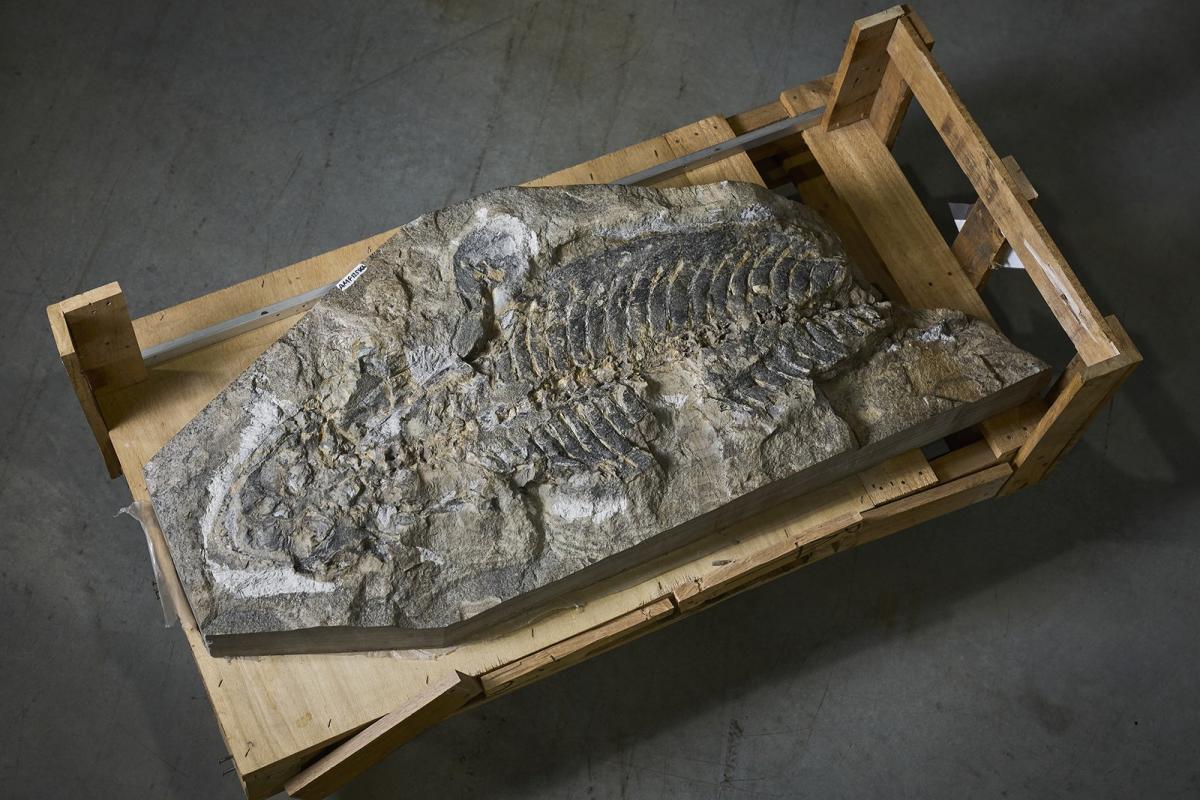
Palaeontologists have identified a 240-million-year-old amphibian fossil found in a garden rock wall in New South Wales as a new prehistoric species.
The extinct creature has been named Arenaerpeton supinatus, meaning sand creeper lying on its back, following a study led by Lachlan Hart at the Australian Museum and the University of New South Wales.
Scientists determined that the predator measured approximately 1.2 metres from its snout to the tip of its tail and swam in freshwater rivers across the Sydney Basin roughly 240 million years ago, during the Triassic period.
The Triassic period marked the dawn of the Mesozoic Era, a time when the first early dinosaurs emerged alongside sprawling river systems on the ancient supercontinent of Pangaea. The Sydney Basin in eastern Australia formed during this epoch, laying down deep layers of sandstone and shale that preserved rich records of prehistoric aquatic life.
Discovery in a garden rock wall
The fossil came to light by accident in 1996 when landscape designer David King was constructing a garden retaining wall for retired poultry farmer Mihail Mihailidis in New South Wales. While sorting through stone slabs delivered from a local commercial quarry, King spotted the outline of ancient bones embedded directly in the rock, according to People magazine.
Mihailidis recognised that the stone held something unusual and contacted the Australian Museum in early 1997. Several palaeontologists examined the specimen, and Dr Anne Warren determined that the remains belonged to temnospondyls, a major group of extinct amphibians.
Founded in Sydney in 1827, the Australian Museum is the oldest museum in the country and houses millions of natural history specimens, including key collections of early Australian vertebrates and fossilised flora.
Public curiosity surrounding the find prompted curators to include the sandstone slab in the touring Dinosaur World Tour exhibition. Among the visitors who queued to view the specimen was a 12-year-old boy named Lachlan Hart, who held an intense childhood passion for palaeontology.
Mihailidis formally donated the fossil to the Australian Museum in 2000. The slab remained safely preserved in the institution's research collections for nearly two decades until Hart, who had grown up to become a palaeontologist at the museum, began analysing it as the focus of his doctoral dissertation.
Anatomy and rare skin preservation
Hart's analysis revealed an exceptionally intact creature that measured about 1.2 metres from head to tail. While its broad skull bore a passing resemblance to the modern Chinese giant salamander, researchers noted that the prehistoric beast had a substantially heavier build and a much sturdier frame.
Modern giant salamanders are the largest surviving amphibians on Earth, inhabiting cold mountain streams in East Asia where they can grow to similar lengths while relying on nocturnal hunting and sluggish movement along riverbeds.
The fossilised predator was equipped with formidable hunting apparatus, including multiple sharp teeth along the jaws and two prominent, fang-like tusks anchored to the roof of its mouth. Hart explained that the width of the ribs and the visible impressions of soft tissue demonstrated that the animal was far more robust than modern salamanders, noting that its palate tusks gave it a terrifying appearance.
What makes the specimen extraordinarily rare is its condition. Unlike most vertebrate fossils, which consist of isolated fragments, this slab contains almost the entire skeleton, with the skull and torso remaining fully articulated. Faint impressions of the animal's outer skin were also preserved in the hardened sediment, offering scientists a direct view of its external body contours.
Vertebrate remains rarely survive in such complete detail because bacteria and scavengers typically break down corpses soon after death. According to the United States National Park Service, rapid burial under fine sediment is essential for fossilisation, and while hard bones and enamel teeth occasionally endure, soft tissues such as skin almost always disintegrate before mineralisation can occur.
Survival through mass extinction
Research from the University of New South Wales indicates that Arenaerpeton supinatus lived in freshwater rivers and likely ambushed ancient fish. The species belongs to the temnospondyls, an evolutionary lineage of amphibians that originated long before the first dinosaurs walked the Earth and managed to coexist with them for millions of years.
Hart observed that this specimen provides a unique window into how temnospondyls evolved over deep time. While many related species of the Triassic period were considerably smaller, certain branches of the family subsequently grew into river giants measuring several metres in length. Scientists suggest that the capacity to attain large body sizes may have enabled some temnospondyls to survive catastrophic extinction events, though Hart cautioned that further fossil evidence is necessary to confirm why the broader group persisted for so long.
Dr Matthew McCurry, a senior lecturer at the University of New South Wales and curator of palaeontology at the Australian Museum, emphasised the national significance of the research. McCurry said the specimen ranks as one of the most important fossils discovered in New South Wales across the past 30 years, adding that its formal scientific publication represents a major milestone for Australia's prehistoric heritage.
Commercial quarries across the region continue to yield extraordinary glimpses of deep time as heavy machinery peels back rock strata that had been buried for hundreds of millions of years. Similar accidental finds have occurred in other excavation pits, including a previously reported case in which a young boy discovered the 4.5-metre skeleton of an 85-million-year-old marine reptile, complete with its skull, after quarrying operations exposed the prehistoric remains.