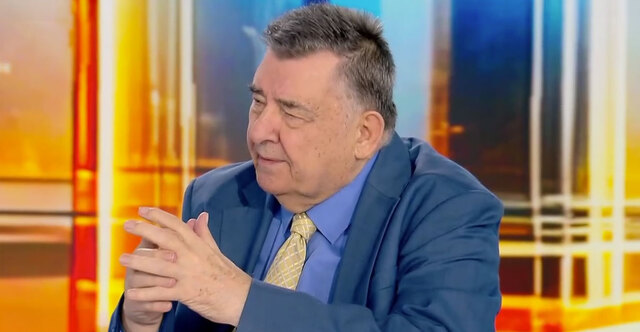
New Democracy spokesperson Alexandra Sdoukou outlined Greece's strategy for economic growth, regional diplomacy, defense, and energy during an interview on ERTnews. She stated that the government is constantly strengthening national economic health, diplomatic presence, and armed forces capability.
Speaking on national television, Sdoukou highlighted recent diplomatic and defense developments, including a summit in Egypt and a naval agreement in Italy. She said Prime Minister Kyriakos Mitsotakis met Egyptian President Abdel Fattah el-Sisi and Cypriot President Nikos Christodoulides in El Alamein to discuss issues affecting the wider region.
Sdoukou explained that the talks in El Alamein deepens Greece's strategic relationship with Egypt while expanding the country's footprint across the Eastern Mediterranean. At the same time, the Greek defense minister signed an agreement in Rome to purchase new frigates for the navy, further boosting military strength.
Greece has sought to bolster its strategic alliances in the Eastern Mediterranean amid complex regional security dynamics. The Hellenic Navy relies on surface frigates for maritime patrol across the Aegean and Mediterranean seas, while El Alamein serves as a coastal hub for North African and regional diplomacy.
Educational reform and PISA performance
Sdoukou addressed the results of the PISA 2025 examination, emphasizing that the data should serve as a starting point for meaningful educational dialogue. She acknowledged that the scores are not cause for celebration, though she noted Greece suffered a smaller decline than other nations and is closing the gap in specific subjects.
To address educational shortcomings, Sdoukou said the government is accelerating reform by updating school curricula, introducing a multiple textbook system, and advancing the national baccalaureate. She stressed that school instruction must move away from simple rote memorization and focus instead on text comprehension, critical thinking, and problem solving.
Sdoukou pointed out that student text comprehension requires immediate improvement through more meaningful classroom instruction. She added that broader societal factors affect learning, noting that mobile phone usage distracts young students and shortens attention spans, while children write far less by hand than in previous years.
The Programme for International Student Assessment, managed by the Organisation for Economic Co-operation and Development, measures reading, mathematics, and science literacy among 15-year-old pupils worldwide. Greek educational policy has traditionally relied on a single state textbook per subject, making the move to multiple text options and standardized secondary diplomas a major structural transition.
Economic measures and targeted support
Turning to the economy and daily living costs, Sdoukou stated that Prime Minister Mitsotakis intervenes constantly across all policy fields. She noted that economic interventions announced by the prime minister have taken immediate effect as part of a long-term plan guiding the nation toward 2030.
Responding to criticism that economic relief packages were too small, Sdoukou maintained that the government acted responsibly within its available budget. She said available resources were directed in a fair and targeted manner to support the disposable income of pensioners, families, and farmers.
Sdoukou stated that strong economic performance gives the government the standing to set ambitious new targets for the future. She noted that these objectives include further raising the minimum wage, increasing pension payouts, and reducing tax burdens on citizens.
Greece has prioritized economic stabilization and targeted welfare measures in recent years to combat inflation and rising living costs. Minimum wage adjustments and tax reform remain central pillars of government economic policy aimed at boosting household purchasing power across rural and urban sectors.
Energy transition and cost reduction
In energy policy, Sdoukou outlined a government objective to reduce energy costs for consumers by 30 percent over the next three years. She recalled that in 2019 Greece relied heavily on lignite and natural gas, which kept electricity prices high.
Sdoukou explained that the government chose to alter the national energy mix by expanding renewable energy sources and constructing electrical interconnections. She highlighted that Greece currently ranks third in the world for solar photovoltaic installations.
Sdoukou emphasized that falling battery prices have made investments in energy storage both practical and profitable. She noted that combining energy storage with ongoing infrastructure projects will drive electricity prices down even further for households and businesses.
Lignite, a soft brown coal, was historically the primary fuel source for Greek power generation, particularly in the northern Western Macedonia region. The rapid expansion of solar power alongside subsea grid interconnections connecting island chains to the mainland grid forms part of broader European decarbonization goals.