
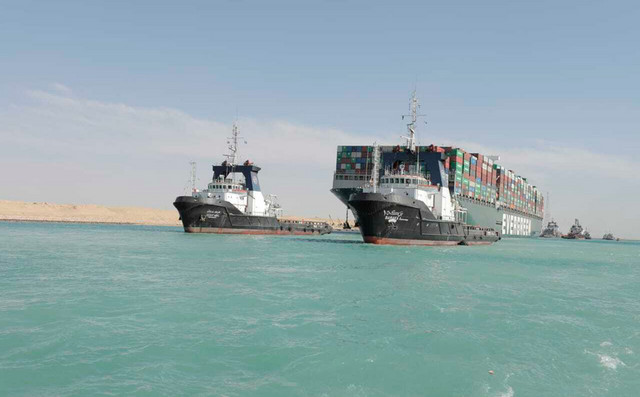
Commercial shipping traffic through the Suez Canal is showing signs of a gradual recovery as vessel operators begin moving away from costly detours around Africa.
The operational shift remains partial and selective, with routing decisions still heavily influenced by security conditions in the Red Sea, ongoing Houthi threats, insurance costs, and specific vessel connections to regional ports and nations.
The Suez Canal, an artificial waterway located in Egypt, provides the shortest maritime route between Europe and Asia. Bypassing the canal forces ships to sail around the Cape of Good Hope at the southern tip of South Africa, adding thousands of nautical miles and up to two weeks to voyage travel times.
Strategic Passages and Tanker Route Diversions
The shift in routing is visible at the Bab el-Mandeb strait, the strategic waterway that connects the Red Sea to the Gulf of Aden. Data from maritime security companies indicates that daily vessel transits in both directions through the strait have dropped to between 30 and 33 ships, down from approximately 47 transits prior to July 20.
At the same time, tanker transits through the Suez Canal have increased by about 27 percent, signaling that crude oil and chemical carriers are starting to return to the shorter route.
The route selection is most pronounced among oil tankers, where decisions are made based on the commercial profile of individual vessels. Ships linked to Saudi Arabian interests, whether through corporate ownership, vessel management, or scheduled port calls in Saudi Arabia, are evaluated as more exposed to Houthi targeting.
Conversely, other tankers continue to use the Bab el-Mandeb strait on a case by case basis, choosing to absorb higher war risk insurance premiums and elevated operational risks. Security observers report that some vessels in the area are transmitting limited Automatic Identification System data, making it difficult to maintain a complete view of regional vessel movements.
Targeted Houthi Naval Blockade
A central factor shaping navigation decisions in the region was an announcement by the Houthis on July 20, 2026, declaring a special naval blockade against ships connected to Saudi Arabia. The Houthis are an Iran-aligned political and military movement based in Yemen.
Since the announcement, available maritime security data shows that eight tankers linked to Saudi interests have been targeted in the region.
The targeted attacks have forced shipowners into a more selective risk assessment process. Rather than relying on general safety evaluations of the Red Sea, maritime operators now weigh a vessel's flag state, corporate ownership, cargo destination, prior port calls, and war risk insurance rates before deciding on a transit route.
Chinese-linked vessels represent a distinct exception in the region. Government officials in Beijing have established direct communication channels with the Houthis to seek safe passage for Chinese tankers navigating through the Red Sea corridor.
Container Lines Adjust Routing Networks
A similar recovery trend is emerging within the container shipping sector. The number of container ships taking the long detour around Africa is declining, while vessel transits through the Suez Canal are steadily recovering.
According to shipbroker data, approximately 34 container ships now transit the Suez Canal each week. This figure corresponds to roughly 43 percent of the weekly container shipping traffic recorded before the onset of the Red Sea security crisis.
Industry analyst firm Linerlytica estimates that fewer than 300 container ships are still taking the route around Africa. Total capacity on the African detour has dropped to about 4.1 million twenty-foot equivalent units, down from 5.3 million units recorded earlier in the year.
Container capacity remaining outside the Suez Canal now represents about 5.2 percent of the global container fleet, marking the lowest level recorded since January 2024. Industry experts note that the change indicates shipping lines are adapting their schedules to targeted risk environments rather than signaling an end to the security crisis.
Carrier Alliances and Scheduled Transits
Major ocean container carriers are reflecting the strategy shift in their global service offerings. Shipping lines Maersk, based in Denmark, and Hapag-Lloyd, based in Germany, altered their SE3 service line under the Gemini Cooperation agreement to route vessels through the Red Sea instead of around the Cape of Good Hope.
As part of the network adjustment, the Manchester Maersk, a vessel with a capacity of 20,568 twenty-foot equivalent units, was scheduled to complete a westbound transit through the Suez Canal on August 16. The transit aligns with the return of the Gemini network's AE2 and NE1 service lines to the Suez route, which connects major ports in Asia with Northern Europe.
French container shipping firm CMA CGM is also among the major ocean carriers increasing vessel transits along the Red Sea route. However, Operation Aspides, the European Union naval task force deployed to safeguard merchant ships in the region, continues to assess security risks as elevated for vessels with commercial or operational links to Israel or the United States.
Global Freight Rates and Market Impact
The realignment of shipping routes is directly affecting global freight markets. In the tanker sector, daily vessel earnings remain at exceptionally high levels as geopolitical tensions, elevated risk costs, and tight tanker availability support freight rates.
On the Arabian Gulf to China route, daily earnings for Very Large Crude Carriers stand at approximately 484,000 dollars, while rates on the route from the United States to China average near 115,000 dollars per day. For medium-sized Aframax tankers, average daily earnings sit at roughly 74,000 dollars.
The container shipping market presents a more divided picture. The Drewry World Container Index, produced by London-based maritime research firm Drewry, rose 1 percent to 4,339 dollars per 40-foot container, driven largely by rate increases on Transpacific trade lanes.
Spot rates for container shipments from Shanghai to New York rose 10 percent to 8,706 dollars per 40-foot container, while rates from Shanghai to Los Angeles increased 6 percent to 6,244 dollars. In contrast, routes connecting Asia to Europe saw declines, with Shanghai to Genoa spot rates falling 8 percent to 5,080 dollars and Shanghai to Rotterdam rates dropping 5 percent to 4,425 dollars per container.
Strategic Outlook for Red Sea Shipping
Current shipping data demonstrates that the Suez Canal is recovering a portion of the cargo traffic previously diverted around Southern Africa. While the trend is clear, maritime industry analysts emphasize that shipping operations have not returned to normal.
For shipowners, the decision to transit the Red Sea remains dependent on multiple variables, including vessel ownership, commercial links, regional security conditions, insurance premiums, cargo values, and developments around the Bab el-Mandeb strait. The Suez Canal is regaining its position as a primary trade option, but remains a route carrying calculated operational risks.