

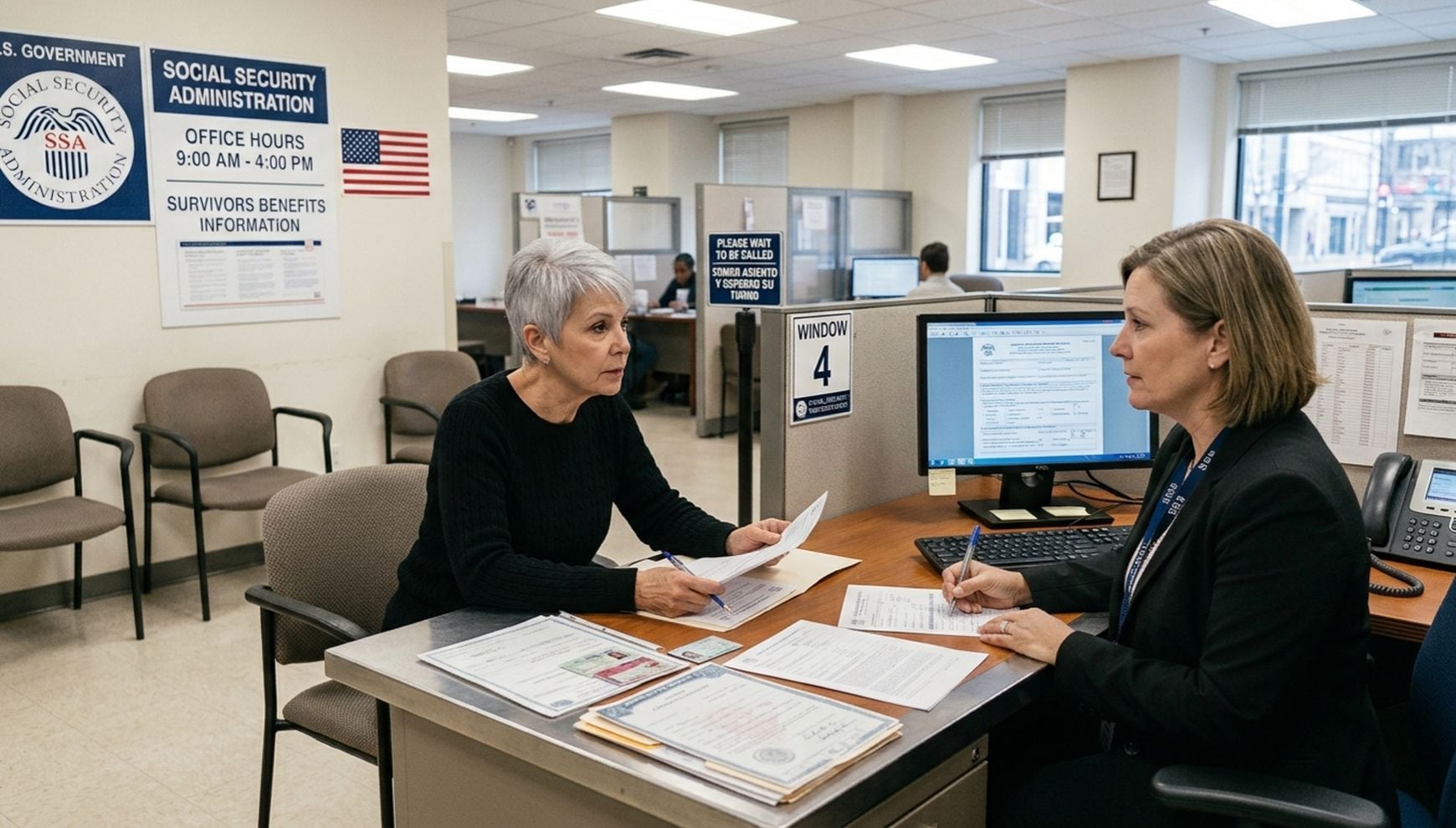
The Social Security Administration provides survivor benefits to eligible family members following the death of a relative who worked and paid Social Security taxes.
The size of the monthly payments and an applicant's eligibility depend on the earnings record and years of contributions accumulated by the deceased worker, as well as the applicant's age and relationship to the deceased.
Social Security benefits do not transfer automatically to surviving family members upon death and do not form part of an estate or inheritance. In addition, not all family members are eligible to collect payments at the same time, and not all recipients are entitled to receive 100 percent of the deceased worker's benefit amount.
The Social Security Administration is an independent agency of the United States federal government that manages social insurance programs, including retirement, disability, and survivor benefits. These programs are financed through federal payroll taxes paid by employees and employers during a worker's employment history.
Who Can Receive Social Security Survivor Benefits
According to the Social Security Administration, specific categories of surviving relatives may qualify for monthly survivor payments based on established rules:
- Surviving spouses: A widow or widower generally becomes eligible for survivor benefits starting at age 60. Eligibility begins at age 50 if the surviving spouse has a disability that satisfies Social Security Administration standards. A surviving spouse of any age can qualify if caring for the deceased worker's child, provided the child is under age 16 or has a disability and is entitled to Social Security benefits.
- Surviving former spouses: A divorced spouse may qualify for survivor benefits if the marriage lasted at least 10 years and all other agency criteria are met.
- Dependent children: Unmarried children under age 18 are eligible for survivor benefits. Unmarried children up to age 19 can also qualify if they are enrolled full-time as high school students. Adult children who developed a disability before reaching age 22 may receive benefits if they satisfy eligibility conditions. Secondary schools generally include standard four-year high school programs preparing students for higher education or employment.
- Dependent parents: Parents aged 62 or older who depended on the deceased worker for financial support may qualify under specific circumstances.
Steps to File a Survivor Benefit Claim
To receive payments after a family member dies, relatives must first report the death to the agency and then submit a formal application for survivor benefits.
The application process follows several specific steps:
- Report the death: Funeral homes frequently notify the Social Security Administration directly when provided with the deceased person's Social Security number. Relatives should confirm with the funeral home that the report was submitted. If the funeral home has not reported the death, the family member must contact the agency directly.
- Schedule an appointment or call: Applicants can report a death or request survivor benefits by calling the agency at 1-800-772-1213, available Monday through Friday from 8:00 a.m. to 7:00 p.m. local time. Individuals who are deaf or hard of hearing can use the TTY line at 1-800-325-0778. TTY devices allow users to type text messages over standard telephone lines. Applicants may also contact their local Social Security office.
- State the benefit requested: During the call, applicants must inform the representative that they wish to apply for Survivor Benefits and, if applicable, the Lump-Sum Death Payment. The agency can process applications for both benefits during the same phone call.
- Submit required documentation: The agency accepts certified copies or specific legal documents to evaluate claims. Representatives advise applicants not to delay contacting the agency simply because a document is missing, as staff will explain how to provide outstanding paperwork later.
- Await the determination: The Social Security Administration evaluates whether monthly payments are approved, determines the benefit amount, and sets the effective start date. If an application is rejected or the payment amount is calculated incorrectly, the official decision notice must explain the procedure for filing an appeal.
Documents Required for the Application
Applicants must assemble specific identification, financial, and legal records when filing a survivor benefit claim with the agency:
- Death certificate or official documentation issued by the funeral home.
- Social Security numbers for both the deceased worker and the applicant.
- Birth certificate of the applicant.
- Marriage certificate, if applying as a surviving spouse.
- Divorce decree or final divorce paperwork, if applying as a surviving former spouse.
- Birth certificates and Social Security numbers for all dependent children.
- W-2 forms or self-employment tax returns for the deceased worker from the most recent tax year. A W-2 form is an official Internal Revenue Service document used by employers to report annual employee wages and withheld taxes.
- Bank account details to set up direct deposit. Direct deposit allows the federal government to transfer monthly benefit funds electronically into an account.
One-Time Death Payment Rules
In addition to potential monthly benefits, the Social Security Administration offers a one-time Lump-Sum Death Payment of $255.
This single payment is normally awarded to a surviving spouse who was living in the same household as the worker at the time of death. If no qualifying spouse exists, an eligible child who meets agency criteria may receive the payment.
According to the agency guide Social Security Survivor Benefits, applicants must file for the $255 lump-sum payment within two years of the date of the worker's death.
Important Rules for Beneficiaries
The agency highlights several operational rules that applicants and beneficiaries must observe following a worker's death:
Beneficiaries must not cash or keep Social Security payments issued for months after the worker's death. If an unentitled check or direct deposit is received, relatives must immediately contact their bank and the Social Security Administration to arrange for the return of the funds.
If the deceased relative was still employed prior to death, recent earnings may be factored into the benefit calculation, making recent W-2 forms or self-employment records vital to the claim.
Individuals who already receive their own retirement benefits from Social Security may be entitled to a higher monthly amount as a survivor. In these situations, agency staff analyze combination rules and benefit adjustments to determine if a transition to higher survivor payments is permitted.
The Social Security Administration advises relatives to apply as quickly as possible. Although retroactive payments are available in limited circumstances, delaying an application can lead to lost monthly payments or complicate overall eligibility.


