

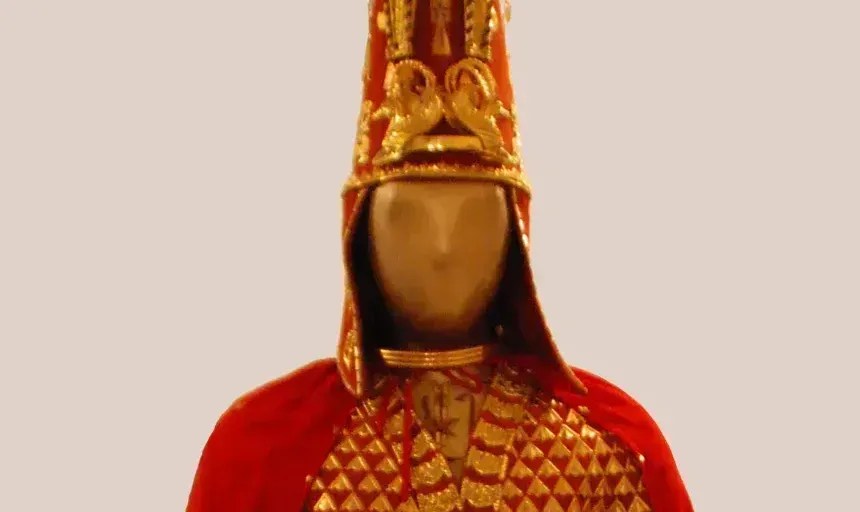
Ancient DNA extracted from Iron Age skeletons has revealed that elite Scythian nomads inherited their social status through dynastic family bloodlines across the Eurasian steppe and confirmed that Kazakhstan's famous Golden Man was genetically male.
Researchers analyzing genetic material from dozens of ancient burial mounds found that high-status Scythian warriors shared close hereditary links even when buried nearly 100 kilometres apart, establishing the first direct genetic evidence of inherited elite power in the region.
The findings, published on Friday in the journal Science Advances, also resolve long-standing questions surrounding the Golden Man, an elite youth exhumed in 1969 from a burial mound known as a kurgan at an archaeological site in Kazakhstan. Although the tomb contained iron weapons, bronze artifacts, a silver bowl, and more than 4,000 gold ornaments, archaeologists had been unable to confirm the individual's sex due to degraded skeletal material.
To determine the individual's sex, scientists examined DNA markers across the genome, using statistical techniques to fill in missing or damaged genetic data. The results indicated that the Golden Man was likely male and belonged to the Sakas, a southern Scythian subgroup whose tomb dates from around 400 BC to 300 BC.

Hereditary power in Iron Age burials
The research team examined DNA samples and archaeological data from 85 individuals, comprising 38 elite burials and 47 non-elite burials. Population genetic analysis showed that while Iron Age communities across the Eurasian steppe were more genetically diverse overall than earlier Bronze Age populations, the DNA of elite individuals contained distinct genetic similarities known as regions of homozygosity.
These adjacent genetic markers indicated shared ancestry and demonstrated that high-status Scythians possessed more homogeneous genomes than their non-elite contemporaries. The study authors concluded that high-status individuals formed a distinct genetic subgroup, underscoring the role elites may have played in preserving genetic continuity during a period of intense population mixing.
Alicia R. Ventresca-Miller, an associate professor of anthropology at the University of Michigan and associate curator of archaeological science at the university's Museum of Anthropological Archaeology, who did not take part in the research, said the paper did a fantastic job of integrating genetic, archaeological, and textual evidence to support its findings. In an email to CNN, Ventresca-Miller noted that discovering a lineage-based elite system is significant because wealth was passed down through generations, and the new data shows that social status and power were inherited in the same way.

Massive burial mounds and ancient rituals
The Scythians were nomadic pastoralists who dominated the vast grasslands stretching from eastern Europe to central Asia during the Iron Age, from approximately the ninth century BC to the second century BC. Their elite kurgans were colossal earthen structures, measuring up to 15 metres in height and up to 105 metres in diameter. These burial mounds typically featured central corridors, catacombs, and side chambers holding grave goods, sacrificed animals, and human remains.
Skeletal remains recovered from the mounds frequently showed signs of artificial mummification or post-mortem trepanation, a procedure where the skull was drilled to remove the brain. Ainash Childebayeva, the lead author of the study and an assistant professor in the department of anthropology at the University of Texas at Austin, explained to CNN that body preservation techniques were crucial because the elaborate funeral rituals and mound construction required substantial preparation time.
Childebayeva noted that preservation made sense if a massive earthwork had to be built for the deceased or if the body had to be transported to a specific ancestral burial site. In one striking case, scientists identified an elite man and his grandchildren buried in separate kurgans located more than 60 miles, or nearly 100 kilometres, apart, providing a clear example of dynastic rule spanning geographical distances.
One of the grandchildren interred in a wealthy elite kurgan was a girl who died at just one year old. Childebayeva highlighted this infant burial as compelling evidence of hereditary status, stating that a one-year-old child could not have performed acts in her lifetime to earn such a lavish burial, meaning her elite status was granted purely by birth into a specific ruling family.

High status women in Scythian culture
Nearly half of the 38 elite individuals analyzed by the researchers were women. Several female skeletons showed evidence of post-mortem trepanation, and their kurgans included elaborate entry passages, sacrificed horses, fine clothing, and valuable artifacts, indicating that women held high respect and authority within Scythian society.
Ventresca-Miller noted that these findings align with patterns seen among other Eurasian populations during the Bronze Age, where women held significant wealth represented by ornate bronze headdresses and jewelry. She added that among the Xiongnu, a nomadic confederation inhabiting eastern Eurasia in the late Iron Age, the individuals buried with the highest social status were also women.
The study highlighted another elite Scythian female, known as the Princess of Urdzhar, who was buried wearing an elaborate gold headdress similar to that of the Golden Man. Her kurgan also contained a stone altar and medicinal plants, which suggested to archaeologists that she may have performed a shamanic role in her community.
Unanswered questions on steppe inequality
Childebayeva observed that elite status in Scythian culture was not uniform and carried different meanings across different roles. She stated that her future research will further examine the diverse social roles and positions occupied by Scythian women.
A primary question remaining for researchers is what caused the initial emergence of an elite dynastic class among Scythian nomads, as such extreme social stratification was absent among earlier Bronze Age groups in the Eurasian steppe. Childebayeva noted that she hopes to uncover the specific factors that drove the rise of social inequality during the Iron Age compared to the more egalitarian social structures of the preceding Bronze Age.


