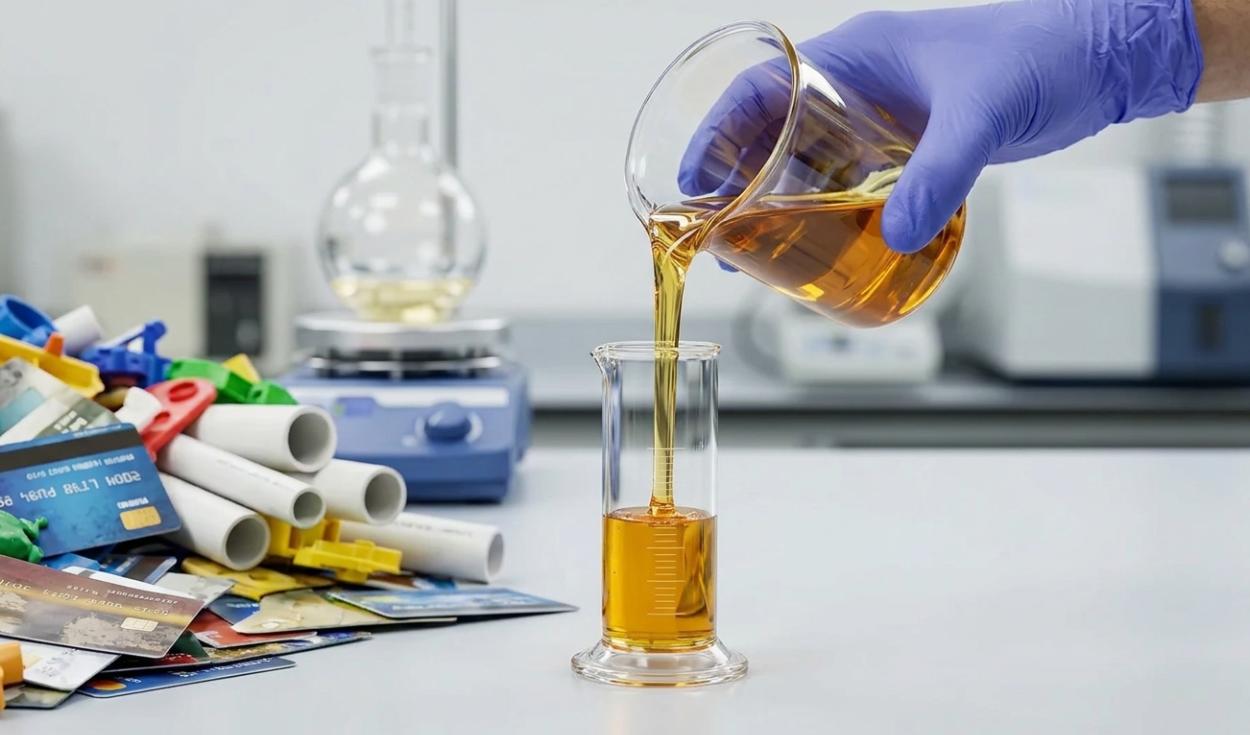
Researchers at Virginia Tech in the United States have developed a chemical process that converts polyvinyl chloride (PVC) waste into a lubricating oil used as an ingredient in high-performance synthetic motor oils. The technique makes use of a material found in pipes, window frames and credit cards that usually ends up in landfills because it is so difficult to recycle.
The study, published in the journal Nature, was led by chemist and chemical engineer Guoliang Liu. His team managed to transform the plastic into polyalphaolefin (PAO), a component used in making synthetic lubricants, including motor oils.
How did they turn PVC waste into lubricating oil?
The procedure developed by the scientists uses PVC as a raw material to obtain a product with industrial applications. To achieve this, they place the plastic waste in a solvent and add aluminum trichloride along with alpha-olefins, hydrocarbons used in the manufacture of synthetic lubricants.
The mixture is then heated to 70 degrees Celsius for three hours. Once the chemical reaction is complete, the researchers extract a relatively thick lubricating oil. The resulting material belongs to the polyalphaolefin family, known for its stability and its ability to retain lubricating properties across different temperatures. These substances serve as the base for high-performance synthetic oils.
Liu said the team had first shown that it is possible to use plastic waste to make high-performance lubricants. He said the lubricants are also environmentally friendly and can meet new sustainability demands in the market.
Why is PVC so hard to recycle?
Polyvinyl chloride is used in many everyday products, but recycling it is difficult because of its composition. The material contains chlorine and various chemical additives that manufacturers add to change its properties.
These additives allow manufacturers to produce flexible, rigid or heat-resistant PVC, but they also complicate conventional recycling methods. As a result, large quantities of PVC products end up accumulating in landfills.
The research grew out of earlier work in Liu's laboratory, in which his team had managed to transform various plastic wastes into surfactants, substances used in products such as soaps and detergents. The scientists initially tried to modify the molecular structure of PVC by replacing its chlorine atoms, but the experiments produced soft, sticky materials that did not have the properties they expected.
Liu recalled that he realized that if the polymer was so viscous and soft, he should keep breaking the polymer chains into smaller segments instead.
When could these lubricants be made at a larger scale?
To evaluate the properties of the oil they obtained, the team worked with specialists from Texas A&M University and the California Institute of Technology (Caltech). The researchers analyzed the material's performance, its chemical composition and the economic feasibility of producing it in larger quantities.
Although the results showed that PVC can be used as a raw material to make lubricants, the process still needs to be improved and scaled up for industrial production.
Liu said lubricants are the silent heroes, often unnoticed even though they are always there, working quietly. He said the team wants to be able to produce this oil at a larger scale to reach more people around the world.
What happens next
The researchers say the process still needs improvement before it can be scaled up for industrial production of the lubricant.
Test yourself
What did Virginia Tech researchers convert PVC waste into?
Who led the study on converting PVC into lubricant?
Why is PVC difficult to recycle?
Have your say
Should more research funding go toward turning hard-to-recycle plastics like PVC into new industrial products?
Where it happened
Blacksburg, United States