

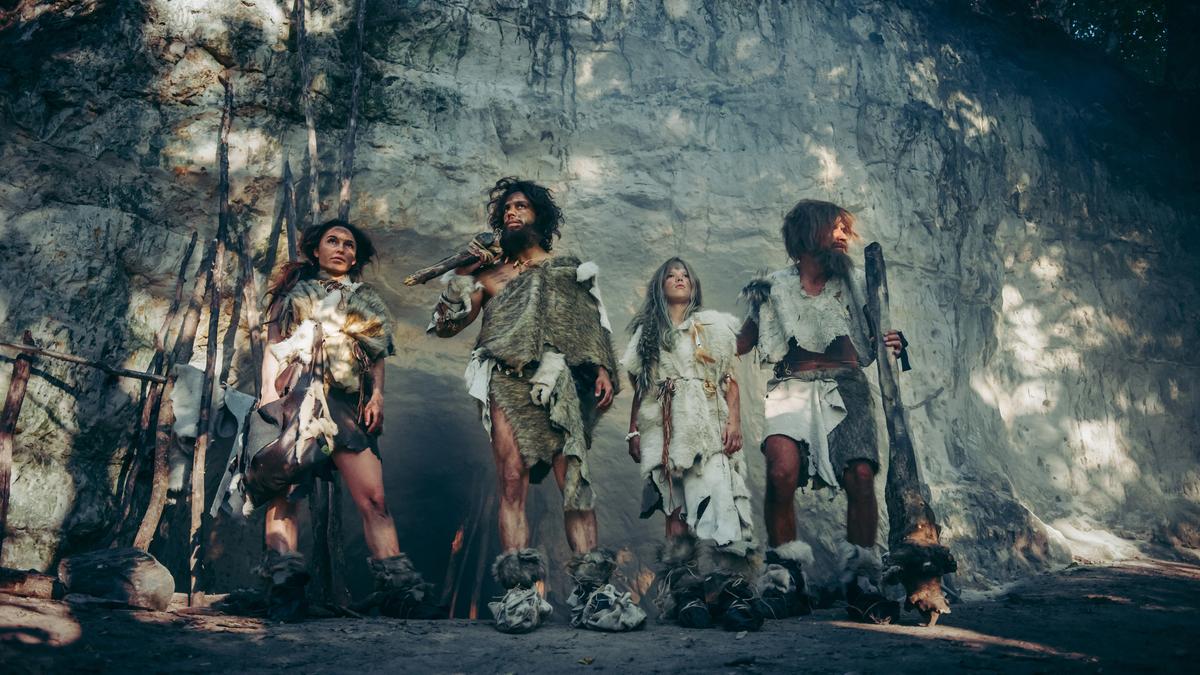
Modern humans interbred with two previously unknown "ghost" lineages of ancient hominins, in addition to Neanderthals and Denisovans, according to a new study led by the University of California, Berkeley. One population mixed with humans in Africa more than 50,000 years ago, while the other interbred in Eurasia more than 1.7 million years ago, the researchers reported, according to Sci.News.
Sequencing the genomes of Neanderthals and Denisovans had already transformed scientists' understanding of human evolution by revealing genetic exchange between modern humans and archaic hominins, University of California, Berkeley graduate student Yulin Zhang and colleagues said in a statement.
Most present-day non-African people carry between 1% and 2% Neanderthal ancestry, while people in Asia and Oceania carry between 0.1% and 5% Denisovan ancestry, according to the researchers. They said this archaic ancestry has had a significant effect on human adaptation and disease, influencing traits such as skin pigmentation, adaptation to high altitude, and immune system function.
A new method called TRACE
To uncover the hidden lineages, the study's authors developed a new computational method called TRACE, which detects genetic traces of ancient interbreeding. Rather than relying on DNA extracted from fossils, the method reconstructs family relationships hidden within hundreds of modern human genomes, allowing researchers to identify DNA segments whose ancestry stretches back further than expected.
Using TRACE, the team identified a "ghost lineage" that interbred with anatomically modern Homo sapiens in Africa more than 50,000 years ago, before the major human migration into Europe and Asia. This lineage split from the human family tree around 800,000 years ago, roughly the same time as the split that produced Neanderthals and Denisovans.
Zhang said his team was able to identify and map the regions of modern human genomes descended from this ghost lineage. He said this showed the ancestry is present in all modern humans, not just Africans.
An even older second lineage
The second ghost lineage is far older still, with roots stretching back around 1.8 million years, according to the researchers. They believe this population most likely did not interbreed directly with modern humans, but instead mixed with Denisovans in Eurasia.
When Denisovans later interbred with Homo sapiens, some of this "super-archaic" DNA was passed into the human genome as well. Its traces are most visible today in Oceanian populations, which carry unusually high levels of Denisovan ancestry.
Together, the two newly identified lineages make up about 2% of the modern human genome, the researchers said. Both African and non-African populations inherited similar shares of the ghost ancestry, and each person carries roughly 0.5% to 1% of their genome from this lineage, the researchers emphasized.
Earlier evidence of fire use
The study follows an earlier discovery in South Africa that transformed scientists' understanding of when ancient humans began using fire. The find was made at Wonderwerk Cave.
Scientists estimate that hominins may have used fire in the cave as far back as 1.79 million years ago, pushing back the earliest known evidence of human fire use by hundreds of thousands of years.


