
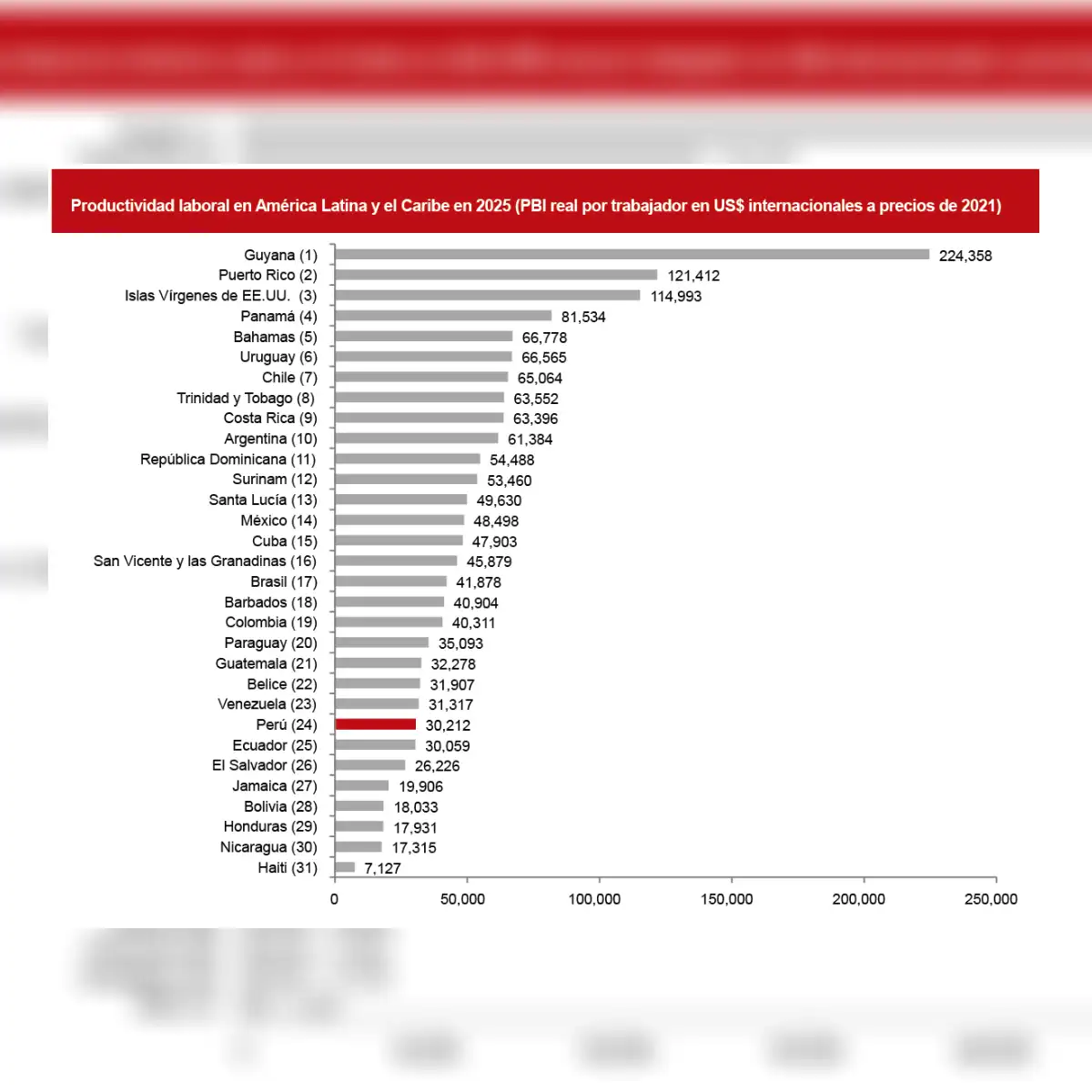
Peru generated $30,212 per worker annually to rank 24th out of 31 Latin American and Caribbean economies in labor productivity, according to a ComexPeru report based on International Labour Organization estimates.
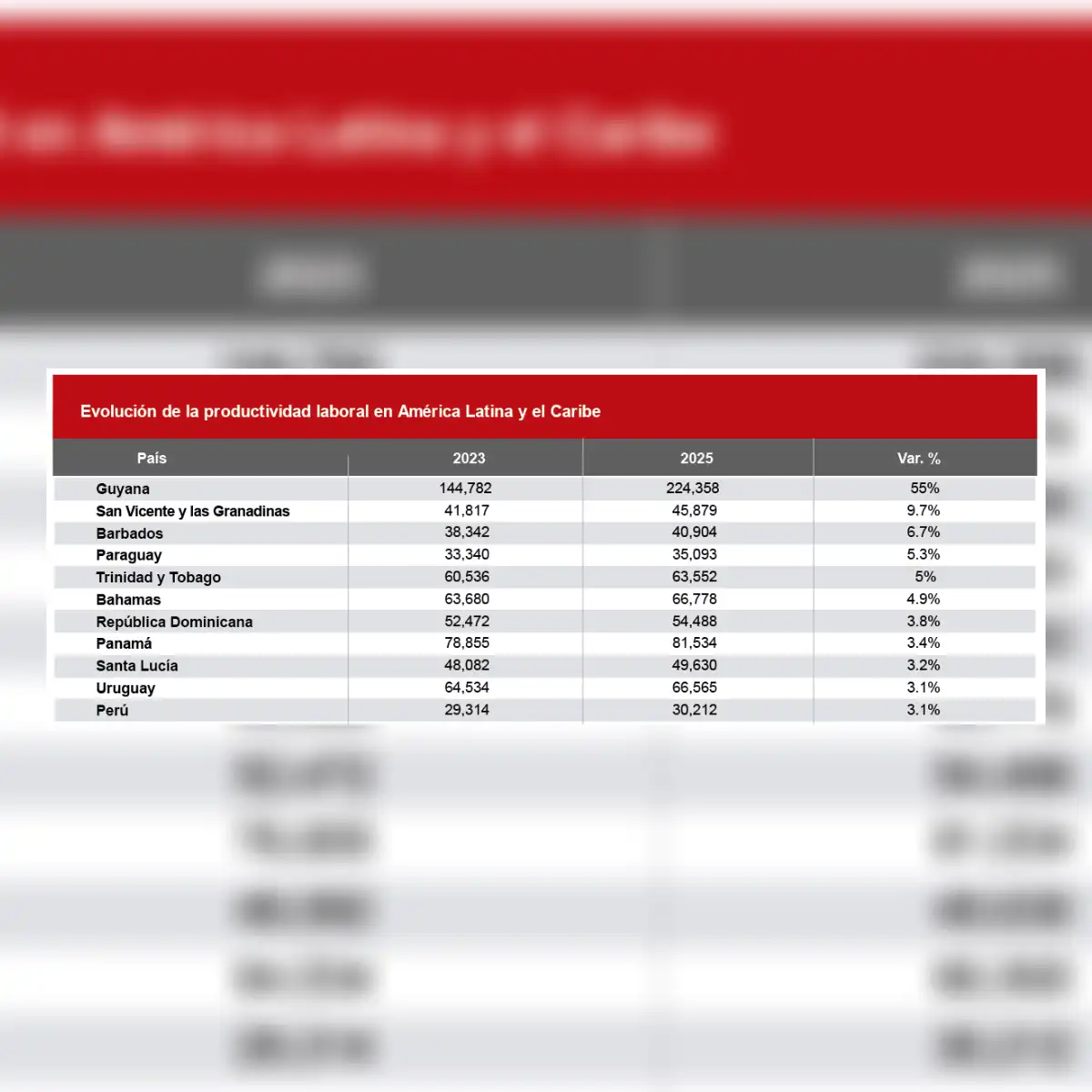
Although Peruvian worker productivity grew by 3.1 percent between 2023 and 2025, the figure remains less than half the level recorded in Chile and Argentina.
ComexPeru, the Foreign Trade Society of Peru, analyzed figures compiled by the International Labour Organization, a specialized United Nations agency that tracks labor standards and statistics worldwide. The analysis shows that despite recent progress, Peru faces a persistent productivity gap compared to rival regional economies.
Peru also trailed other regional commercial partners that belong to the Organization for Economic Cooperation and Development, an international group of market-focused democracies. Chile logged a labor productivity of $65,064 per worker, while Costa Rica reached $63,396, Mexico recorded $48,498, and Colombia registered $40,311 per worker.
The study noted that the productivity gap goes beyond how much an individual worker produces. It highlights broader structural differences in how easily businesses can incorporate technology, invest capital, upgrade infrastructure, and improve internal processes to raise value per job position.
Regional comparisons and economic growth
The 3.1 percent expansion in Peruvian labor productivity between 2023 and 2025 exceeded the regional average for Latin America and the Caribbean, which stood at 2 percent during the same timeframe. That growth enabled Peru to climb one position in the regional rankings, overtaking Ecuador.
Guyana took first place in the regional ranking with an output of $224,358 per worker. However, the study explained that Guyana's exceptional figure stems from a massive surge in offshore oil production that boosted gross domestic product without a matching increase in employment, making it an outlier among economies with more diversified production structures.
The International Labour Organization noted that labor productivity is a primary driver of real wage growth and the creation of higher quality employment. Low productivity levels in Peru limit the margin for sustainable wage gains and formal job expansion.
Total factor productivity and systemic obstacles
Labor productivity does not capture the complete picture of economic efficiency. An enterprise can raise output per worker simply by purchasing machinery or adding capital, making total factor productivity a key metric for observing how efficiently labor and capital work together.
Peru performed less favorably in total factor productivity estimates calculated by The Conference Board, a global business research organization. The group found that Peru experienced negative average annual growth in total factor productivity between 2011 and 2019, followed by a 4.8 percent decline during the 2020 pandemic that subsequent recovery failed to fully reverse.
The International Monetary Fund also identified a core problem in Peruvian economic growth. The Washington-based lender reported that national output expansion over much of the analyzed period relied heavily on capital accumulation, while productivity made a negative contribution to growth.
Factors behind this stagnation include barriers that prevent businesses from entering and expanding within the market. The International Monetary Fund pointed to distortions created by labor and tax regulations, including the presence of multiple tax regimes and specific rules tied to employee profit sharing.
Formal employment and economic policy debate
The productivity issue is central to efforts in Peru aimed at expanding formal employment and raising worker incomes. Increasing investment in machinery, infrastructure, or technology raises output per worker, but analysts emphasized that higher investment alone does not guarantee efficient resource use across the economy.
Sustainable improvement requires conditions where companies can grow, adopt new technologies, and compete without facing regulatory penalties for expansion. The Ministry of Economy and Finance, the government department overseeing Peru's fiscal policies, announced plans to simplify and reduce tax regimes to address one of the primary obstacles identified in the report.
The financial cost of formal hiring remains another major topic of discussion. When employment obligations increase without a corresponding rise in worker output, smaller companies with limited capital face difficulties integrating workers into the formal labor market.
The report concluded that minimum wage discussions cannot focus solely on the payout received by workers. Economists stressed that discussions must account for worker output, operational costs for businesses, and the broader conditions required for wage increases to accompany improvements in economic efficiency.