Peruvian political group Ahora Nacion has introduced a bill in Congress to penalise de facto unions involving minors with up to ten years in prison.
The legislative proposal, drafted by lawmaker Marleny Armintia, has been referred to the Justice and Human Rights Commission of the Congress of Peru, where it is expected to be debated shortly by the working group.
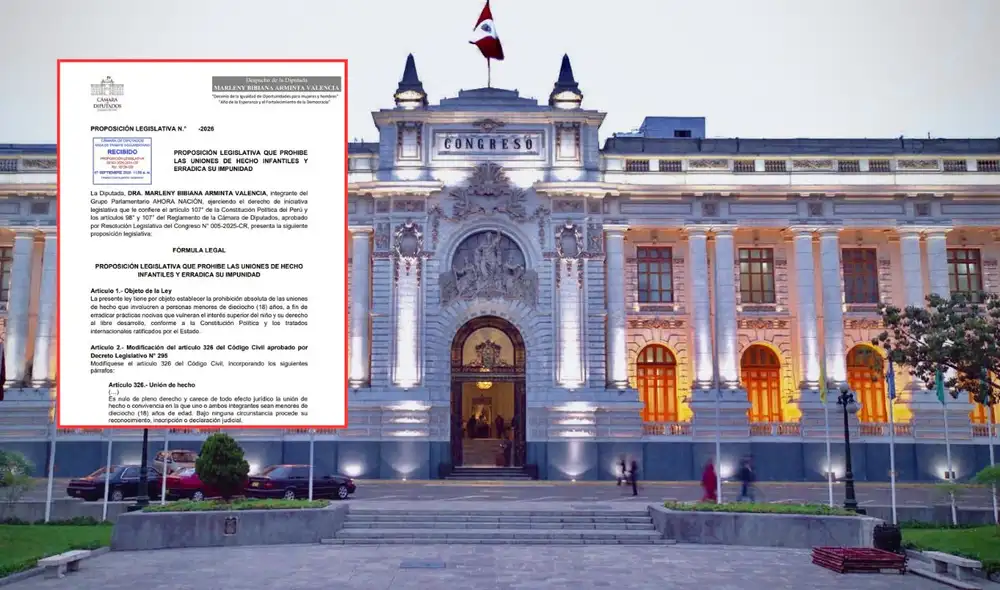
To establish legal penalties for adult-minor cohabitation, the initiative proposes amending Peru's Penal Code by adding Articles 151-B and 151-C.
Proposed Penal Code Changes
Under the proposed Article 151-B, any individual who uses violence against a minor to compel them into a de facto union would face a prison term of between four and eight years.
The penalty would escalate to ten years imprisonment if evidence proves an unfavorable position of power between the minor and the person who forced them to maintain the relationship.
Under Article 151-C, anyone who promotes, organizes, agrees to, or contributes to such unions involving minors would face a prison sentence ranging from five to eight years.
In Peru, a de facto union refers to informal cohabitation between partners living together without undergoing a formal legal marriage ceremony.
Data on Child Cohabitation
The bill's statement of motives cites data from the 2025 Demographic and Family Health Survey, known locally as ENDES.
According to the survey figures referenced in the proposal, an estimated 52,000 minors are currently living in cohabitation across the country.
The survey data indicates that the majority of these minors are concentrated in rural areas and belong to Peru's poorest households.
ENDES is an official national statistical survey conducted periodically in Peru to track demographic trends, health indicators, and living conditions across urban and rural populations.
Support from Former Minister
Diana Miloslavich, a former Minister of Women and Vulnerable Populations, welcomed the legislative initiative as an important step for child protection.
Miloslavich said the bill addresses a critical need to close legal loopholes left by previous legislation regarding the protection of minors' rights.
She stated that the protection of childhood must remain a central priority for both the Peruvian state and society as a whole.
Miloslavich pointed out that a delegation from the Organization of American States is currently completing a technical assistance visit in Peru under the framework of the Belem do Para Convention.
The Organization of American States delegation is evaluating the state's response to violence against indigenous Awajun and Wampis girls, who inhabit remote regions in the Peruvian Amazon.
The Belem do Para Convention, adopted by the Organization of American States in 1994, is an international treaty dedicated to preventing, punishing, and eradicating violence against women throughout the Americas.
Miloslavich urged Peruvian deputies and senators to consider the recommendations issued under this international convention when casting their votes on the proposal.
International Treaties and Congressional Next Steps
She also highlighted the United Nations Convention on the Rights of the Child, describing it as the universal agreement establishing child care standards that serves as a foundation for this legislative initiative.
The UN Convention on the Rights of the Child is a globally ratified human rights treaty that sets out the civil, political, health, and social rights of every child.
Miloslavich concluded that she hoped the initiative would receive a positive reception and secure broad support as it moves forward in Congress.