North Macedonia's NOMAGAS and Serbia's Transportgas Serbia have formally joined the Vertical Corridor initiative, the regional gas transport project led by Greece's Gastrade, after signing a new Memorandum of Understanding on Friday.
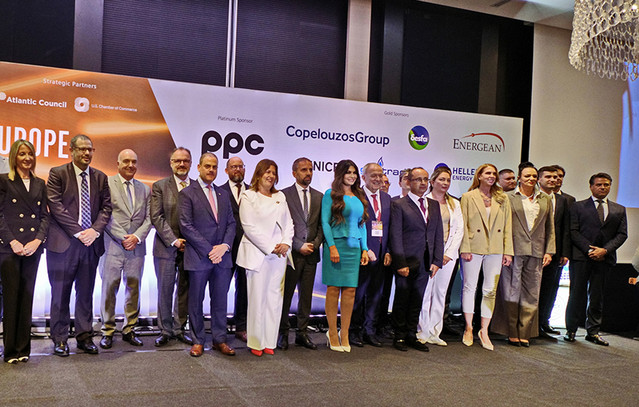
The signing took place in Thessaloniki as part of the 10th Southeast Europe Energy Forum (SEEF), an annual gathering of energy officials and companies from across the region.
The ceremony was attended by Greece's Deputy Minister of Environment and Energy, Nikos Tsafos; Bulgaria's Energy Minister, Iva Petrova; North Macedonia's Minister of Energy, Mining and Mineral Resources, Sanja Božinovska; Ukraine's Deputy Minister of Recovery, Infrastructure and Transport, Artem Rybchenko; Serbia's Deputy Minister of Energy and Mining, Jovana Joksimović; and Romania's Deputy Minister of Energy, Cristian-Silviu Bușoi.
Hungary's Honorary Consul in Thessaloniki, Dimitrios Takas, and Slovakia's Honorary Consul in Thessaloniki, Dimitrios Papastavrou, also took part. The United States was represented by its Ambassador to Greece, Kimberly Guilfoyle, its Special Envoy for Energy, Joshua Volz, and its Chargé d'Affaires in North Macedonia, Nicole Varnes.
Who now makes up the Vertical Corridor
With North Macedonia and Serbia on board, the Vertical Corridor now brings together nine companies from nine countries: DESFA and Gastrade from Greece, ICGB and Bulgartransgaz from Bulgaria, Transgaz from Romania, FGSZ from Hungary, Eustream from Slovakia, GTSOU from Ukraine, Vestmoldtransgaz from Moldova, NOMAGAS from North Macedonia and Transportgas Serbia from Serbia.
The Vertical Corridor is a north-south gas transport route intended to link supply sources reaching Greece, including the Trans Adriatic Pipeline and liquefied natural gas terminals, with markets in Bulgaria, Romania and further into Central Europe. It has grown gradually since it was first launched as a way to help diversify the region's gas supply away from a single dominant source.
What the new memorandum covers
Under the new memorandum, the participating companies will coordinate further on developing and operating their interconnected transmission systems. The stated aims include making better use of existing infrastructure, identifying where additional infrastructure is needed, strengthening the ability to flow gas in both directions, and expanding capacity across borders.
Cooperation will also continue at regulatory, technical and commercial levels, with the goal of making the Vertical Corridor more flexible, competitive and attractive to the market.
The expansion reflects ongoing cooperation among the companies involved, backed by the energy ministers of the countries concerned, aimed at reinforcing supply security, diversifying supply sources and routes, and strengthening regional interconnection.
Reaction from Gastrade
Konstantinos Sifnaios, the chief executive of Gastrade, described the signing as a significant milestone in broadening alternative energy sources and routes toward the Western Balkans and Central European markets. He said it further reinforced the momentum behind the project and Greece's strategic role as a reliable energy gateway to Southeast and Central Europe.
Sifnaios said the port city of Alexandroupolis was at the centre of that momentum, pointing to the Alexandroupolis LNG terminal and the planned Thrace LNG project. Gastrade, he said, was proud to be leading efforts to build a safer, more stable and more resilient European energy system.
Alexandroupolis, in northeastern Greece near the Turkish and Bulgarian borders, has become a focal point for regional energy projects in recent years due to its port and its links to onward pipeline routes.