
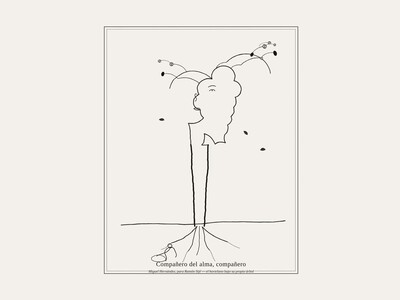
Spanish poet Miguel Hernández composed his landmark poem Elegía a Ramón Sijé in Madrid days after learning that his closest friend, 22-year-old essayist and lawyer José Marín Gutiérrez, died suddenly of septicemia in Orihuela on Christmas Eve 1935.
Gutiérrez, who published his essays and literary criticism under the pseudonym Ramón Sijé, suffered a rapid blood infection that proved fatal just as his career as a writer and cultural journal editor was becoming established.
Hernández was staying in Madrid when news of Sijé's death arrived, leaving him temporarily paralyzed by grief before he turned to writing as his sole means of reconnecting with his companion.
Early years in Orihuela
The friendship between the two writers originated in the city of Orihuela, where both grew up amidst local church bells, orchards, and lemon trees.
Despite sharing a deep interest in literature, the young men came from vastly different backgrounds.
Hernández had worked as a shepherd from childhood, developing his poetic sensibility outdoors through close observation of nature, changing seasons, trees, and damp soil.
Gutiérrez came from an academic path, studying law while reading widely in philosophy and theology.
Literary magazine and intellectual debate
Gutiérrez served as director of El Gallo Crisis, which emerged as one of the most active cultural magazines of its era.
During literary gatherings centered around the magazine, the pair discussed classic Spanish authors including Luis de Góngora, Francisco de Quevedo, and Saint John of the Cross.
Gutiérrez recognized an untamed poetic talent hungry for methodology in Hernández, while Hernández found an exacting interlocutor who demanded intellectual growth rather than offering flattery.
Gutiérrez provided structural discipline and intellectual rigor to Hernández's poetic imagery, while Hernández showed his friend that intellect required emotional resonance to fully comprehend reality.
Over time, ideological differences developed between them, as Gutiérrez maintained a deeply Christian humanist perspective while Hernández explored different political and intellectual views.
However, both writers maintained that literature represented a search for truth, allowing their political disagreements to deepen their bond rather than break it.
Sudden death and writing the elegy
The sudden arrival of septicemia killed Sijé on December 24, 1935, offering no respite.
Upon receiving the news in Madrid, Hernández began writing the elegy within days, producing a piece where technical precision matched emotional intensity.
In the opening line of the poem, Hernández wrote that he wished, weeping, to be the gardener of the earth that his friend occupied and fertilized.
The image of the gardener represented patience and humble work, transforming a mourning lament into a promise to continue cultivating his friend's presence in the ground where death had taken root.
Imagery of defiance and cosmic rebellion
As the poem continues, Hernández expressed a cosmic rebellion against death, describing the loss as a hard slap, a frozen blow, and an invisible, murderous axe stroke.
He deployed imagery of stone storms, lightning bolts, axes, and bites against the earth to depict death as a violent disruption of the natural order.
The poet wrote of his desire to unearth his friend, confront death face to face, and reclaim what had been stolen.
The tribute granted Sijé a second existence through literature, preserving his memory against time through his friend's devotion.
Literary legacy and postponed farewell
In the final lines of the poem, Hernández summoned his friend to the winged souls of the roses of the cream almond tree, stating that they still had many things to talk about and addressing him as companion of his soul.
The closing verses presented their separation not as a final goodbye, but as a postponed appointment between lifelong friends.
Hernández died six years after Sijé at the age of 31, leaving behind a broader body of work that addressed love, hunger, war, fatherhood, and hope.
Despite the passage of time, the elegy written for Sijé continues to circulate on social media platforms, keeping the memory of both writers alive in Spanish literature.