

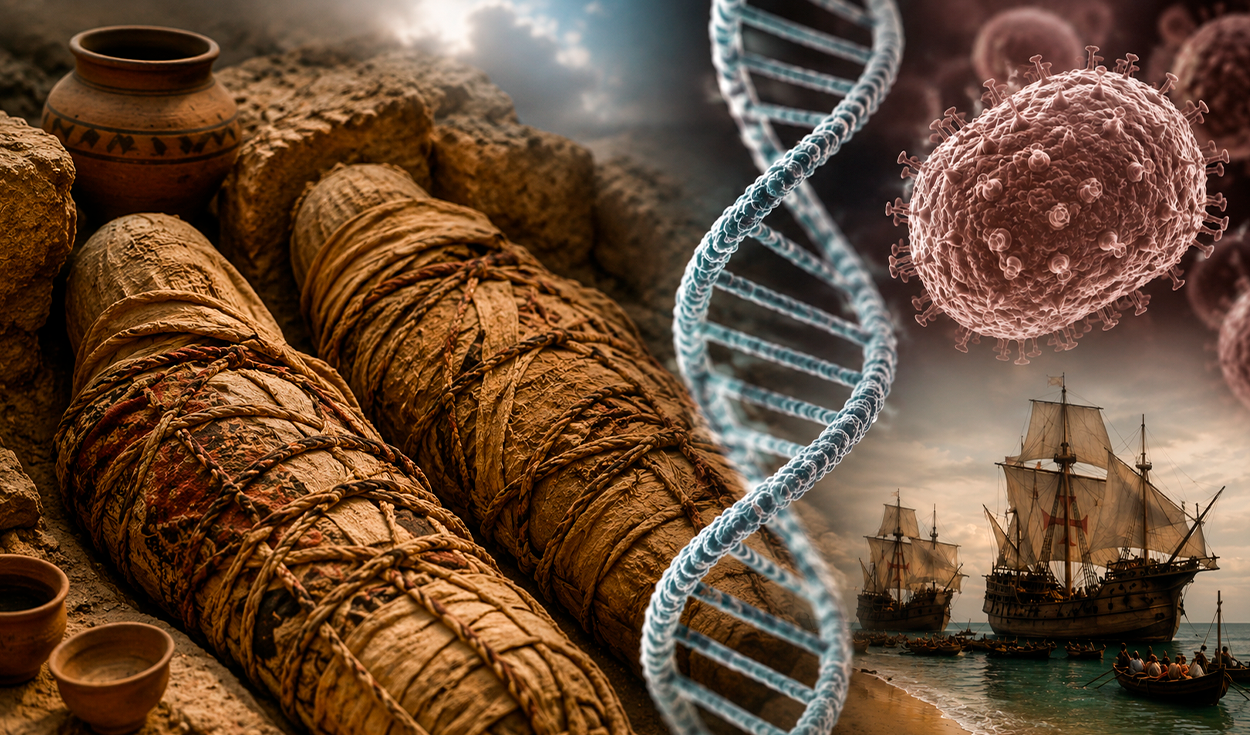
DNA recovered from two indigenous people linked to the Inca Empire has produced the first molecular evidence of smallpox's impact after Europeans arrived in the Americas, according to a study published in the journal Science. The research documents the oldest Variola virus genomes found on the continent so far.
The remains were found at Camarones 9, an archaeological site in northern Chile. The extreme aridity of the Atacama Desert preserved genetic material in individuals who lived in the region at the start of the colonial period, according to the researchers.
Genome match in two sets of remains
An analysis of femur fragments from Camarones 9 revealed Variola virus sequences with 99.9% similarity between a woman aged 30 to 35 and a young man aged 18 to 20. Ancestry testing confirmed both individuals belonged to indigenous American populations with no European genetic trace, showing the infectious disease was already circulating locally within the Andean community.
Radiocarbon dating and a molecular clock placed the remains between 1492 and 1631, a period overlapping with transatlantic contact. Historical records document smallpox outbreaks in the Caribbean around 1518 and in Mexico in 1520, but the researchers said the Camarones 9 find offers the first direct biological evidence of a strain introduced during Spanish colonization in South America.
Phylogenetic analysis placed the ancestral variant between medieval European lineages and later branches of the virus, ruling out an origin native to the continent. Biological anthropologist Constanza de la Fuente Castro said the finding is literally written in the biological evidence that scientists can still recover and read today.
An extinct lineage that reshapes the record
The genetic analysis confirmed the variant found in Chile belongs to a Variola virus lineage that is now extinct, having split from the main line sometime between 1124 and 1460. That branch evolved independently, so no twentieth century strain descends from it. The disease did not disappear when that lineage ended; other lineages kept circulating worldwide until smallpox was declared eradicated in 1980.
Historical debate had never questioned whether epidemics followed European colonization, but the researchers said there had been a lack of ancient genomes capable of identifying the microorganisms responsible. Chronicles from the period documented outbreaks but could not establish the biological relationship between pathogens. The study resolves that gap by providing direct molecular evidence of the pathogen's introduction through colonial contact.
The genetic data cannot pinpoint which expedition or individual introduced this specific strain, the researchers said, but it rules out the possibility that the virus evolved in isolation in the Americas before explorers arrived. The link between the South American genomes and Old World variants connects historical records of the demographic catastrophe among indigenous people to the pathogen's actual biological evolution.


