

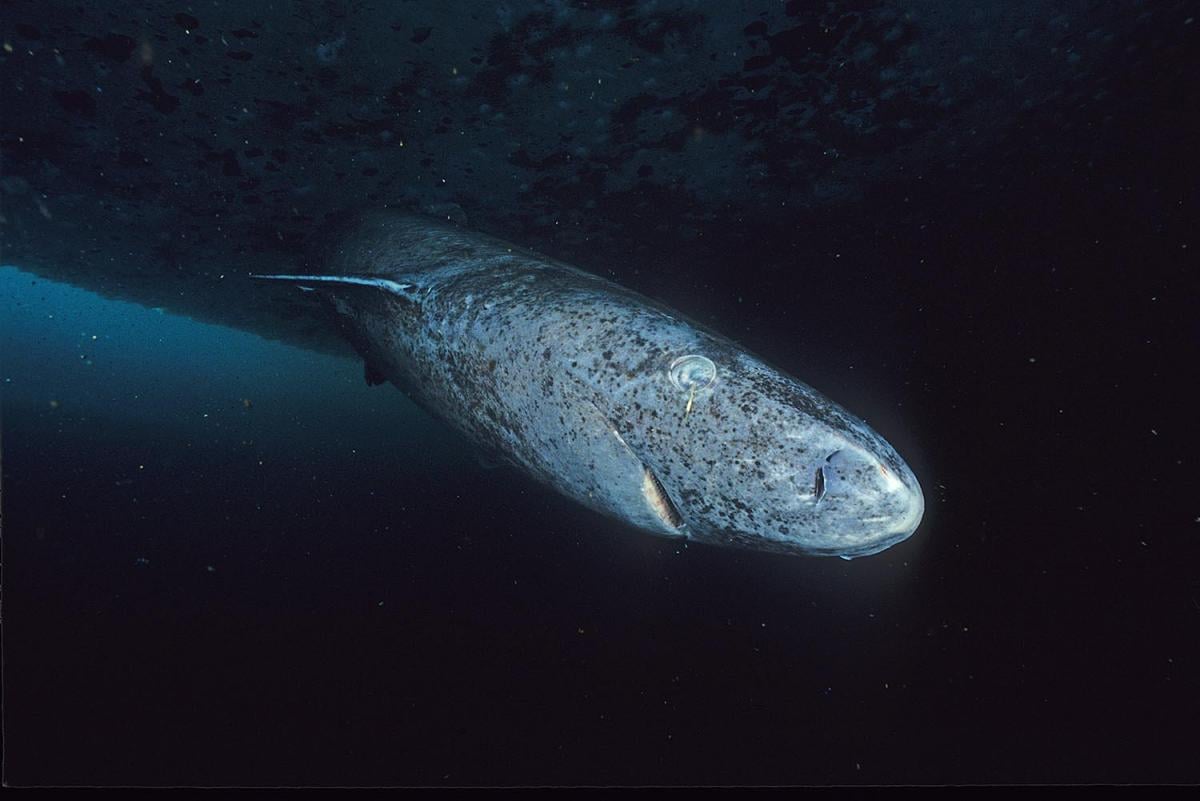
The world's oldest Greenland shark was not born with a recorded birth date, scientists said, explaining its estimated age spans from 272 to 512 years.
The single figure of 392 years often cited for the creature originated from radiocarbon dating conducted on tissue at the center of its eye lens, which was interpreted using a statistical model with a broad range of probable ages, according to a report published by Science Blog.
The animal in question is a female measuring 5.02 meters in length. She was the largest of 28 female Greenland sharks analyzed in a major 2016 study that estimated her midpoint age at 392 years, within a 95.4 percent probability range extending from 272 to 512 years.
Researchers specified that the 240-year interval is a key fact necessary for an objective interpretation of the data rather than a minor footnote. They clarified that the investigation never confirmed an exact age of 392 years, nor did it prove that the shark had reached 512 years of age.
Statistical model of shark growth
Scientists derived the figures by combining radiocarbon analysis results with a Bayesian growth model, a probabilistic statistical system that uses Bayes' theorem to update hypothesis probabilities as new data becomes available. For large marine animals born prior to atmospheric nuclear tests, the model generated probability distributions rather than a fixed calendar age.
The probability distribution for the 5.02-meter female had a midpoint of 392 years. In the original 2016 paper, researchers recorded this value as 392 plus or minus 120 years based on the 95.4 percent confidence range, which yields the span from 272 to 512 years when subtracting and adding 120 years.
Media headlines describing the animal as a 512-year-old shark are therefore inaccurate. The honest scientific finding is that the age of the shark falls within an estimated window covering more than two centuries.
Radiocarbon testing and bomb pulse markers
To perform the analysis, scientists identified lens tissue that preserves carbon locked in during the earliest stages of the shark's life. In eye lens testing, proteins in the core of the lens form in embryonic development and remain metabolically inert throughout life, preserving early chemical signatures.
Researchers used the bomb pulse, a sharp rise in global radiocarbon levels caused by mid-twentieth-century nuclear bomb testing, to anchor the younger end of their sample set. They then constructed a growth model for older animals born before that chemical benchmark existed in the oceans.
Scientists concluded that although the measurement cannot pinpoint a single birth year, it confirms that Greenland sharks can live for at least 272 years, with the largest specimen in the sample potentially living much longer. They noted that this discovery establishes a record for vertebrate longevity without pretending an eye lens serves as an official birth certificate, describing the 240-year margin as the true boundary of scientific measurement.
Species background and other animal findings
Greenland sharks, known scientifically as Somniosus microcephalus, inhabit the cold, deep waters of the Arctic and North Atlantic Oceans. Growing extremely slowly in near-freezing conditions, these massive apex predators possess sluggish metabolisms that contribute to their extraordinary lifespans.
In other animal reports cited by news agency UNIAN, ring-necked pheasants introduced to Texas during the 1930s spread rapidly across the region within 50 years. Annual harvests of the game birds peaked at approximately 122,000 birds during the 1987-88 and 1988-89 hunting seasons.
Separately, researchers detailed deep-sea sharks capable of glowing at depths of 500 meters. These bioluminescent light-emitting sharks live in ocean layers between 480 and 540 meters deep, where very little natural sunlight penetrates.


