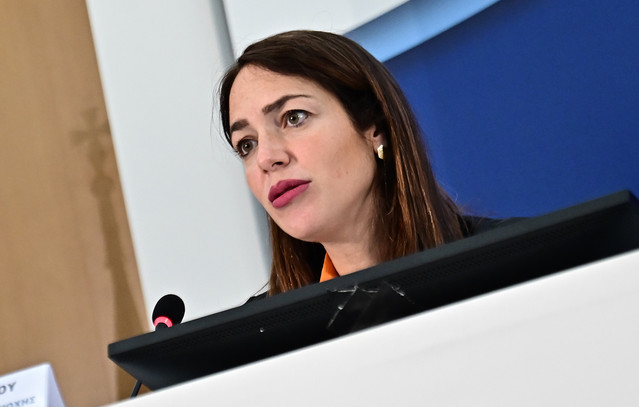
Greece has made its Personal Assistant program for people with disabilities a permanent nationwide institution, Minister of Social Cohesion and Family Domna Michailidou announced on Wednesday.
Under the expanded scheme, eligible beneficiaries will receive up to 1,939 euros per month for personal assistance starting on January 1, 2027. Current participants in the program will see no changes to their existing support through December 31, 2026.
The Ministry of Social Cohesion and Family stated that the transition follows a pilot phase that allowed officials to gather practical feedback from disabled citizens and care workers. The ministry said the permanent service is designed to help disabled individuals choose their own support, manage daily life with greater autonomy, pursue education, work, and participate equally in society.
Michailidou said the government systematically addressed areas for improvement identified during the pilot testing. She noted that the state has established a stable nationwide service using digital procedures and personalized assessments, while also increasing compensation for Personal Assistants and Assessment Committee members to reflect their crucial role.
She added that the government is ensuring continuity for current beneficiaries while delivering a major reform aimed at fostering independent living for disabled individuals across the country.
Eligibility requirements and income limits
The permanent program is open to legal and permanent residents of Greece aged 16 to 67 who are tax residents of the country and hold lifelong disability certification from the Disability Certification Center, known as KEPA. Eligible participants must have a motor, intellectual, developmental, sensory, or mental disability.
Applicants must have a primary disability rating of at least 67 percent or be certified as being in a continuous state requiring the assistance of another person. An exception allows individuals up to 75 years old to apply if they became beneficiaries of a mobility allowance before turning 67.
The annual income limit for a single-person household is 35,000 euros. This threshold increases by 17,500 euros for each additional adult household member, or for the first minor child in a single-parent household. It increases by an additional 8,750 euros for every subsequent minor child.
Applicants must reside in a home to receive funding. Individuals who do not currently live in a private home may still apply and undergo evaluation, with their inclusion activated once they move into a residence.
Digital application and evaluation process
Applications will be processed digitally through the official platform prosopikosvoithos.gov.gr, with applicant data automatically verified against public registries. The system will issue immediate decisions on eligibility and scoring points, and applicants will have the right to file electronic appeals.
The scoring system evaluates household composition, income, the presence of other household members with disabilities, and the degree and specific characteristics of the applicant's disability. Additional scoring points are awarded to applicants who are employed or enrolled in studies.
Top-scoring applicants will be evaluated in their homes by an interdisciplinary Special Committee, with videoconference evaluations permitted by exception. The committee will examine daily operational needs and assess how personal assistance supports education, work, and social inclusion. Existing assistance provided by family members will not count against the applicant.
Assistance tiers and assistant compensation
From January 1, 2027, monthly financial assistance will be divided into four tiers based on evaluation by the Special Committees. Beneficiaries with minor needs will receive up to 416 euros per month, while those with moderate needs will receive up to 831 euros. High needs will qualify for up to 1,352 euros per month, and total continuous dependence will receive up to 1,939 euros.
Beneficiaries can select one to four Personal Assistants from an official registry to work on an hourly basis, or hire one live-in assistant. Gross hourly compensation ranges from 6 euros to 7 euros. For live-in care, gross monthly compensation is set at 1,200 euros, and the beneficiary receives a monthly allowance of 250 euros.
In island and mountainous municipalities with populations of up to 5,000 residents, beneficiaries may choose a spouse, civil partner, or blood or affinity relative up to the second degree as their Personal Assistant.
Personal Assistant candidates must be aged 18 to 67 and legally entitled to work in Greece. Final registration in the official registry requires completing a free online training program operated by the Welfare Benefits and Social Solidarity Organization, known as OPEKA. Caregivers already registered will maintain their status.
Rules for existing pilot beneficiaries
Participants who completed at least 60 days of personal assistance by June 30, 2026, or who reside in mountain or island municipalities with populations up to 5,000, will remain in the program through December 31, 2026, without taking any action. To continue receiving support from January 1, 2027, they need only submit a Consent Declaration without undergoing new eligibility checks, scoring, or reassessments.
Beneficiaries who held active contracts on June 30, 2026, but do not meet the 60-day or location criteria, will also remain covered through December 31, 2026, without immediate action. To continue in 2027, they must submit a new Participation Application under the standard process for new applicants.
All other participants in the pilot scheme must submit a new application from the start. The permanent program will be administered nationwide by OPEKA.
The rules, eligibility requirements, assessment procedures, funding tiers, and caregiver selection rules were established by a Joint Ministerial Decision signed by Michailidou, Deputy Ministers of National Economy and Finance Nikos Papathanasis and Thanos Petralias, Minister of Digital Governance Dimitris Papastergiou, and Minister of State Akis Skertsos, according to the Athens-Macedonian News Agency.