

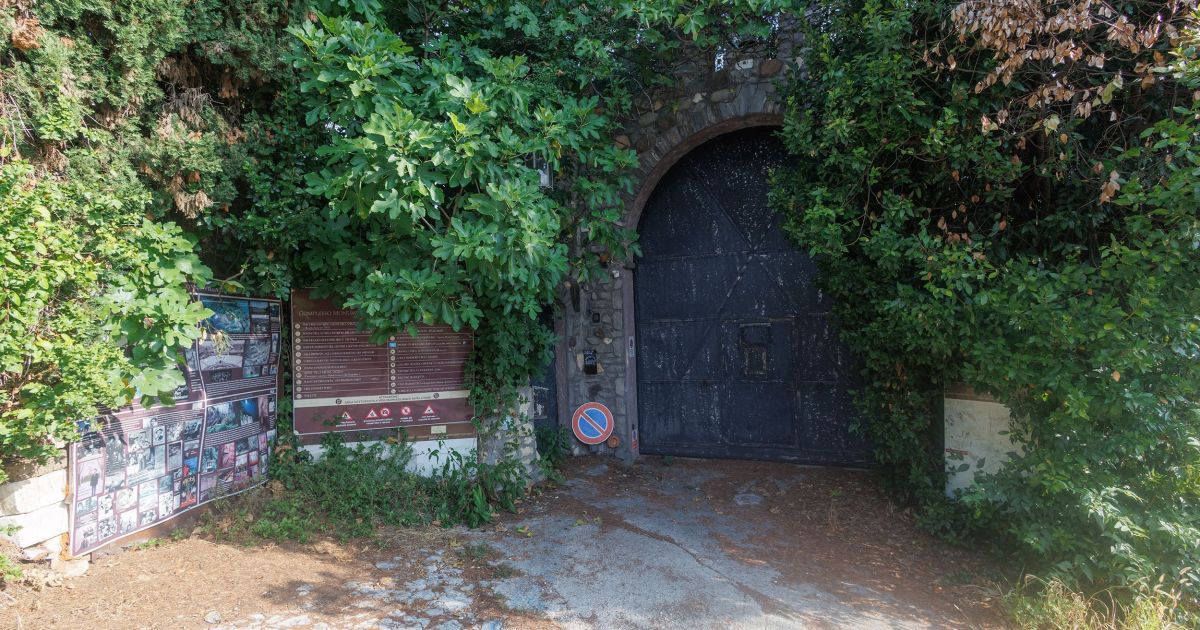
Franco Malosso, the owner of a purported ancient Greek amphitheater near Arcugnano in Italy's Veneto region, was arrested this month after a decade-long legal battle for forging artworks, carrying out unauthorized construction and destroying a protected landscape.
The theater, spread across nearly 54,000 square feet (about 5,000 square meters) on a hillside, was not Greek at all, nor even Roman. Malosso built it himself, then charged visitors up to 40 euros ($46) to tour what he presented as an archaeological discovery.
On TripAdvisor, all eight reviews of the site gave it five stars. One review called it a charming place, another described it as a world beyond space and time, and a third said it was one of the best places they had ever visited. A fourth called it unique on the planet, a description that, as it turned out, was accurate for reasons the reviewer did not intend.
How the theater was built
Malosso hired a local construction firm to build seating and steps on a scenic hillside, which court evidence showed were artificially aged. He then added concrete columns and plaster statues overlooking a small lake he had dug himself.
The stands, which Malosso claimed had been built by hand by ancient Greeks more than 2,000 years ago, were actually erected by 21st-century builders using machinery, according to court documents shared with CNN. The construction used freshly quarried stone from Puglia and concrete, while a retaining wall was lined with polystyrene.
Darius Arya, an archaeologist and director of Ancient Rome Live, told CNN that the idea alone was insane, and he described Malosso's plan as diabolical and terrible.
Concerts, tours and three different names
Court evidence indicated the site had at least three names over time: Anfiteatro Berico, Anfiteatro Marittimo Berico and Anfiteatro Porta degli Angeli. According to the prosecution, Malosso organized concerts and shows there and also led guided tours of the site.
For anyone with basic knowledge of ancient history, the signs were plentiful. Malosso's building was a fan-shaped theater, not an oval amphitheater. It was nowhere near the sea, despite the word "Marittimo" in one of its names. Arcugnano sits roughly 80 kilometers from the coast. There was also no ancient "Porta degli Angeli," or Gate of the Angels, on the site. Nor could the theater have been Greek, since ancient Greek settlers colonized only the southern regions of Italy, even though the north is rich in genuine Roman remains.
None of that appeared to bother the visitors, who praised the concrete columns and chalk statues. They also did not seem to notice that where a stage should have stood, Malosso, who also went by the name Von Rosenfranz, had instead dug a photogenic pool of water.
Arya questioned why a pool of water would be there at all if there had been no maritime performances, calling it an extravagance that did not seem right.
Discovery and investigation
The clandestine theater, built on a hillside within a protected woodland area on the outskirts of the small town of Arcugnano, just over five kilometers south of Vicenza, was discovered by local police, who referred it to the cultural heritage superintendency in October 2016.
An inspection was carried out by a representative of the local heritage council and by officers from the Carabinieri's Tutela del Patrimonio Artistico unit, known in English as the art squad for its work investigating stolen artworks and forgeries.
Lieutenant Colonel Giuseppe Marseglia, commander of the unit in Monza, which covers northern Italy, told CNN the theater was so obviously fake that the inspection was completed in a single day. He described the forgery attempt as truly obscene.
Marseglia said that among criminals, forgers were the most talented, because they were capable of creating actual works of art. He said there was then a separate category of fraudsters, adding that he had no respect for Malosso and that calling him a forger was an insult to forgers.
Marseglia said that in his 25 years on the police force, he had never seen or heard of an entire archaeological site being faked.
A UNESCO-rich country
Italy narrowly surpasses China for the highest number of UNESCO World Heritage Sites and is home to numerous genuine Greek and Roman theaters, including those at Syracuse and Pompeii, where productions are still staged every summer, and the amphitheater in Verona, 64 kilometers west of Arcugnano, which becomes a stage for opera each summer.


