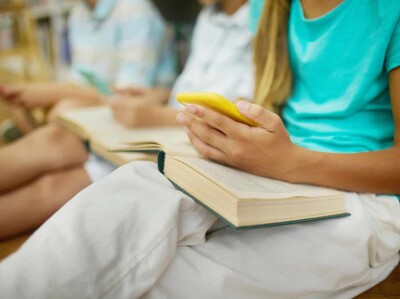
The Community for Learning, a private school in Santo Domingo, demonstrated that classrooms function better without mobile phones after locking student devices in magnetic pouches during the school day starting in September 2019.
Seven years after the school introduced the policy, the Ministry of Education of the Dominican Republic mandated a similar restriction for all educational centers nationwide under Departmental Order 011-2026, signed in May 2026 by Education Minister Luis Miguel De Camps.

On a September 2019 morning, students arriving at the Santo Domingo campus found numbered cloth pouches waiting at the school entrance. Each student was required to place their mobile phone inside, seal the container with a magnetic lock, and carry the pouch inside their backpack for the remainder of the day. The device remained personal property, but students could not open the pouch until dismissal time.
The institution implemented the measure after distributing an informational letter to parents. The school adapted a magnetic closure pouch system originally developed for use at music concerts and comedy theaters. In a written account of the initiative, school founder and principal Carla Meyrink said the teaching staff had felt like phone police who were forced to spend energy monitoring screens rather than teaching.
Classroom Friction and Constant Screen Distractions
The decision at The Community for Learning stemmed from daily operational friction rather than theoretical pedagogy. School officials observed that games, video streaming, and messaging chats competed directly with academic instruction, while unexpected phone calls from parents frequently disrupted classroom lessons.
During break periods, school courtyards had fallen quiet because students preferred staring at screens over conversing with peers. An internal check of student screen time records revealed that some pupils were accumulating between eight and 12 hours of daily phone use. School leaders sought a solution that rendered devices inaccessible during school hours without confiscating student property.
Teachers reported immediate classroom benefits following the change, including fewer student distractions and a smoother instructional flow. The most visible transformation occurred outside the classroom during recess, where courtyards regained active noise as students across different grade levels resumed playing and talking together.
Student resistance to the pouch system proved short-lived. One student noted that recess had become great because classmates were now talking to each other. Another student recalled that while they initially disliked the idea for about a week, they subsequently noticed increased interaction with teachers and classmates. Students also reported decreased anxiety about checking notifications, along with higher classroom participation and improved focus.
The pouch system became a standard routine at the institution, which maintains a student-centered, inquiry-based curriculum focused on critical thinking, meaningful learning, and socio-emotional development. The policy includes an exception allowing teachers to request that phones be unlocked when needed for specific educational activities.
Global Push for Classroom Mobile Restrictions
What began as an isolated school initiative in 2019 reflects a major international shift across primary and secondary education. According to data from the United Nations Educational, Scientific and Cultural Organization, 114 educational systems had implemented national school phone restrictions by March 2026. That total represents 58 percent of countries worldwide, up from 24 percent in 2023.
Across Latin America, national governments have taken varying approaches to classroom technology. Bolivia and Costa Rica recently enacted full national bans on mobile phones in schools. In contrast, authorities in Colombia and Peru passed mandates requiring individual school administrations to establish their own binding regulations.
Academic research supports the trend toward restriction. In a widely cited study, economists Louis-Philippe Beland and Richard Murphy evaluated 91 secondary schools in the English cities of Birmingham, Leicester, London, and Manchester, analyzing performance data from more than 130,000 students between 2001 and 2011. The researchers found that restricting mobile phones led to significant improvements in student test scores, with the largest gains achieved by previously low-performing students.
International evaluation data from the Organisation for Economic Co-operation and Development reinforces those findings. Results from the 2022 Programme for International Student Assessment showed that 65 percent of surveyed students reported being distracted by their own digital devices during mathematics classes. In addition, 59 percent reported being distracted by devices used by their classmates.
Students who experienced frequent digital distractions across most or all classes scored 15 points lower in mathematics, a drop equivalent to nearly three-quarters of a school year of learning. UNESCO noted in its Global Education Monitoring Report that the physical proximity of a smartphone degrades student attention even when the device is not being actively used.
Dominican National Mandate Takes Effect
The new national regulations issued by the Ministry of Education apply equally to all public and private schools across the Dominican Republic. Departmental Order 011-2026 imposes a complete ban on mobile phones in early childhood education, restricts device use in primary schools, and limits secondary school usage strictly to supervised educational tasks.
The regulation established a 90-day implementation period that expires as the new academic year begins across the country. While most Dominican schools now face a period of trial and error regarding enforcement, exceptions, and parent communication, The Community for Learning enters the term with seven years of experience. School leaders noted that removing phones from school life does not mean rejecting technology, and that the ultimate recovery is measured in the social noise of a school yard at break time.
The facts reported in this story draw from primary documents and research studies, including Carla Meyrink's October 2019 report titled Disconnect to Connect: How to Use Yondr Pouches for a School Smartphone Detox in The Teaching Experiment, Departmental Order 011-2026 issued by MINERD and the Presidency of the Dominican Republic, the March 2026 UNESCO Global Education Monitoring Report, the 2016 Labour Economics study by Beland and Murphy, and the OECD PISA 2022 report titled Students, digital devices and success.