
The Dominican Republic's executive branch submitted a draft budget amendment to the National Congress on July 17, seeking authorization to raise public spending by RD$40,978.3 million for the current fiscal year. The draft has since been converted into a formal bill.
An analysis by the Centro Regional de Estrategias Económicas Sostenibles (CREES) concludes that the proposal misclassifies RD$21,147.5 million in 2025 government cash reserves as revenue rather than financing. Applying the correct treatment, the fiscal deficit for 2026 would rise from 3.26 percent to 3.50 percent of gross domestic product, the analysis finds.

The Ministry of Finance and Economy presents the revenue and spending increases as a matching pair, projecting that income will grow by exactly RD$40,978.3 million, which would leave the deficit unchanged from the original 2026 budget target. That balance depends in part on Article 6 of the amendment, which requests authorization to draw RD$21,147.5 million from cash accumulated during fiscal year 2025 to help cover 2026 expenditures.
CREES argues that under the International Monetary Fund's Government Finance Statistics Manual 2014, that treatment is incorrect. Using cash reserves reduces a government asset and does not increase public sector net worth. Because revenue must increase net worth by definition, the 2025 funds belong below the line as financing, not above it as income.
Economist Nelson Suárez reached the same conclusion in explanatory notes for public audiences published July 21, and CREES said it agreed with his assessment.
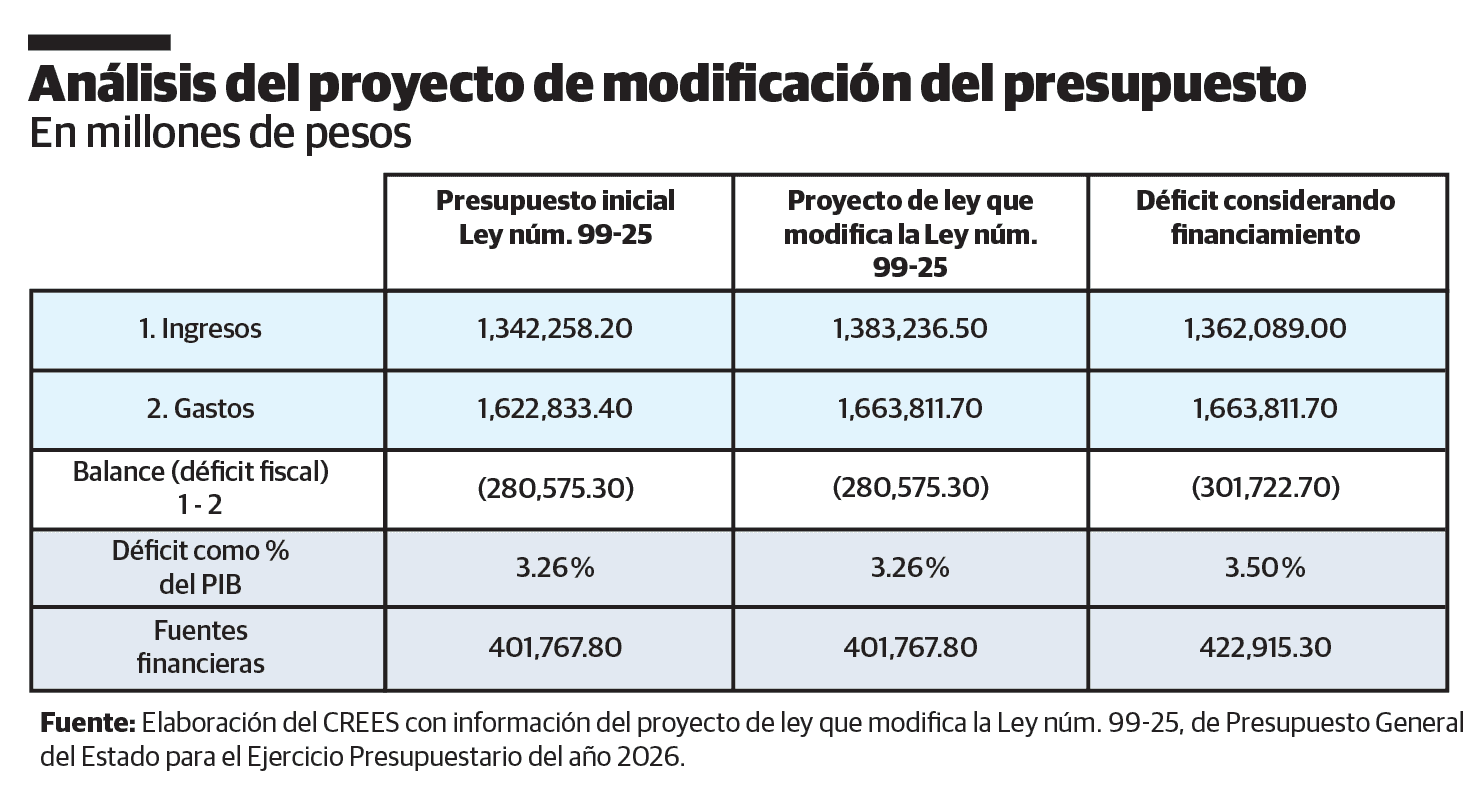
With the misclassified amount removed, CREES calculates that genuine new revenue comes to only RD$19,830.8 million. Under the spending plan that legislators have already approved, the 2026 deficit would therefore climb from RD$280,575.3 million to RD$301,722.8 million.
The analysis also raises a transparency concern over how the new money would be spent. About half the proposed new expenditures, some RD$20,500 million, is grouped under a single broad line item for administration of national treasury obligations with no further breakdown. CREES said lawmakers and citizens should have received a fuller accounting of how those funds would be allocated, including whether any portion would go toward transfers to electricity distributors.