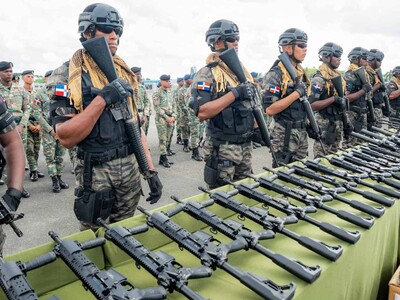
The Dominican Republic Defense Ministry has handed over new supplies of rifles, machine guns, and grenade launchers to the nation's Navy and Air Force as part of a military expansion that has seen annual defense spending nearly double under President Luis Abinader.
Defense Minister Carlos Antonio Fernández Onofre led the handover ceremony on August 25, 2026, across two military facilities in Santo Domingo Este: the Base Naval 27 de Febrero in Sans Soucí and the Base Aérea de San Isidro.
Troops were presented with Israeli IWI ARAD rifles, Negev machine guns, Barrett and Daniel Defense precision rifles, and 40-millimeter MGL grenade launchers. Although the government disclosed the types of weaponry incorporated into the armed forces, officials did not specify the exact quantities acquired or their overall financial cost.
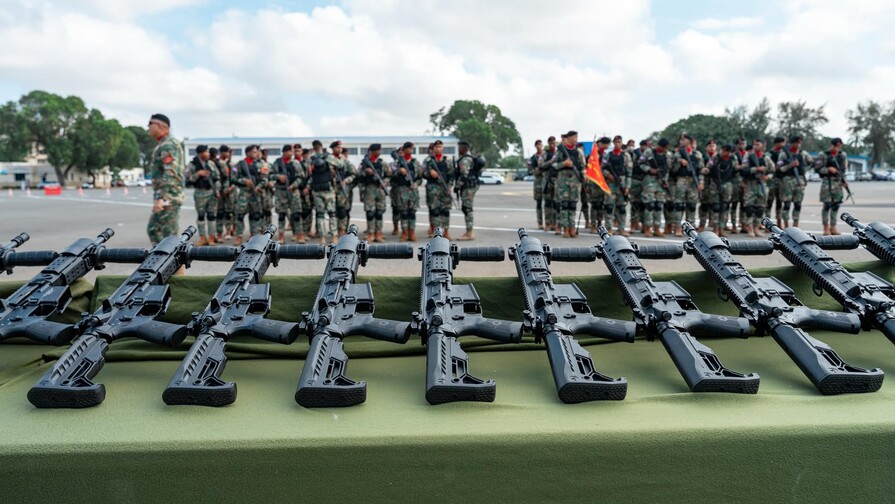
President Luis Abinader assumed office on August 16, 2020. Over his six years in power, the Armed Forces of the Dominican Republic have received expanded budgetary resources alongside continuous shipments of vehicles, armored transports, aircraft, naval vessels, drones, and advanced surveillance equipment.
Defense Ministry budget doubles since 2020
Official spending statistics demonstrate the scale of the expansion. In 2020, when President Abinader took office, the Defense Ministry recorded an accrued expenditure of 32,940.7 million Dominican pesos. That figure grew to 34,903.8 million pesos in 2021, reached approximately 42,513.8 million pesos in 2022, and climbed further to 53,149 million pesos in 2023.
The military budget continued its upward trajectory, reaching 60,303.4 million pesos in 2024 and closing 2025 at 64,771.3 million pesos. Between 2020 and 2025, nominal defense spending increased by 96.6 percent. For 2026, an initial budget of 68,686.6 million pesos was approved, with 30,996.1 million pesos executed through June.
Government records note that these financial figures encompass all operations of the Defense Ministry rather than military equipment purchases alone. The funds cover payroll salaries, social security, troop meals, fuel, equipment maintenance, education, administration, and operational deployments. In 2024, payroll remunerations alone amounted to 39,605.1 million pesos, representing roughly two thirds of all resources executed that year.
Largest military equipment purchase in history
A major acceleration in military procurement took place in October 2022, when the government announced what it described as the largest purchase of military equipment in Dominican history. The program outlined plans to acquire 21 URO VAMTAC ST5 armored vehicles, four anti-riot trucks, replacements for six Huey II helicopters, and ten aircraft dedicated to reconnaissance and surveillance.
In 2023, the Army officially confirmed the arrival of 20 VAMTAC armored vehicles, which were assigned to troop transport as well as command and control roles. The military also integrated two Bell TH-67 helicopters into service in 2023, followed by two Leonardo AW169 helicopters in 2024.
The largest quantitative transformation occurred in land mobility. In February 2025, during a ceremony delivering 183 vehicles, the Defense Ministry reported that the armed forces had received 934 units since August 2020, including pickup trucks, heavy trucks, buses, minibuses, motorcycles, anti-riot vehicles, and armored units. By July 2026, the cumulative total of delivered land vehicles reached 1,206 units.
Local defense manufacturing and tactical vehicles
During July 2026 alone, military authorities delivered another 179 vehicle units, five vertical takeoff and landing (VTOL) unmanned aerial vehicles, and ten Centauro tactical vehicles designated for the Army Commando Battalion. The ten Centauro vehicles were modified and developed locally using Chevrolet Silverado chassis platforms.
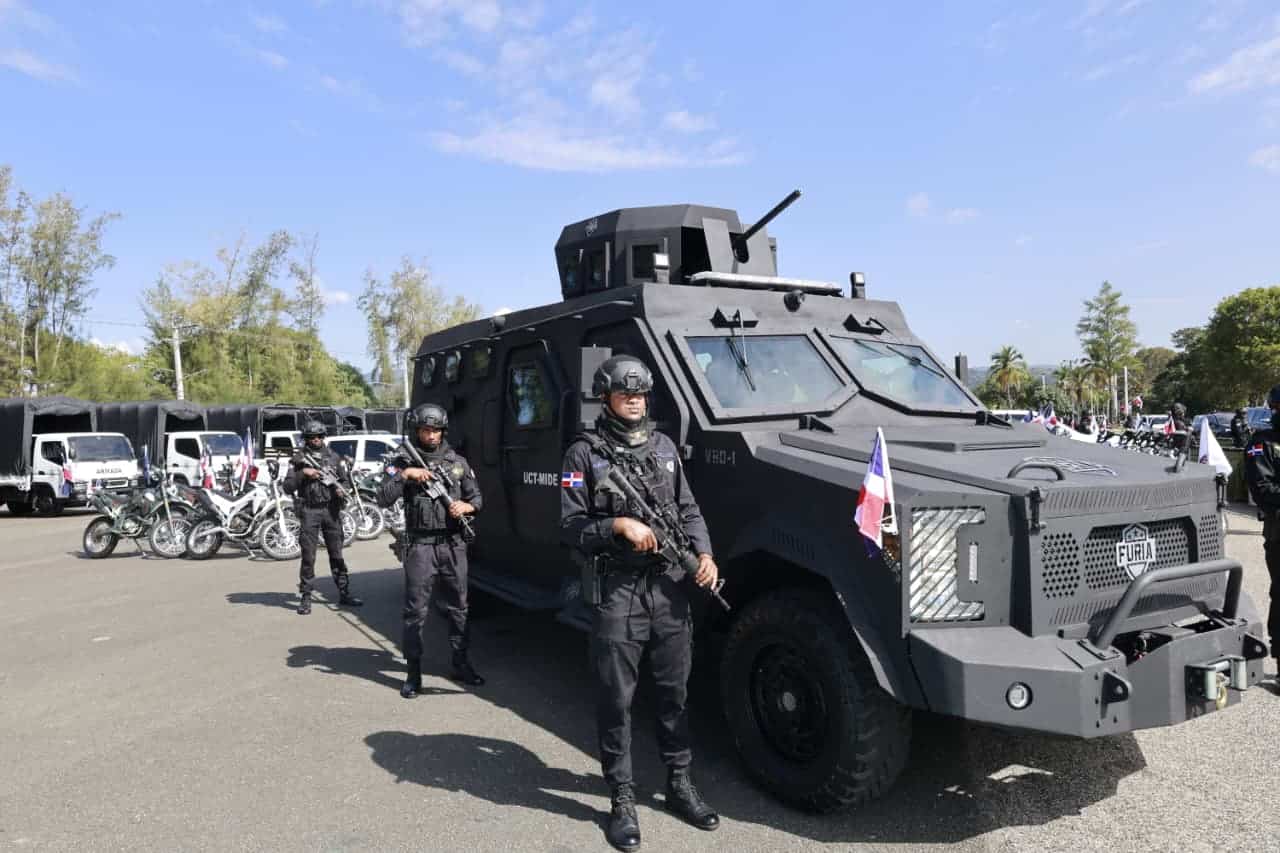
The modernization program has increasingly incorporated domestic defense manufacturing. In 2025, authorities inaugurated the first phase of an assembly plant operated by Industria Militar Dominicana in San Cristóbal. By February 2026, the plant unveiled three FURIA VBD-1 armored vehicles, followed in July by the first FURIA VBD-2 model out of a planned 18-vehicle production run.
Air and maritime surveillance capabilities
Air force modernization has prioritized surveillance, troop mobility, aerial reconnaissance, and search and rescue missions. Alongside the TH-67 and AW169 helicopters, the military deployed the TP-75 DULUS, an aircraft assembled by Dominican Air Force technicians. The DULUS operates alongside Tecnam P2006T aircraft to conduct intelligence, surveillance, and reconnaissance patrols over the border region.
Air capabilities expanded further in 2026 with the introduction of five VTOL unmanned aerial vehicles. To counter growing aerial threats, the Defense Ministry also introduced specialized defense systems engineered to detect, identify, and disable unauthorized drones.
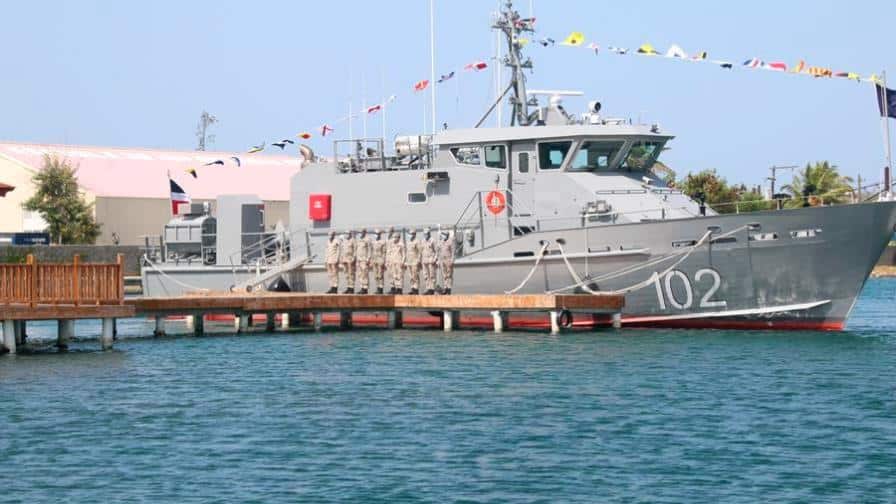
At sea, the Dominican Navy added the coast guard cutter GC-102 Betelgeuse to its fleet in 2020, followed by the GC-114 Arcturus in 2025, both belonging to the Defiant 85 vessel class. The acquisition of the Arcturus was jointly funded, with the Dominican Republic contributing 30 percent of the cost and the United States providing the remaining 70 percent. In 2026, the Dominican Republic signed an agreement with Portugal to purchase four Tejo-class patrol vessels.
Strategic priorities behind military modernization
Throughout 2026, the Defense Ministry showcased new categories of small arms and heavy infantry weapons for specialized military units. The upgrades included carbines, submachine guns, light machine guns, high-precision rifles, and automatic 40-millimeter grenade launchers.
Official documentation indicates that the structural overhaul combines land transport, heavy armor, aerial and naval surveillance, unmanned systems, anti-drone warfare, tactical communications, specialized unit weaponry, and local assembly capabilities. The military strategy reflects core Dominican national security priorities: securing the land border with Haiti, combatting illegal drug trafficking, curbing irregular migration, patrolling territorial waters, providing disaster response, and ensuring rapid troop mobility across the country.