Dominican lawmakers from rival parties clashed on Thursday over how much public money political organizations should receive, with the 2028 general elections looming over the debate.
Minister of the Presidency José Ignacio Paliza argued that political organizations already receive sufficient resources. Opposition representatives countered that cutting those funds would put parties outside the government at a disadvantage against the ruling party.
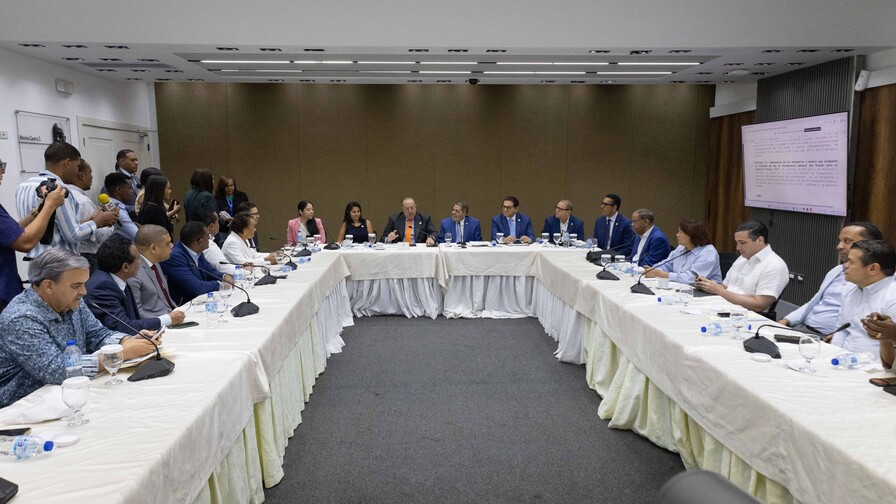
The dispute centers on the draft General State Budget for 2027, which sets aside 1,750.9 million pesos for party financing. That figure falls far short of the 3,498.7 million pesos that the Permanent Forum of Political Parties of the Dominican Republic, known as Foppredom, says parties are owed under current law.
Opposition Warns of Imbalance
José David Báez, spokesman for the Fuerza del Pueblo party, said Paliza's comments reflected an intention by the ruling Modern Revolutionary Party (PRM) to limit the resources of other organizations in order to secure its own hold on power.
Báez argued that any revision of the law governing party financing, as Paliza proposed, should wait until after the 2028 elections, so that the economic conditions for competing organizations are not altered while parties are preparing for the contest.
He said it was disadvantageous for a government that administers public money to push changes that would affect the financing of its own political rivals. Báez also accused the ruling party of using state resources to favor its own political activities, a practice he said leaves opposition parties at an unequal footing.
Ydenia Doñé, spokeswoman for the Dominican Liberation Party (PLD), took a similar position, saying parties were not asking for an increase in funds but simply for the government to comply with what is already established in Law 20-23. She questioned why the debate over revising party resources was emerging now, just as the country heads toward a new electoral process.
Doñé said any modification should be discussed only after the 2028 elections and asked the governing party to refrain from using state resources to advance its own political ambitions.
Ruling Party Voices Back a Review
Within the ruling party, however, some lawmakers backed the idea of reviewing how political organizations are financed. Amado Díaz, the PRM spokesman in the Chamber of Deputies, said democracy carries a cost that must be assumed to preserve its functioning, and argued that differences over party resources should be settled through dialogue.
Díaz interpreted Paliza's remarks as pointing to a need to revise financing arrangements going forward, and said any solution should come through talks with the parties while still guaranteeing the resources the democratic system requires.
Independent deputy Rogelio Genao also supported a review of party financing, but for different reasons. He questioned why parties receive large sums of public money during years when no elections are held.
Genao asked what parties actually do with those resources in non-electoral periods, suggesting that some of the money ends up funding assemblies, marches and other political activities held on weekends. He said financing should be concentrated mainly in election years, while allocations during years without general elections should be reduced to a minimum.
Genao said only four, five or six parties actually take positions and function as real parties, while asking what the other thirty do besides living off the state budget.
Foppredom's Appeal to Congress
Amid the disagreement, Foppredom sent a letter to the National Congress asking lawmakers to restore public financing for political organizations in line with the formula set out in article 224 of Law 20-23, the Electoral Regime Law.
The forum says the law establishes a contribution equivalent to 0.25% of national revenue in years without general elections and 0.5% in years when elections are held. The letter warned that 2027 will be a period of intense activity for parties, covering internal candidate-selection processes, pre-campaigning, primaries and preparations for the municipal elections scheduled for February 2028.
2027 Budget Still Pending
The dispute over funding comes as a bicameral congressional commission works on recommending whether to approve or reject the 2027 budget, which includes the money allocated to political parties.
The commission has not met since November 10, as it awaits possible modifications from the Executive Power.
What happens next
The bicameral commission reviewing the 2027 budget, which includes party financing, is awaiting possible modifications from the Executive Power before it meets again.
Test yourself
How much does the 2027 draft budget allocate for party financing?
What did Foppredom ask Congress to do?
Why did independent deputy Rogelio Genao support a review of financing?
Have your say
Should public financing for Dominican political parties be reduced in years without elections?
Where it happened
Santo Domingo, Dominican Republic