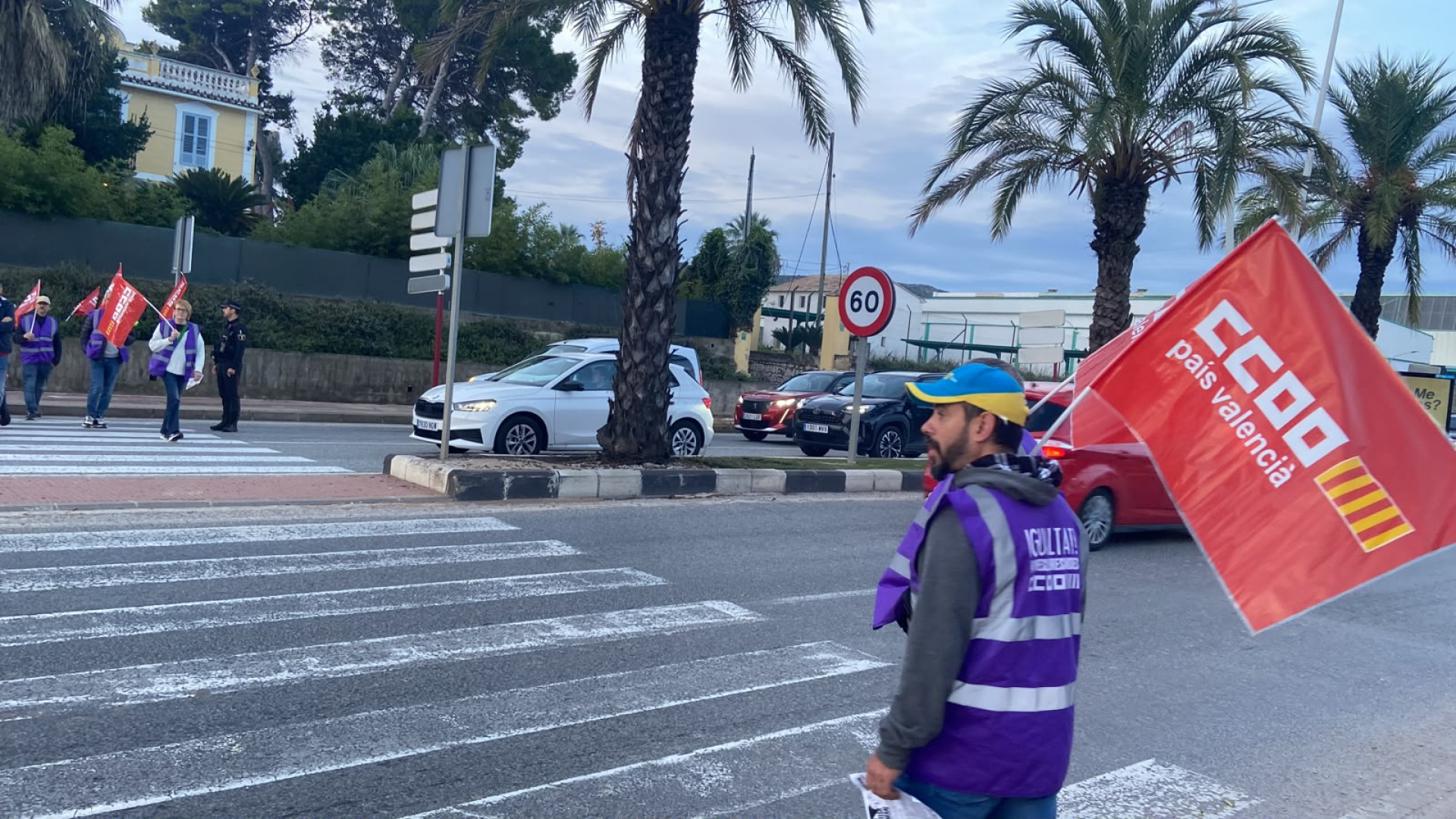
A general strike across the Marina Alta region caused traffic delays and intermittent road cuts in Dénia on 11 November 2026 as trade union pickets gathered at the main entrance to the town under a special National Police deployment.
The day of industrial action began early in the morning with demonstrations and information pickets at several points across the coastal municipality, ahead of a main afternoon march scheduled to depart from Plaza Jaume I at 18:00.
Pickets accompanied by police officers staged intermittent traffic blockades along the main access route into Dénia during the morning rush. Dénia is a port city on Spain's Mediterranean coast in the province of Alicante and serves as the administrative capital of the Marina Alta district in the Valencian Community.
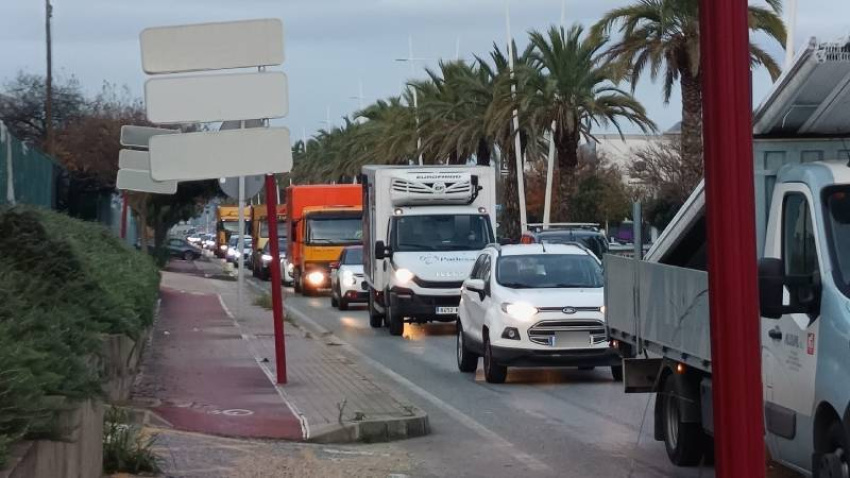
Union pickets at the Toyota roundabout
Pascual Industria, the regional representative for the Comisiones Obreras trade union confederation in the Marina Alta, told local radio station COPE Dénia Marina Alta that union members had positioned themselves near the municipal funeral home and the Toyota roundabout at the entrance to the town.
Industria explained that the demonstrators were repeatedly walking across the pedestrian crossing at the junction to raise visibility for the strike and hold up passing traffic. He added that many motorists passing through the area were showing support for the strikers and said the morning protests were proceeding smoothly.
Comisiones Obreras, commonly known as CCOO, is one of the largest trade union confederations in Spain. COPE, or Cadena de Ondas Populares Españolas, is a major Spanish national commercial radio network that operates a local broadcaster serving Dénia and the wider Marina Alta district.
Union organisers planned to move the information pickets to additional sites around Dénia over the course of the morning. Industria noted that other groups were carrying out parallel actions across the town and said pickets did not rule out travelling to Dénia Hospital later in the day.
National Police deployment and strike rights
To maintain public order and normal activity during the walkout, the National Police station in Dénia launched a dedicated policing operation across the municipality. The National Police Corps, or Cuerpo Nacional de Policía, is Spain's state civilian police force responsible for law enforcement and public safety in urban centres.
Chief Inspector Carlos Nieto, who heads the Dénia National Police station, said the special deployment had a dual objective. He stated that officers were on the streets both to protect workers exercising their constitutional right to strike and to safeguard employees choosing to go to work.
Nieto emphasised that nobody can force an employee to take part in a strike. He pointed out that the legal role of information pickets is strictly to inform workers and the public about the industrial action rather than to obstruct access.
Under Spanish labour law and the 1978 Constitution, workers hold both the right to strike and the right to work. Information pickets are permitted to publicise a walkout and explain union demands peacefully, provided they do not use coercion or intimidation to stop others from working.
Nieto added that National Police officers would remain on duty across Dénia throughout the day to ensure that both rights could coexist peacefully for the duration of the general strike.
Evening demonstration at Plaza Jaume I
Alongside the morning traffic protests at the entrance to the town, union organisers scheduled further picket activity at prominent local sites including Torrecremada, a large municipal park and public grounds area, and the Glorieta del País Valencià, a central square in the heart of Dénia.
The central event of the general strike was called for the evening, with a public demonstration set to begin at 18:00 from Plaza Jaume I, one of Dénia's main public squares.