

Chinese carmakers are establishing assembly operations in Spain to evade European Union import tariffs after flooding the European market with 34 separate brands.
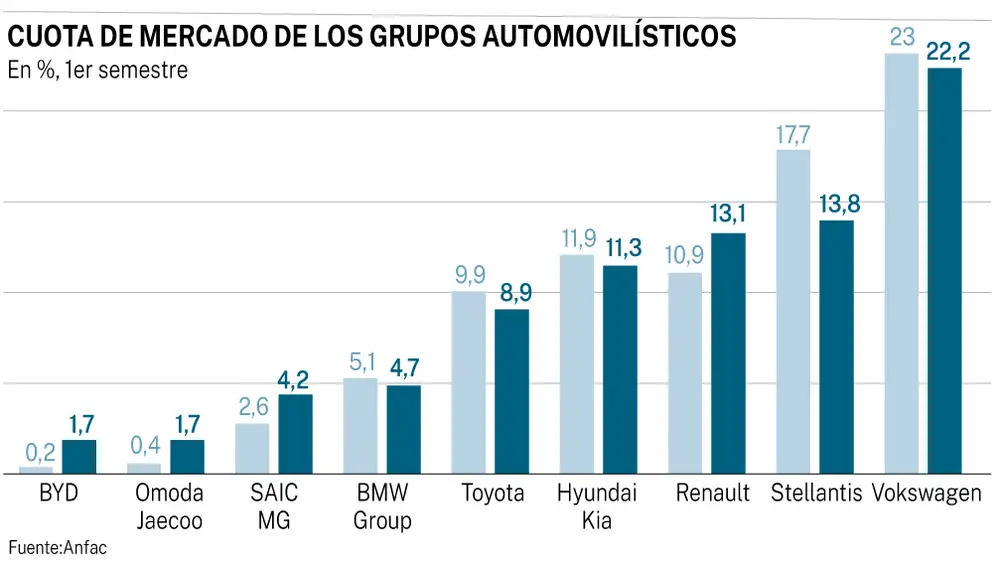
During 2025 and the first half of 2026, the arrival of new automotive brands from China multiplied across the country. By the end of July 2026, those 34 manufacturers had registered a combined 110,406 vehicle units in Spain.
The registrations represent nearly 15 percent of Spain's total automobile market. That figure excludes established European brands owned by Chinese parent companies, such as Volvo, Lynk & Co, and Polestar.
The drive into European markets follows a sharp economic downturn in China that severely depressed domestic automobile sales. A study by Swiss investment bank UBS revealed that car sales in China dropped by approximately five million units last year.
In response to slowing domestic demand, the Chinese government ordered carmakers not to close factories within China. Authorities instructed manufacturers to export surplus vehicles worldwide and backed the push with financial subsidies.
The influx of low-priced Chinese vehicles into Europe triggered complaints from European competitors, who argued that subsidized pricing violates free-market principles.
Impact on European Automakers
Facing rapid market share losses to low-cost imports, major European vehicle manufacturers have launched widespread restructuring programs. Volkswagen announced the most severe cutbacks, planning to eliminate roughly 100,000 jobs.
BMW and Mercedes-Benz are evaluating smaller workforce reductions, while luxury sportscar maker Porsche confirmed plans to eliminate more than 5,000 positions.
European Union policies favoring electric vehicles have aided Chinese manufacturers, who dominate battery production and hold direct access to critical rare earth minerals.
European carmakers face steep financial penalties under Brussels CAFE emission regulations if they fail to meet stringent pollution reduction goals. However, consumer demand for electric cars remains weak, with pure electric models accounting for only about one in 10 registrations in Spain.
Assembly Strategy to Bypass EU Tariffs
To protect domestic industry and employment, the European Union imposed tariffs on imported Chinese electric vehicles. Chinese manufacturers countered by signing partnership agreements to utilize underused European assembly plants.
Under these agreements, major vehicle components are manufactured in China and shipped abroad. European factories complete final assembly on standard parts, allowing finished cars to clear factory gates as European products and avoid import duties.
This assembly model is expanding across several industrial hubs in Spain. Leapmotor vehicles will be assembled at the Stellantis plant in Figueruelas, Zaragoza, alongside Opel and Lancia models. Geely paid Ford 221 million euros for a 34 percent stake in facilities at the Almusafes plant in Valencia to produce up to 100,000 cars, though specific models and local component ratios remain unconfirmed.
In Barcelona, Chery is utilizing former Nissan facilities in the Zona Franca to assemble Ebro vehicles from components imported entirely from China. In Linares, a similar project is preparing to assemble Chinese pickup trucks at former Santana facilities.
SAIC Plant Proposal Raises Security Questions
The latest project involves SAIC Motor, the corporate owner of the MG brand, which proposed building a new assembly plant in Ferrol, Galicia. Promoters claim the facility will generate over 2,000 jobs and produce 120,000 vehicles annually.
SAIC allocated a budget of 200 million euros to develop a 70,000-square-meter site on former Amper land. Industry analysts noted the budget is far too small to construct a full manufacturing facility comparable to the nearby Stellantis plant in Vigo. Construction is scheduled to begin in 2027, with operations planned before the end of 2028.
SAIC Motor is controlled by Shanghai public authorities, which hold a 63.7 percent equity stake. Unlike private firms such as BYD or Geely, Chinese law requires Communist Party committees to operate within SAIC's corporate structure and participate in strategic decisions.
Established in 1955, SAIC partnered with Volkswagen in the 1980s to produce the Santana luxury sedan in China and later created joint ventures with General Motors. Its primary brand in Europe is MG, a historic British manufacturer named Morris Garages that went bankrupt before being purchased by Chinese investors. SAIC also operates the Maxus, Wuling, and Baojun brands.
SAIC operates in around 170 countries with more than 3,000 overseas dealerships and total foreign sales exceeding seven million vehicles. In May 2026, SAIC became the first Chinese automaker to surpass 100 million total vehicles produced. Last year, the group sold 4.5 million vehicles globally, up 12.3 percent, with overseas sales rising over three percent to surpass one million units.
Brussels imposed an additional 35.3 percent tariff on SAIC imports, the highest rate applied to major Chinese automakers, citing distortive public subsidies. Although SAIC previously stated it would not target Western markets until dominating domestic sales, MG has become its primary European growth driver.
The Ferrol plant project has drawn national security scrutiny due to its location near a Spanish naval base and Navantia shipyards. Intelligence and defense reports warned of potential espionage risks, as the proposed site sits adjacent to military facilities handling sensitive United States military technology.