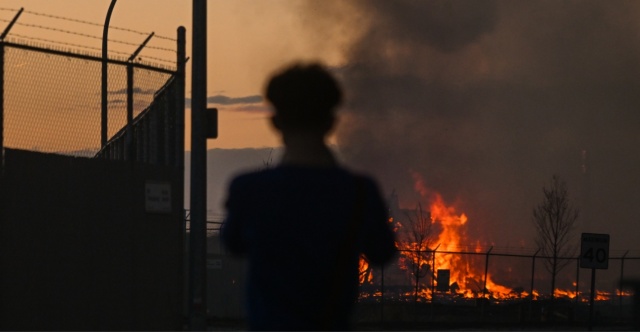

Police arrested around 20 people in Bilbao after masked youths torched vehicles and clashed with officers following the cancellation of an event by Vito Quiles.
The Basque regional security minister, Bingen Zupiria, confirmed that approximately 20 individuals were detained during the disturbances, noting that several of those taken into custody were minors.
According to the Spanish news website eldiario.es, the unrest began in the Deusto district near the local university before spreading to other parts of the city, including the area surrounding the Iberdrola Tower.
Bilbao is the largest city in the Basque Country, an autonomous community located in northern Spain, and serves as the economic hub of the province of Biscay. The Deusto neighbourhood sits on the right bank of the Nervion estuary, while the 165-metre Iberdrola Tower stands as the tallest skyscraper in the city.
Street fires and property damage
Tensions in the neighbourhood began escalating at approximately 18:30 local time, when groups remained in the area where earlier protests against the visit by Quiles had occurred.
Shortly after 19:15, dense smoke and flames rose above Jose Antonio Agirre Avenue, where demonstrators constructed barricades using street rubbish bins.
Crowds launched flares into the street as parked cars caught fire along the thoroughfare. Demonstrators also seized a Municipal Police motorcycle and incorporated it into an improvised barricade before setting it alight.
In Spain, municipal police forces operate under the authority of city halls to handle local traffic and urban bylaws, frequently working alongside regional police during major disturbances.
Firefighters deployed across the district to extinguish a succession of blazes that broke out along the avenue. Authorities also received reports of attacks on commercial premises and the looting of shops in the surrounding streets.
Police redeployment and union criticism
Riot squads from the Basque police force, known as the Ertzaintza, redeployed to the Deusto area at about 19:40 to disperse the crowds and restore order. Officers carried out nine initial arrests by 20:15, with the total number of detentions rising gradually to around 20 as the operation continued.
The Ertzaintza is the autonomous police force established for the Basque Country under Spain's regional governance system, operating alongside municipal police forces to oversee public safety, traffic and regional security.
The handling of the police response sparked criticism after units that had been deployed on a preventative basis were withdrawn from certain positions shortly before the most serious rioting began.
The police union Erne condemned the withdrawal decision, arguing that the cancellation of an event did not mean that the threat of violence had passed. The union demanded formal explanations from regional political leaders, pointing out deficiencies in the timely delivery of information to officers on the ground.
Basque government reaction and claims
The Basque Ministry of Security said that a group of individuals who had assembled to protest against the presence of Quiles marched directly toward the Deusto police station, pelting the building with stones and causing property damage.
Regional officials confirmed that Quiles had notified authorities in writing of the cancellation of his event at 16:06, several hours before the clashes reached their peak. The Basque government assessed that the disturbances were pre-planned with the deliberate intention of provoking violence.
The president of the Basque autonomous government, Imanol Pradales, condemned the violence and pointed to widespread damage caused by organised groups. Pradales said the unrest caused him deep concern, describing the behaviour as intolerable and unacceptable, and stated that enough was enough, while emphasising that hundreds of local citizens had previously taken part in peaceful demonstrations.
The title of Lehendakari designates the president of the Basque regional government, who leads the executive branch in the autonomous community under powers devolved by the Spanish constitution.
The mayor of Bilbao, Juan Maria Aburto, described those who took part in the destruction as fascists. Maria del Rio, a spokeswoman for the Basque pro-independence coalition EH Bildu, also condemned the violence, making clear that the pro-independence left rejected the destructive incidents that followed the peaceful protests.
EH Bildu is a left-wing coalition that campaigns for Basque independence and holds seats in the Basque regional parliament as well as the national Congress of Deputies in Madrid.
Student protests and university closure
The evening riots followed two large anti-fascist rallies staged in Bilbao earlier in the day, with thousands of university students and other demonstrators taking to the streets. Demonstrators accused Quiles of promoting far-right, racist and sexist views.
Vito Quiles is an activist, political campaigner and online commentator known in Spain for his association with right-wing causes and media platforms, having previously generated controversy through confrontations at public events and political press conferences.
The University of Deusto suspended all academic activities from 14:00 and closed its campus facilities at 15:00 as a precaution, following recommendations issued by police forces. The university clarified that it had no involvement in organising or staging the cancelled event.
Founded in 1886 by the Society of Jesus, the University of Deusto is one of the oldest private universities in Spain, with its historic main campus situated directly across the river from the Guggenheim Museum Bilbao.