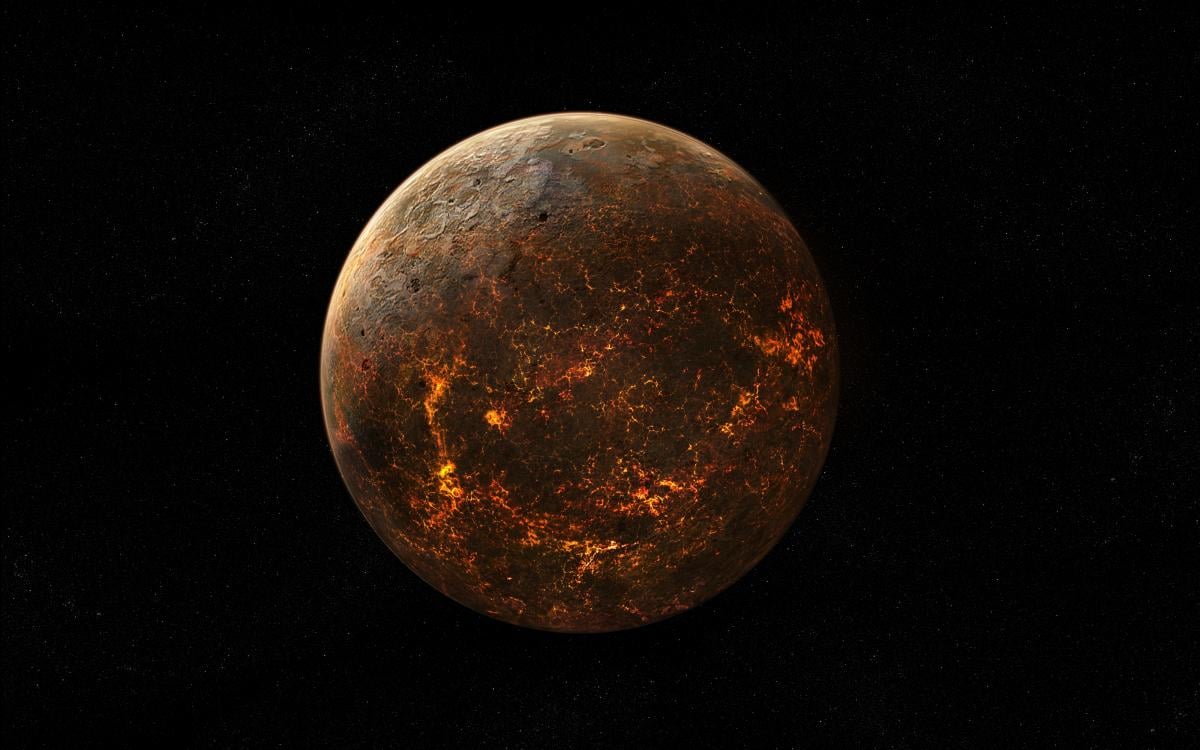
Astronomers have for the first time watched a giant exoplanet appear to disappear from view, according to a report by Popular Science. The planet, TOI-2535 b, nicknamed a "hot Jupiter", did not evaporate in the vacuum of space, scientists said.
Instead, gravitational pull from a close neighboring planet caused TOI-2535 b to wobble on its orbit, the same dynamic that underlies solar and lunar eclipses on Earth, researchers said.
Samuel Yee, an astronomer at the University of California, Los Angeles and a co-author of the new study, said people tend to picture the universe as a clockwork mechanism in which everything happens according to fixed rules, but that this is not the case. When a system contains several planets, he said, they can affect each other's orbits.
TOI-2535 b sits roughly 1,000 light-years from Earth and belongs to a class of worlds known as hot Jupiters, giant, Jupiter-like planets that orbit extremely close to their host stars. Astronomers began studying it in April 2019 using NASA's Transiting Exoplanet Survey Satellite, or TESS, a space telescope that finds distant planets by detecting the faint dimming they cause as they cross in front of their stars.
In some ways TOI-2535 b resembles the largest planet in our own solar system, but it circles its star even closer than Mercury orbits the Sun. Mercury takes 88 days to complete one orbit, while TOI-2535 b does so once every 8.25 days.
Irregular transits
While observing TOI-2535 b, scientists noticed its transits were not occurring on a predictable schedule. The dimming caused by the planet passing in front of its star could happen up to six hours earlier or later than expected.
Researchers now believe TOI-2535 b is not alone. They say it has an incredibly close neighbor, a gas giant on a comparatively tilted orbit. The gravitational interaction between the two planets makes them wobble like a pair of spinning tops, the scientists said, eventually knocking each other out of equilibrium.
Our own solar system's fate
Scientists have separately said the solar system could lose its stability much sooner than previously predicted. According to new work by researchers at the California Institute of Technology, the outer planets could be pushed off their orbits roughly one billion years after the Sun turns into a white dwarf.
Astronomer Konstantin Batygin and his team ran 672 computer simulations and identified a mechanism that had previously been underestimated. They found that near the end of its life, the Sun will swell into a red giant and shed its outer layers, likely not in one smooth burst but in roughly 4,600 separate ejections. Each ejection, the researchers said, would carry a mass of about one ten-thousandth of the Sun's original mass.