

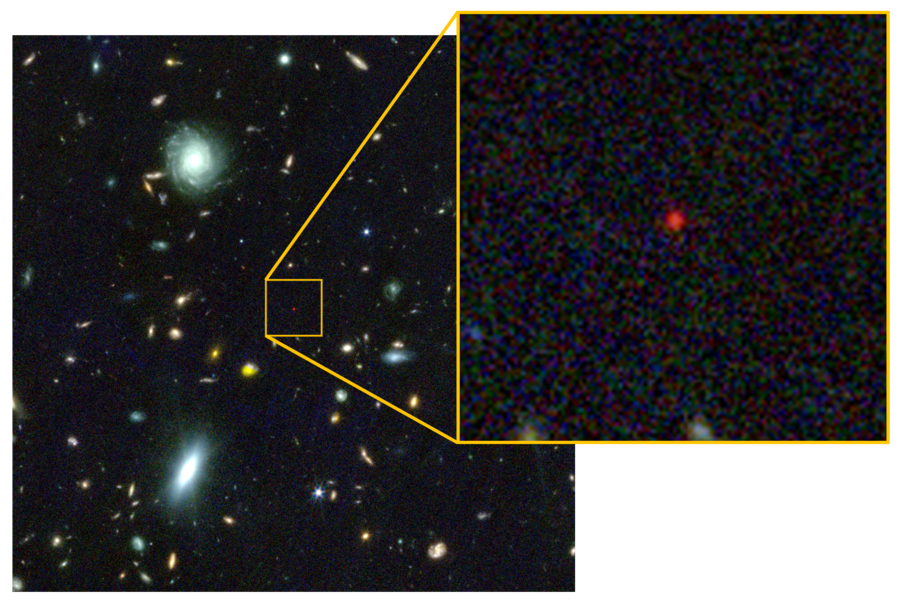
Astronomers using the James Webb Space Telescope have identified a new kind of celestial object dubbed a "black hole star," dating to the early universe, according to a study published in the journal Nature.
The object, named MoM-BH-1, is roughly the size of the entire Solar System and releases about 100 billion times more energy than would be possible for an ordinary star, the researchers reported. Its energy output resembles what a black hole can generate, and the object carries an estimated mass 100,000 times that of the Sun.
According to the study, the object was observed when the universe was only a few hundred years old, a brief span on a cosmic scale and not long after the Big Bang.
The James Webb Space Telescope, a joint project of NASA, the European Space Agency and the Canadian Space Agency, is built to capture light from some of the earliest galaxies and stars in the universe's history.
The star carries a large red patch, which scientists say is most likely explained by a merger between a black hole and a star, a phenomenon that had never been observed before.
According to the Massachusetts Institute of Technology (MIT), the object is probably an extremely dense cloud of gas, powered not by conventional nuclear fusion but by a black hole at its center.
Rohan Naidu, a NASA Hubble Fellowship Program fellow and Pappalardo Fellow at MIT's Kavli Institute for Astrophysics and Space Research (MKI) and the lead author of the study, told MIT that understanding of the object was evolving very rapidly. He said small red dots like this one seemed to be everywhere in the early universe but essentially disappeared in the present day.
How the Object Was Found
The researchers were not originally looking for a black hole star. They were searching for more distant, older galaxies as part of a survey called MoM, short for Mirage or Miracle, which aims to find galaxies that formed shortly after the Big Bang.
While analyzing James Webb images gathered for the MoM survey, the scientists noticed an unusually bright, deep red point of light.
Robert Simcoe, director of MKI and a co-author of the study, explained that when astronomers see something very red in the universe, they often assume it is surrounded by dust, such as soot or ash. He compared this to how smoke from wildfires in Canada recently turned the sky over Boston an intense red, noting that astronomical objects can likewise appear redder than their true color when viewed through a layer of dust.
The light coming from the red point contained almost no trace of metals or any elements besides hydrogen and helium, the researchers said.
Testing the Red Point
To understand how the red point had formed, the researchers ran simulations of various scenarios to determine which combination of astrophysical features could produce the red glow surrounding the star.
The simulations suggested the point could be a source of energy extremely dense in hydrogen, though that alone did not explain why it was so bright.
The researchers concluded that the hypothesis closest to the truth was that the red point is what makes the star a kind of black hole.
First of Its Kind
The team named the object MoM-BH-1, after the survey that detected it, and nicknamed it "black hole star one," implying it is the first of many similar objects still to be identified. The researchers suspect that black hole stars could explain many of the other small red dots that have appeared in James Webb images, though they note those objects are not as bright as MoM-BH-1.


