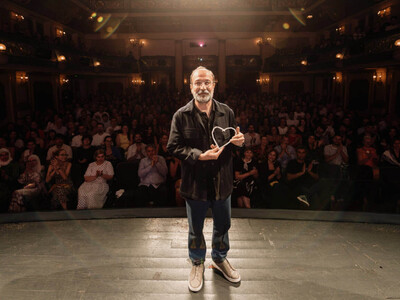
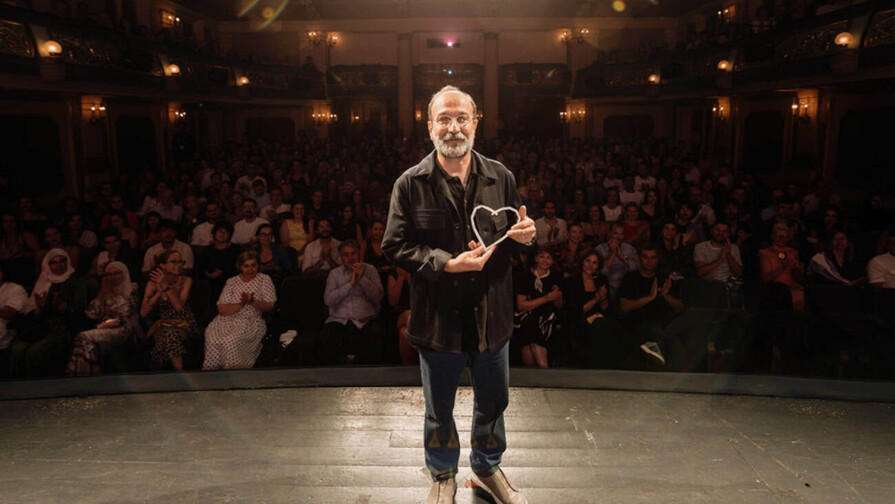
Iranian filmmaker Asghar Farhadi received the Honorary Heart of Sarajevo award at the National Theatre of Sarajevo during the city's 32nd film festival.
Festival director Jovan Marjanovic presented the award during a ceremony honoring the two-time Academy Award winner for his contributions to contemporary cinema.
Farhadi described the recognition as especially meaningful and expressed his gratitude to festival organizers. Upon receiving the honor, he said it was a great moment for him.
During the ceremony, Marjanovic highlighted Farhadi's distinct approach to storytelling. He said that while some filmmakers construct their movies around extraordinary events, Farhadi accomplishes something perhaps even more difficult by finding extraordinary drama within daily life.
Marjanovic explained that Farhadi builds much of his filmography from seemingly ordinary situations, such as a marriage, a family, a misunderstanding, or a decision that initially seems minor. These situations, he noted, ultimately reveal complex human conflicts and unexpected consequences.
The festival director also praised the precision with which Farhadi develops his narratives. He said Farhadi's films raise profound questions about truth, responsibility, dignity, family, and the difficult choices people face when no perfect solution exists.
International recognition and narrative approach
Farhadi stands among Iran's most internationally celebrated filmmakers. He won the Academy Award for Best Foreign Language Film for A Separation, which became the first Iranian production to earn an Oscar.
He later secured a second Oscar for The Salesman, solidifying a body of work that includes About Elly, The Past, Everybody Knows, and A Hero. His film A Hero received the Grand Prix at the Cannes Film Festival, while several of his other productions have been featured and awarded at major international festivals.
Farhadi's cinema is characterized by characters confronting ethical and social dilemmas without simple answers or absolute declarations of who is right. Farhadi explained that he does not want to tell audience members what to think, but instead aims to give them sufficient reasons to draw their own conclusions.
Childhood memories and path to cinema
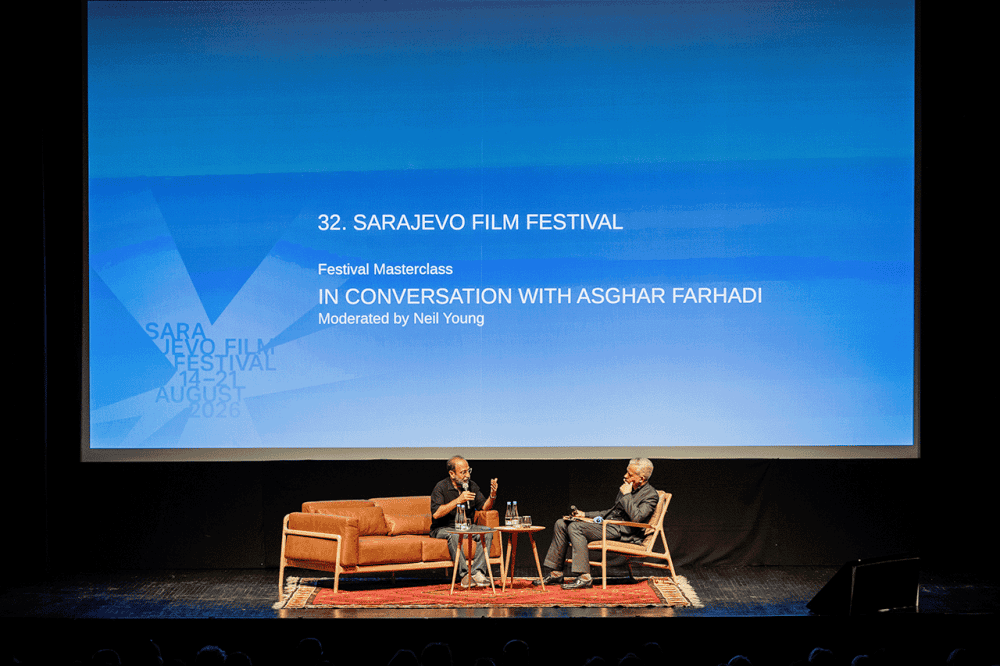
Farhadi reflected on his early life and career during a masterclass at the Bosnian Cultural Center. He recalled that his connection to movies began in childhood while growing up in a small Iranian town that had no movie theater.
He and his friends would secretly travel by bus to a nearby town to try to watch films. However, the bus almost always arrived late, leaving seven-year-old Farhadi to see only the final portions of the movies.
Farhadi explained that this limitation ultimately fueled his imagination. Not knowing what had happened earlier in the film, he began imagining the storylines that led to those endings, an experience he later realized shaped his overall approach to narrative storytelling.
Following the Iranian Revolution, when access to foreign films was restricted, television served as his primary window into international cinema. Early in his professional career, Farhadi wrote a radio play primarily because he needed money. That work led to writing television scripts before he made his transition into feature filmmaking.
Filmmaking philosophy and emotional storage
During the masterclass, Farhadi explained that life experiences remain stored inside people and later emerge in their stories. He said everyone carries an emotional bank inside, where childhood experiences, encounters, images, and feelings accumulate to feed the creative process.
He also cited the influence of his grandfather, whom he viewed as a hero who could transform any situation into a story. Farhadi said telling stories became his way of expressing himself, leading him to direct his first short film at the age of 13.
A central concept in Farhadi's work is his rejection of stories where the director instructs the audience on who is good and who is bad. During the event, he stated that life is not linear but layered, describing how experiences build up within individuals over time.
He explained that his goal is for viewers to actively participate in interpreting events and evaluating character decisions. This philosophy is evident in A Separation, which was screened at this year's Sarajevo Film Festival. The story begins with a marital crisis and expands into a complex drama touching on social class differences, responsibility, faith, parenthood, and truth.
Directing children and festival details
Farhadi also discussed one of the most demanding aspects of his work: directing child actors. He explained that children serve a crucial dramatic function in his movies because they observe everything happening around them, thereby intensifying the conflict within the story.
The tribute to Farhadi formed part of the special Tribute To program at the 32nd Sarajevo International Film Festival, held from August 14 to August 21, 2026, in Sarajevo, the capital of Bosnia and Herzegovina.
The annual festival features competitive sections for feature films, documentaries, short films, and student films, with entries vying for Heart of Sarajevo awards. The retrospective honoring Farhadi concluded with a special screening of A Separation, celebrating a director who turns everyday conflicts into stories about human decision-making.