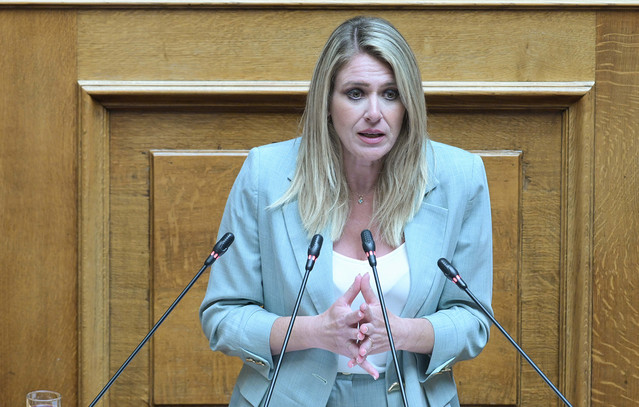
Greek Deputy Labour Minister Anna Efthymiou has presented a major social security reform bill to the Hellenic Parliament in Athens, aiming to expand occupational pension funds and boost long-term worker savings.
Addressing the parliamentary plenary during debates on the legislation, Efthymiou said the reform creates a flexible, reliable, and tax-attractive framework for the second pillar of Greece's pension system. She told lawmakers that occupational insurance currently covers less than five percent of the Greek workforce, while fund assets equal roughly one percent of national gross domestic product.
Under the proposed law, the government aims to increase future retirement income for employees and generate new domestic capital to support economic growth. Efthymiou rejected opposition claims that the initiative undermines state pensions or worsens social inequality, arguing instead that it broadens financial security for workers, freelancers, and businesses.
Low Coverage and Three Key Objectives
Greece's social security architecture relies on three pillars, with the second pillar consisting of workplace and occupational pension funds managed separately from the state system. Efthymiou noted that current figures include all four mandatory occupational insurance funds, highlighting the need for structural change to broaden access.
She explained that the ministry established three main goals when drafting the legislation: improving the existing framework, expanding access to occupational insurance, and conveying a government message of stability and opportunity for younger generations. She expressed confidence that the final bill fully satisfies all three objectives.
The minister referenced Law 5078/2023, for which she previously served as parliamentary rapporteur. She said two years of practical application provided valuable data to evaluate past changes and identify necessary corrections. That 2023 law modernized occupational funds, improved member transparency, and transferred all supervisory authority over occupational funds to the Bank of Greece, the country's central bank.
Broad Consensus and EU Law Alignment
Efthymiou told the assembly that the new bill comes to a vote following extensive deliberations within the parliamentary committee and after consultations with social partners and industry representatives. She stated that more than 90 percent of proposals submitted by stakeholder groups during public consultation were incorporated into the final text.
The reform is fully aligned with European Union law and strengthens occupational insurance as a complementary retirement benefit, Efthymiou said. She added that the framework provides companies with an effective tool to recruit and retain staff while strengthening the overall resilience of the national welfare system.
To establish equal operating conditions across the second pillar, the legislation introduces the Open Group Occupational Pension Insurance Product, known by its Greek acronym OAPES. This new vehicle operates similarly to open occupational funds, fulfilling a government pledge to equalize rules for occupational funds and corporate group pension plans.
Supervision and Worker Protection
Regulatory oversight of both occupational funds and OAPES products will remain with the Bank of Greece. Efthymiou explained that central bank supervision will focus on asset adequacy, product distribution under EU rules, and mandatory transparency standards for fund members.
The bill also grants regulators expanded intervention powers if a pension fund or insurance scheme fails to perform according to projected targets. Efthymiou stressed that combining regulatory flexibility with robust supervision will ensure strong protection for policyholders.
To address concerns over social inequality, Efthymiou emphasized that open occupational funds will be allowed to function as umbrella funds. This structure will permit smaller businesses, self-employed professionals, and independent contractors to join schemes previously accessible only to large employers.
The legislation introduces individual and group portability rights, allowing workers to transfer accumulated pension rights when changing jobs. Efthymiou said portability ensures that retirement savings follow workers across an increasingly flexible labor market.
Tax Incentives and Support for State Pensions
Tax incentives under the new framework will be linked directly to retirement ages of 62 and 67. Efthymiou stated that these age thresholds are designed to reinforce the role of occupational plans as true long-term retirement products rather than short-term savings vehicles.
Addressing criticism regarding public pensions, Efthymiou affirmed that state support for the mandatory first pillar remains an unshakable priority. She highlighted government employment policies that created more than 563,000 new jobs, with targeted measures for young people, women, individuals with disabilities, and older workers.
She also cited reforms enabling retirees to work legally, noting that approximately 300,000 working pensioners have registered on the online portal of EFKA, Greece's primary public social security agency. Efforts to combat contribution evasion were boosted by the Digital Work Card, which logged 2.7 million additional overtime hours in 2025 compared to 2024, alongside digital upgrades to EFKA's operational systems.
Economic Impact and Relief for Pensioners
Efthymiou argued that expanding long-term savings will benefit the broader economy by building a larger pool of domestic capital for investment, job creation, and sustainable economic growth. She added that stronger second-pillar funds will fortify the financial stability of the entire social security network.
Concluding her address, the deputy minister highlighted wider government measures for retirees, including the abolition of cuts to survivor pensions. She described that action as a restoration of social justice, while reaffirming that the historical pension calculation adjustment known as personal difference will be permanently eliminated starting January 1, 2027.
Efthymiou urged members of Parliament to pass the bill, stating that the government is attempting to build the second pillar of the future while delivering perspective for younger generations and demonstrating broad political consensus.