

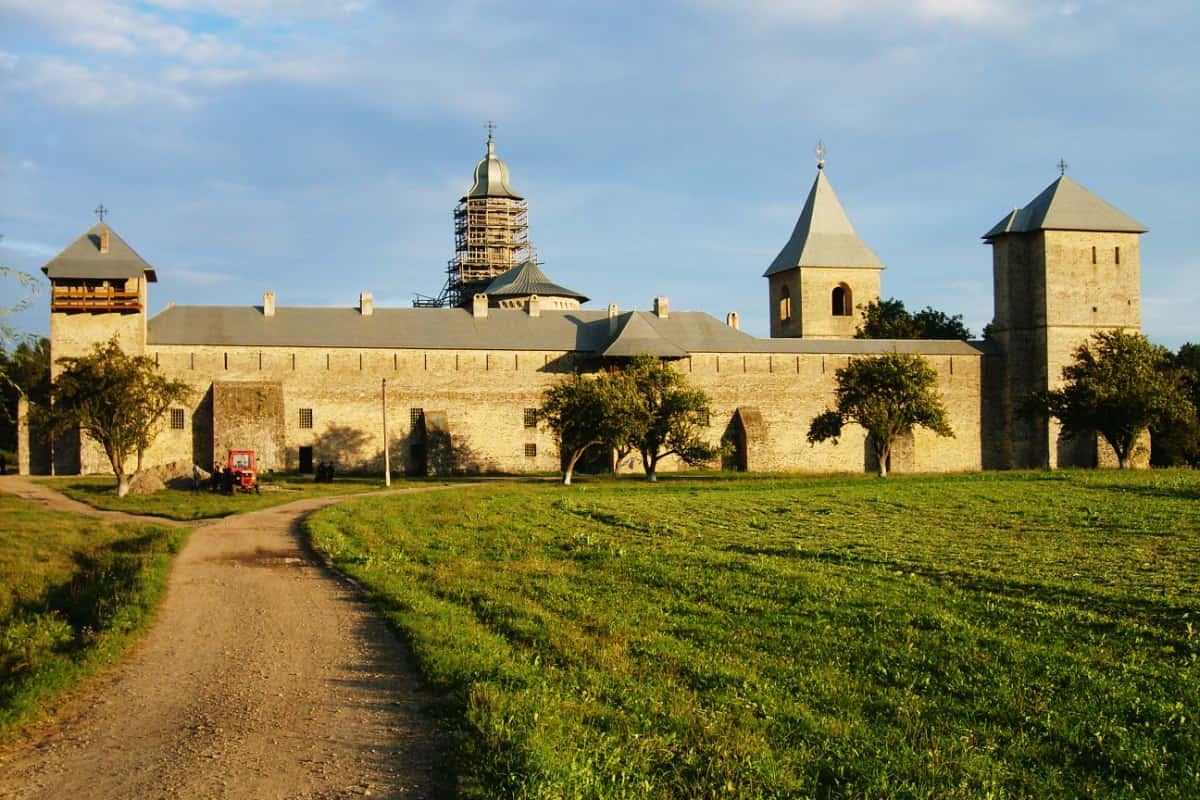
An ancient stone slab dating back more than 2,200 years has been discovered embedded in the main porch floor of Dragomirna Monastery in northern Romania.
The carved artifact features ancient Greek lettering and three laurel wreaths, according to Romanian news outlet EVZ. Historians believe the slab was originally created during the Hellenistic era around the 3rd century BC.
The monastery was established between 1602 and 1609 near Suceava in the historical region of Moldavia, founded through the efforts of Metropolitan Anastasie Crimca. Positioned along active trade routes, the religious site accumulated numerous historical relics over the centuries, though researchers noted that the floor discovery surprised even experienced specialists.
Deciphering the Ancient Decree
Scholars first published a decipherment of the stone text in March 1885 in an epigraphy journal in Leipzig, Germany. Epigraphy is the scientific discipline dedicated to studying inscriptions carved on stone, metal, and other durable materials.
The inscription is written in the Ionic Attic dialect of Ancient Greek, which was spoken in classical Athens and Ionia. Epigraphists classify the stone slab as a telamon, referred to in Latin as a stele.
The text contains a formal legislative decree known as a psephisma that granted proxeny. While the term proxenos means consul in modern Greek, proxeny in antiquity was a high form of honorary citizenship granted by one Greek city to a resident of another town.
Honouring a Visitor from Byzantium
The inscription identifies the recipient as the architect Epicrates, son of Nicobulus, from Byzantium, the ancient Greek city where Constantinople and modern Istanbul later arose. However, the name of the specific city that issued the decree was worn away on the damaged stone.
The text was published in Romania by Grigore Tocilescu in 1887. In the 1950s and 1960s, historian D. M. Pippidi proposed that Epicrates received his citizenship from either Istros or Tomis, two Greek colonies on the Black Sea coast.
Both Istros and Tomis were founded as colonies by Miletus, an ancient Greek city in western Asia Minor, during the 7th and 6th centuries BC. The text on the Dragomirna slab closely matches the style of other official decrees originating from those settlements.
War and Construction on the Black Sea
During the 3rd century BC, Byzantium and the nearby city of Callatis went to war over control of the trade center at Tomis, which was not yet a fully developed city. Istros intervened in the conflict, either to assist Callatis or to protect Tomis, which historians believe Istros may have founded.
EVZ reported that Epicrates likely traveled to the area on official business. Experts suggest he may have arrived during the conflict to offer architectural services, potentially helping to rebuild structures damaged by military actions.
How the stone slab traveled to Dragomirna Monastery remains uncertain. A version described in the report suggests traveling monks or merchants brought the stone from Dobruja to Moldavia. Alternative possibilities suggest the stone first reached Brăila or Galați before being moved to Suceava and the monastery, where builders were struck by its appearance and placed it in the floor.
Related Archaeological Findings
The report also noted separate archaeological discoveries in North America, where stone tools four times older than the Great Pyramid of Giza were uncovered in Oregon rock shelters beneath volcanic ash. Two tools made of orange agate, one bearing traces of bison blood, were found deeper than 18,250 year old camel and bison remains, suggesting humans lived in North America earlier than previously estimated.


