

The United States midterm elections are approaching, and this time the worry among many local officials goes beyond isolated attempts at voter intimidation or conspiracy theories about ballot boxes. In several states, officials are already drafting emergency plans for a possible confrontation with federal agencies or interference that could affect the conduct and certification of the vote.
At the center of that concern is President Donald Trump and his administration's clashes with state and local officials over issues ranging from mail-in voting and citizenship checks to the presence of federal agents near polling places. Tension has grown as election day nears, with some states already sending ballots to voters.
From armed observers to fears of ICE and troops
In 2022, groups of activists appeared near ballot drop boxes in suburbs of Phoenix, Arizona, wearing body armor, covering their faces and carrying weapons at their waists. The groups filmed citizens as they voted, until a federal judge imposed restrictions, ruling that armed observers had to keep their distance so voters would not be intimidated.
Four years later, prosecutors and election officials in various states are preparing for different kinds of scenarios. In Pima County, Arizona, District Attorney Laura Conover has already prepared legal documents so she can appeal directly to the Department of Justice if she believes illegal interference is being attempted in the process. She said that when it comes to election preparation, her office is operating at an intense pace.
Calls for ICE presence at polling places
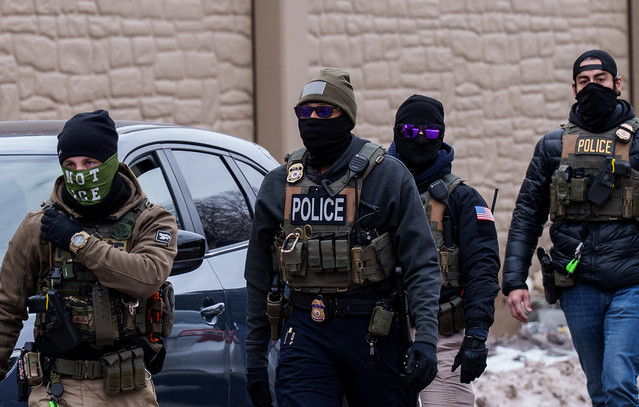
Particular alarm has been caused by discussion of a possible presence of agents from Immigration and Customs Enforcement, or ICE, near polling centers. Former Trump adviser Steve Bannon has publicly called for a stronger ICE presence at polling stations, saying such a presence should be intimidating to those in the country illegally.
Similar comments have come from Republican candidates in key states, and the possibility of a National Guard presence has also been discussed. Federal law generally prohibits the deployment of troops or armed federal agents at polling sites, with certain limited exceptions. The Pentagon has said there is no plan to send troops to polling places or to seize ballots or election equipment.
Fears over seizure of ballots and voting machines
For some local officials, the most worrying scenario involves a possible seizure of ballots or voting machines by federal agencies. The concern is not considered purely theoretical, since Trump has said in the past that after the 2020 election he wished he had mobilized military forces to take possession of voting machines.
The FBI has previously obtained election material as part of investigations in states including Georgia and Arizona. The Department of Homeland Security has said, for its part, that ICE would only appear near a polling location if there were a specific warrant or a genuine threat.
A new fight over mail-in voting
A second major front concerns mail-in voting. The United States Postal Service has developed a new system for verifying envelopes and voter information, but a whistleblower complaint alleges that it was rolled out on an extremely tight timeline with limited testing. According to the complaint, a mismatch in a single voter's information could, under certain conditions, lead to the rejection of an entire batch of mail-in ballots.
The Postal Service rejects the characterization of a rushed process and says the system was developed with adequate safeguards. Implementation of the new rules remains the subject of litigation, with the Trump administration arguing that stricter checks are needed to protect mail-in voting.
The dispute over noncitizens on voter rolls
Another point of contention is the federal government's effort to strengthen checks for noncitizens on voter registration lists. Trump has repeatedly claimed that noncitizen voting is a serious problem, though independent research and court evidence have shown such cases to be extremely rare.
Election officials and voting rights organizations fear that stricter checks based on incomplete or outdated data could lead to the removal of legitimate voters from the rolls. The administration counters that its goal is to ensure the accuracy of voter lists and prevent ineligible individuals from taking part in elections.
The 'election emergency' scenario
Political and legal circles are also concerned about the possibility that Trump could try to use emergency presidential powers to intervene in election rules. Allies of his have publicly proposed declaring a state of emergency in order to restrict mail-in voting and impose mandatory proof of citizenship for voter registration.
Constitutional scholars note that the conduct of elections belongs primarily to the states and to Congress, not the president. Their concern, however, centers more on what could happen in the critical hours of an election before courts have time to intervene.
The final risk: refusal to certify results
The concern does not end when polls close. In recent years there have been dozens of cases of local officials refusing, or attempting to refuse, to certify election results, citing disputed claims of fraud or problems with voting machines. Such attempts have so far generally failed after court intervention.
Even when certification ultimately goes ahead, experts warn that public disputes raised by election officials themselves can erode citizens' trust in the process. In a country where control of Congress can be decided in just a handful of districts, the stakes are enormous. Those on the front lines of running elections say the challenge is not only to count every ballot correctly, but to convince the public that the count was fair.


