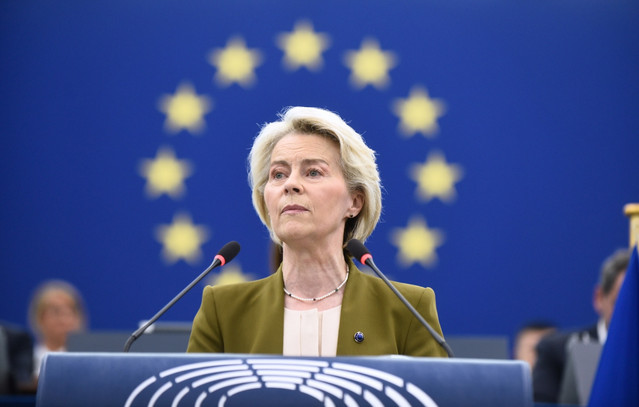
European Commission President Ursula von der Leyen told the European Parliament that soaring energy prices have added 100 billion euros in costs for Europe since late February.
Speaking to lawmakers ahead of the European Council summit on October 15 and 16, von der Leyen reported that natural gas prices have surged by 140 percent and diesel fuel costs have doubled over that period. She warned that businesses across the continent are operating under immense pressure while citizens struggle to pay their energy bills.
In response, she called for immediate support to help member states manage short-term price pressures alongside long-term structural reforms to strengthen European energy resilience. She stressed that because energy needs and national energy mixes vary widely across the 27-member European Union, no single uniform solution exists for the entire bloc.
To illustrate the market disparity, she noted that one megawatt hour of electricity can cost 145 euros in a country heavily dependent on natural gas, compared to just 70 euros in a nation with higher shares of nuclear power and renewable energy sources. A megawatt hour is the standard wholesale unit used to measure electrical energy production and consumption across utility markets. She said the role of European institutions is to equip member states with the tools and flexibility needed to respond effectively.
She also backed targeted relief for vulnerable households, highlighting energy voucher programs implemented in France and Romania as practical examples of immediate national assistance.
Supply measures and market intervention
Addressing global energy supply, von der Leyen announced that the Group of Seven industrialised nations agreed to make 100 million barrels of crude oil and diesel available to stabilize international markets. The G7 economic forum comprises Canada, France, Germany, Italy, Japan, the United Kingdom, and the United States, with representation from the European Union.
She stated that the European Union will extend regulatory flexibility regarding methane rules for energy exporters for an additional year. Methane is a potent greenhouse gas released during fossil fuel extraction and transport, and exporters must comply with strict monitoring standards. In addition, the bloc plans to initiate a strategic dialogue focusing on the operational challenges facing European oil refineries.
To maximize the EU's collective purchasing power, she announced the creation of a specialized task force to aggregate energy demand across member states. The initiative aims to coordinate joint energy procurements for member governments and secure better terms on international markets.
The European Commission functions as the executive arm of the European Union, responsible for proposing legislation and overseeing policy implementation, while the European Parliament acts as the bloc's directly elected legislative assembly. The upcoming summit of the European Council will gather heads of state and government in Brussels to set overarching political priorities during periods of economic disruption.
Long term transition and grid investments
Looking to long-term solutions, von der Leyen argued that Europe must reduce its structural reliance on imported oil and natural gas by accelerating the transition toward clean energy generated within the continent.
She pointed out that despite expanding renewable power generation, a significant portion of newly built capacity remains disconnected from power grids. High-voltage transmission grids transport electricity from power plants across long distances to local distribution networks. She called for urgent investments in European grid infrastructure to ensure clean power reaches homes and industrial centers where demand is highest.
The European Union is also aiming to expand direct electrification across industrial and residential sectors. The EU Electrification Action Plan projects a doubling of electricity's share in final energy consumption by 2040.
According to figures presented in her address and reported by the Athens-Macedonian News Agency (ANA-MPA), reaching that electrification target could reduce European fossil fuel import spending by 260 billion euros annually.