
Turkish President Recep Tayyip Erdogan has signed decrees establishing two marine protection parks in the Aegean Sea and Eastern Mediterranean, overlapping areas claimed by Greece.
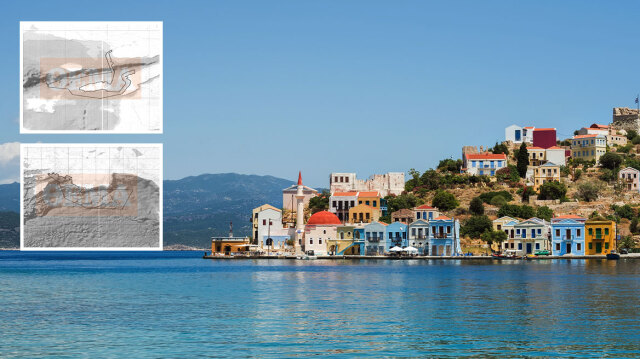
The presidential decrees, published on Saturday in the Turkish Official Gazette, set up one reserve between the Greek islands of Lemnos and Samothrace and a second expansive zone isolating Kastellorizo from Rhodes.
Ankara officially presented the measure as a step to protect the marine environment and preserve biodiversity. However, the designation moves to enforce Turkish territorial ambitions under its Blue Homeland doctrine across areas of Greek sovereign rights and un-demarcated continental shelf.
The newly declared boundaries completely overlap Greece's Maritime Spatial Planning framework, which Athens unveiled in 2025 ahead of its formal submission to the European Union. Turkey's decrees reflect its standing position that islands possess no maritime rights beyond a six-nautical-mile territorial sea, insisting instead on a median line drawn strictly between the two continental mainlands.
Boundaries in the North Aegean and Mediterranean
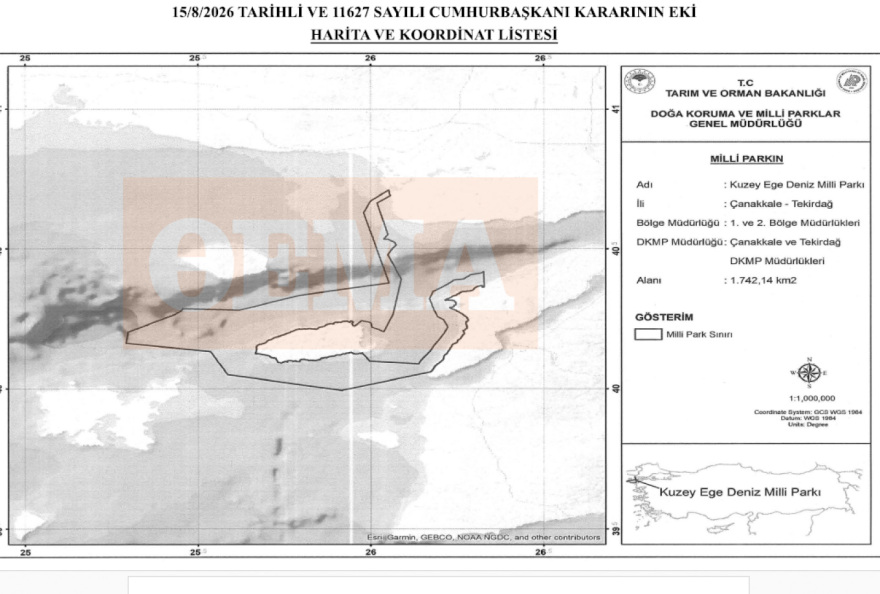
In the North Aegean, the Turkish reserve is positioned in international waters between Lemnos and Samothrace. This location covers seabed on the un-demarcated Greek continental shelf and reaches inside the potential 12-nautical-mile territorial sea limit of the neighboring Greek islands.
The North Aegean park alignment follows Turkish claims on the Greek continental shelf that date back to the 1970s, when Ankara first granted energy exploration permits to state oil firm TPAO in disputed maritime areas.
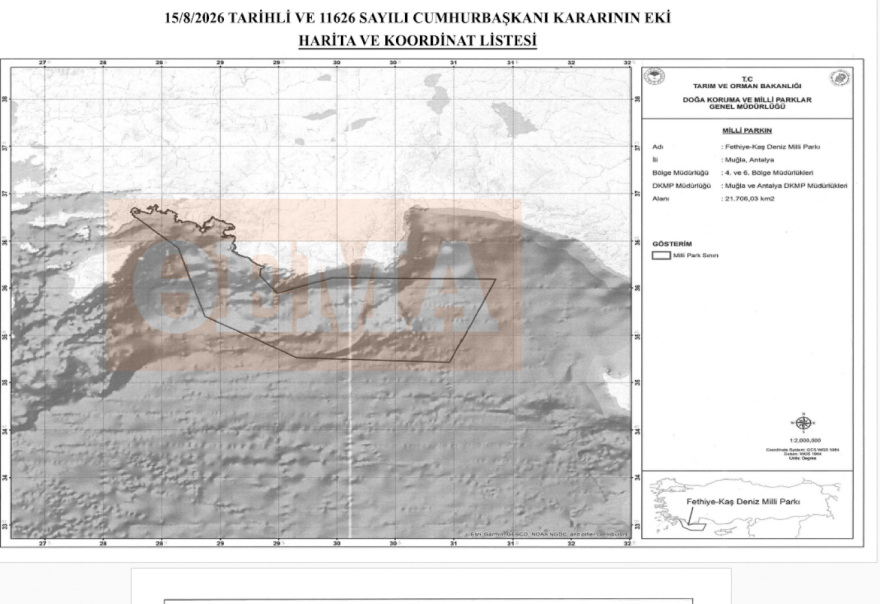
In the Eastern Mediterranean, the second Turkish park covers a vast area east of Rhodes up to Kastellorizo, restricting the small island to its existing six-nautical-mile territorial sea. Under the United Nations Convention on the Law of the Sea, international legal principles recognize islands as generating their own continental shelf and exclusive economic zones, a standard that Ankara rejects as a non-signatory.
Ankara's move is viewed as an effort to establish fait accompli maritime boundaries through environmental protection measures.
Maps published alongside the presidential decrees depict Turkish claims under the Blue Homeland doctrine. The official Turkish cartography omits border lines around Kastellorizo and other Greek islands entirely, omitting even their six-nautical-mile boundaries to reflect Ankara's view that no maritime borders exist in the Aegean Sea between Greece and Turkey.
Response to Greek environmental initiatives
Turkish media reported that the decision was taken as a direct response to recent maritime initiatives launched by Athens. Greece established two marine parks in the Ionian Sea and South Cyclades, though those reserves remain strictly within Greek island territorial waters.
Ankara also targeted Greece's 2025 spatial plan, which incorporated un-demarcated Exclusive Economic Zone boundaries defined under Greek Law 4001/2011 where formal bilateral agreements are absent.
Turkey previously voiced opposition to Greek offshore activities through official Foreign Ministry statements and a formal protest letter submitted to the United Nations. Ankara similarly challenged offshore exploration blocks designated south of Crete, which were awarded to American energy major Chevron based on the outer limits established by Greek Law 4001/2011.
Geopolitical context and upcoming legislation
The geography of the Aegean Sea has long made maritime boundary delineation a sensitive flashpoint between the two NATO allies. Kastellorizo, also known as Megisti, lies less than two miles off the Turkish coast but more than 70 miles east of Rhodes, making its surrounding waters central to competing continental shelf claims.
Turkey's Blue Homeland doctrine, known in Turkish as Mavi Vatan, asserts expansive maritime rights over vast stretches of the Aegean and Eastern Mediterranean seas. The strategy aims to secure energy resources and strategic influence while disputing the maritime extent of Greek islands.
The timing of the presidential decrees coincides with expected legislative developments in Ankara. The Turkish parliament is scheduled to vote this autumn on formally adopting Blue Homeland legislation, a step expected to introduce renewed friction into Greco-Turkish diplomatic relations.