

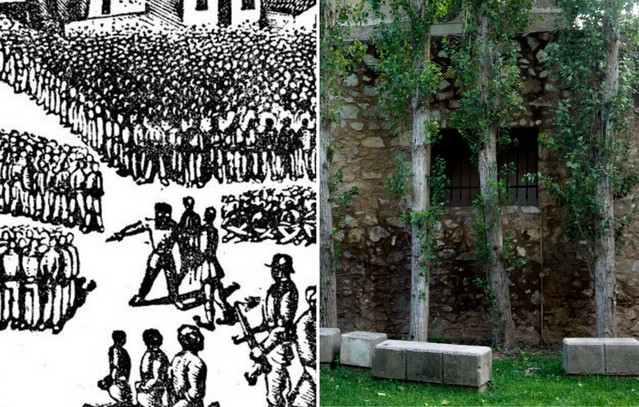
German occupation forces and Greek collaborator units surrounded the Athens neighborhood of Kokkinia at dawn on August 17, 1944, executing dozens of resistance members and arresting thousands of residents.
Nazi troops and Security Battalions ordered male residents between the ages of 15 and 60 to assemble at Osia Xeni Square early in the morning. Masked informants walked through the crowd, pointing out individuals suspected of supporting the anti-fascist resistance movement.
Those identified by the informers were immediately marched to a nearby disused carpet factory known as the Mantra of Kokkinia. Resistance fighter Dimitris Mavrakis recalled in a testimony recorded in Nasos Bratsos' book Labor Stories that anyone singled out by the masked men was taken straight to the wall to be shot. Firing squads executed approximately 75 people at the factory grounds, including several women.
Casualties and Hostages in Kokkinia
Additional summary executions occurred across the district as occupation forces searched homes and set residential buildings on fire. The exact total death toll for the day varies among historical sources. The Municipality of Nikaia-Agios Ioannis Rentis records approximately 300 victims killed across different locations in the city during the operation.
German forces arrested thousands of men during the raid and marched them to the Haidari concentration camp in western Athens. From Haidari, authorities later deported numerous prisoners to Nazi concentration camps and forced labor facilities inside Germany.
Kokkinia, which is known today as Nikaia, was a major working-class and refugee settlement established largely after the 1922 population exchange between Greece and Turkey. During the Axis occupation, the district became a key stronghold for the National Liberation Front, known as EAM. Five months prior to the blockade, in March 1944, heavy fighting broke out in the area between the Greek People's Liberation Army, known as ELAS, and German occupation troops alongside collaborating Greek units.
The Kokkinia Blockade remains documented as one of the bloodiest civilian roundups carried out in the Greek capital during World War II. The site of the Mantra carpet factory is preserved today as a permanent historical monument honoring the victims of the August 17, 1944 massacre.
Historical Events of August 17
On August 17, 986, Bulgarian forces led by Tsar Samuel defeated the Byzantine army at the Battle of the Gate of Trajan. Emperor Basil II barely escaped capture in what marked one of the most severe military humiliations in the history of the Byzantine Empire.
A Greek royal decree issued on August 17, 1833, officially banned the circulation of Turkish currency within the country. The measure served as a key step toward establishing economic and monetary independence for the newly formed Greek state following its war of independence.
A major fire broke out at the University of Athens Chemistry Department on Solonos Street on August 17, 1911. Three firefighters died while attempting to extinguish the flames, which completely destroyed the building before it was rebuilt through public funding in 1918.
Indonesian nationalist leaders Sukarno and Mohammad Hatta declared independence from Dutch colonial rule on August 17, 1945. The proclamation initiated the country's multi-year armed struggle for national liberation in Southeast Asia.
Cold War and World Milestones
Commercial operations began on the electric railway line between Athens and Kifissia on August 17, 1957. The line represented one of the earliest major urban transport modernization projects completed in post-war Greece.
East German border guards shot 18-year-old Peter Fechter on August 17, 1962, as he attempted to climb over the Berlin Wall. Guards left Fechter bleeding to death in the border strip in full view of western spectators, creating an international scandal that came to symbolize the human toll of Cold War division.
The Woodstock Music and Art Fair concluded in Bethel, New York, on August 17, 1969. More than 400,000 attendees gathered for the four-day event, making it the largest music festival of the 1960s counterculture movement.
The Soviet Union launched the Venera 7 space probe on August 17, 1970. The probe successfully landed on Venus later that year, becoming the first spacecraft to transmit scientific measurement data directly from the surface of another planet.
British rock band The Rolling Stones released their single Angie on August 17, 1973, which grew into one of the group's most commercial acoustic ballads. On August 17, 1999, a magnitude-7.4 earthquake struck northwestern Turkey, killing 17,000 people, injuring 44,000, and leaving hundreds of thousands without shelter.
Greek judoka Ilias Iliadis won the gold medal in the men's 81 kg division at the Athens 2004 Olympic Games on August 17, 2004. At the Beijing 2008 Olympics on August 17, 2008, American swimmer Michael Phelps set an all-time record by winning eight gold medals in a single Olympic Games. On August 17, 2021, Swiss researchers using a supercomputer calculated pi to 62.8 trillion digits, surpassing the previous world record by 12.8 trillion digits.
Notable Births on August 17
French mathematician and jurist Pierre de Fermat was born on August 17, 1601. Fermat helped found modern number theory and made foundational contributions to analytic geometry, early calculus, and probability theory, while gaining lasting fame for Fermat's Last Theorem.
Greek politician Theodoros Pangalos was born on August 17, 1938. Pangalos served as a prominent PASOK parliamentarian, government minister, and deputy prime minister, participating in the anti-dictatorship struggle and academic teaching at the Sorbonne before coining the famous political phrase that they all ate the money together.
American actor and director Robert De Niro was born on August 17, 1943. De Niro won Academy Awards for his performances in The Godfather Part II and Raging Bull, while establishing a long artistic collaboration with director Martin Scorsese in films such as Taxi Driver and Casino. Fellow American actor and director Sean Penn was born on August 17, 1960. Penn won two Best Actor Academy Awards for Mystic River and Milk, alongside performances in Dead Man Walking, 21 Grams, and Carlito's Way.
French football player Thierry Henry was born on August 17, 1977. Henry became Arsenal's all-time top goalscorer during their undefeated 2004 Premier League season, won the UEFA Champions League with Barcelona, and scored 51 goals in 123 caps for France while winning the 1998 World Cup and Euro 2000.
Notable Deaths on August 17
French novelist Honoré de Balzac died on August 17, 1850. Balzac pioneered literary realism in Europe through his multi-volume collection The Human Comedy, which comprised over 90 works including Father Goriot, Eugénie Grandet, and Lost Illusions.
Greek economist and Panteion University rector Sakis Karagiorgas died on August 17, 1985. Karagiorgas led efforts to democratize Greek higher education and public finance after co-founding the anti-junta resistance group Democratic Defense. Greek photographer Nelly Sougioultzoglou, known as Nelly's, died on August 17, 1998, leaving behind an acclaimed archive of portraits, dance photos, and Acropolis landscapes that shaped modern Greek visual culture.
Former AEK Athens football club president Nikos Goumas died on August 17, 2001. A shipping executive from Andros, Goumas presided over AEK from 1956 to 1963, leading the club to its first post-war championship and directing the expansion of its Nea Filadelfia stadium.
Name Days Celebrated on August 17
Christian name days celebrated on August 17 include Lefkothea, Myron, and Stratos.


