The sudden eruption of a volcano on October 10, 1961, forced all 264 residents of Tristan da Cunha, the most remote inhabited island in the world, to evacuate their South Atlantic home and adjust to modern British life for the first time.
Rescued by a passing Dutch ocean liner after fleeing in fishing boats to a nearby islet, the entire island community was transported to an abandoned military air base near Southampton on the southern coast of England.
Tim Brinton told a BBC broadcast in 1963 that just over a year earlier, the islanders had never seen road traffic, a paved road, or a building taller than a farmhouse.
Volcanic Eruption in the South Atlantic
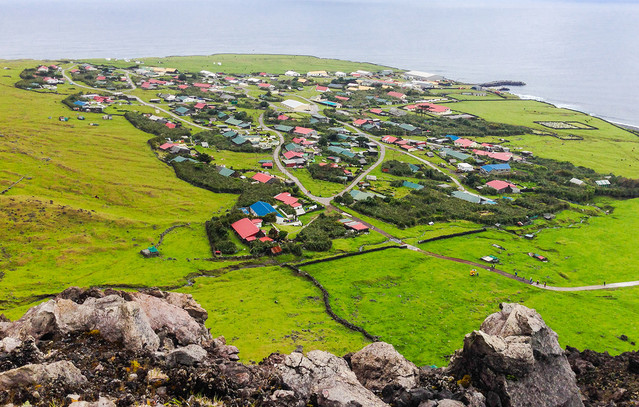
Tristan da Cunha lies in the middle of the South Atlantic Ocean, located roughly midway between Cape Town in South Africa and Rio de Janeiro in Brazil. The remote British overseas territory sits more than 1,500 miles from the nearest inhabited land, with access possible only via a seven-day ocean voyage.
The island's total isolation came to an abrupt end on October 10, 1961, when a long-dormant volcano suddenly erupted. One resident recalled in a 1998 BBC documentary that the islanders first heard deep roars before the ground split open, sending smoke and flames rising from the earth.
Resident Mary Swain remembered running to her husband, Fred, shouting for him to get up quickly because the earth was opening. The volcano had remained inactive since the island was first settled approximately 150 years earlier.
Large fissures opened in the ground just a few hundred metres from the island's main village, Edinburgh of the Seven Seas. As lava threatened their homes, residents escaped across the water in small fishing boats to nearby Nightingale Island, while a BBC reporter on the scene stated that earthquakes were shaking the entire area as its eastern corner cracked apart.
Evacuation and Arrival in England
The 264 evacuees spent the night on Nightingale Island before a Dutch ocean liner arrived by chance the following day. Within hours, the entire population was taken aboard, carrying only what they could hold in their hands.
Swain recalled taking only a rifle, a coat, and a lamp. The islanders also brought their wooden fishing boats, which were stored in their gardens upon arriving in England several weeks later.
The British government resettled the community at a disused Royal Air Force base near the port city of Southampton. Brinton noted that almost every aspect of British life was alien to the islanders, who had lived simple farming lives for 150 years without money, shops, or exposure to the Industrial Revolution.
History of the Isolated Settlement
Discovered in 1506 by a Portuguese admiral who named the territory after himself, Tristan da Cunha remained inhabited only by seabirds and seals for three centuries. The United Kingdom formally annexed the island in 1816 to prevent its use as a base for any attempt to rescue Napoleon Bonaparte from his exile on Saint Helena.
When the British military garrison withdrew in 1817, Corporal William Glass, a Scottish soldier, chose to stay behind with his family and a few companions to found the first permanent civilian settlement.
By 1961, the 264 islanders lived on 40 square miles, or about 100 square kilometres, of rugged volcanic rock. Many residents descended from shipwreck survivors, and the entire population shared just seven family surnames.
Over the decades, potato crop failures and fishing boat shipwrecks repeatedly brought the community to the brink of starvation. However, the islanders consistently refused to leave, defying several attempts by the British government to relocate them.
Struggles with Modern Life
Adapting to life in 1960s Britain proved exceptionally difficult for the islanders, who had never encountered motor cars, bicycles, televisions, or income tax forms. They also struggled with the English climate and industrial air quality.
Joy Repetto told the BBC in 1963 that the air contained too much gas and smoke, explaining that he coughed continuously on the way to their first lodgings. His father, Gerald Repetto, noted that working a fixed 9-to-5 job required doing the exact same daily task at the same place, contrasting sharply with their varied island routine governed by natural tides and weather.
Swain explained that while money was required for every necessity in England, islanders on Tristan da Cunha could simply gather their own potatoes or catch fish without currency. She expressed deep dissatisfaction with Britain, stating that the islanders disliked the cold weather, suffered from frequent illnesses, and disliked the country entirely.
Crime was virtually unknown on Tristan da Cunha, where a single police officer wore a British uniform. The community was shocked when two young men in England mugged an islander, injuring him and stealing his most prized possession, a gold watch, which they then broke.
Cultural Adaptation and Youth Culture
Despite the hardship, younger islanders embraced certain features of British culture, including Italian-style suits and record players. A teenage islander told reporters that country and western music by Johnny Cash and Ernest Tubb was their favourite.
The teenager added that he had learned modern dances like the twist and the locomotion, while forgetting traditional waltzes. Nevertheless, the overwhelming majority of the islanders longed to return to their South Atlantic home.
Secret Ballot and Return Home
In 1962, the British government dispatched a team of scientific experts to evaluate conditions on Tristan da Cunha. Geologists concluded that the volcano had returned to a dormant state, despite continuing to emit smoke.
Inspection revealed that the village of Edinburgh of the Seven Seas had escaped total destruction because the lava flow diverted toward the sea at the last moment, an event the islanders attributed to divine intervention. Although passing sailors had looted homes and stolen livestock, most houses remained intact despite burnt thatched roofs.
Much of the island's livestock had survived, with chickens multiplying, cattle thriving on rich grass, and dogs turning wild to hunt sheep. Lava had covered the beaches, but experts declared the island safe for habitation.
British authorities conducted a secret ballot in the community hall at their RAF base, granting voting rights to all islanders over the age of 21. The result was nearly unanimous, with 148 voting to return and only five voting against.
After an advance party returned to plant seeds for the following year's potato crop, the majority of the islanders sailed back to Tristan da Cunha in November 1963. Swain told the BBC she looked forward to a free life where they could catch fish and live without money.
Elaine Repetto, who was born on the island and later left in 1984, reflected in a 1998 BBC interview that the islanders remained fiercely independent and relied on each other to battle the elements. She noted that the volcano remains a smoking reminder of the disaster that shaped their community and its relationship with the outside world.