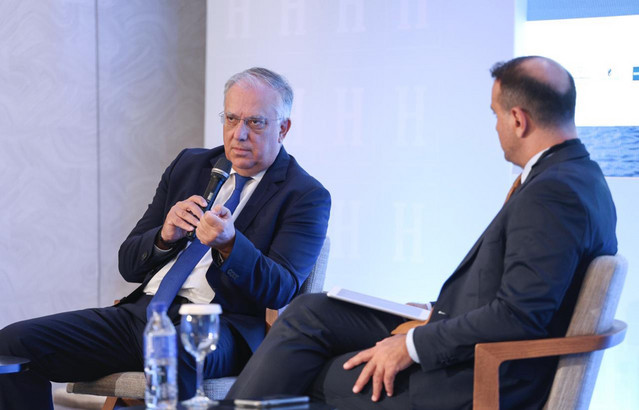
Greek Development Minister Takis Theodorikakos said industry is playing the leading role in the country's new production model, highlighting the central part being played by the regions of Macedonia and Thrace in transforming the Greek economy. He was speaking at the 3rd Economic Conference organised by the newspaper Imerisia, held as part of the 90th Thessaloniki International Fair.
Theodorikakos set out the main directions for the new model, which he said rests on further support for industry, productive investment, innovation, infrastructure, employment and improved competitiveness.
600 Investments Worth 2.1 Billion Euros
The minister said his ministry is currently running more than 600 productive investments in industry with a combined budget of 2.1 billion euros, backed by 950 million euros in grants or tax breaks from the ministry itself. He said the investments are creating more than 10,000 jobs, with most of them located in Macedonia and Thrace.
He said a special development regime has been introduced for border regions, arguing that Greece needs young Greeks living at its borders in order to remain a safe and strong country. The aim, he said, is for boys and girls born in those areas to be able to find good jobs and decent infrastructure close to home.
Theodorikakos described changing the country's production model as a national challenge, saying the priority is to strengthen modern Greek industry and increase its share of the economy, with a focus on linking key production sectors to applied research and innovation.
Faster Approvals and Infrastructure
He said investment proposals are now evaluated within 90 days, a commitment he said the ministry has kept. He argued that if a businessperson submits a proposal today and it takes three years to be assessed, that cannot be called an investment.
The minister put particular weight on infrastructure, citing railways, transport links, industrial parks and industrial ports as essential to boosting production and cutting transport costs. He also called for greater investment in technical education and technical professions, saying that wherever he travels, industrialists tell him they are short of workers.
Diversifying Beyond Tourism
Theodorikakos said growth cannot rest on tourism alone. He described tourism as a very important economic activity but said it cannot be the country's only one. The goal, he said, is to combine tourism with the primary sector, modern manufacturing and industry, so that branded products can be produced and regional development strengthened.
Wages, Productivity and Living Costs
On productivity, the minister said wage improvements must be tied to greater productive capacity in the economy, arguing there cannot be better wages without higher productivity. He said the goal is an economy with no unemployment but one that is not dependent on benefits either. He said everyone should live from their work and support one another, adding that this does not mean scrapping solidarity benefits, which remain part of the government's welfare policy, but that higher productivity is essential for a better standard of living and better wages.
On the cost of living, he pointed to the diesel subsidy, which will continue in September, and a cap on profit margins. He said strict inspections had led to 25 million euros in fines, all of which were collected in full. He also cited a recent initiative cutting prices on 1,740 codes covering basic goods and school supplies, which will run until the end of the year to support households.
Theodorikakos said food inflation stood at minus 2.3% in July and 0.2% in August, which he said reflected pressure on businesses to keep prices stable over the summer. He said the main pressures on households now come mainly from energy and housing costs. He also said the government has created 600,000 jobs since 2019 and that the minimum wage has risen by about 40% over the same period.
EU Funding and the 2027 Greek Presidency
The minister said the Recovery Fund is being completed with a positive outcome, and that it will be followed by the new ESPA programme and the European Union's new Competitiveness Fund, whose terms are still being discussed and negotiated. He said the final terms of the new EU funding programme will most likely be settled during Greece's EU presidency, in the second half of 2027, which he said makes it hugely important which government is in power after elections due at the end of the current four-year term.
Research Investment at CERTH
Earlier in the day, Theodorikakos spoke at an event for the Energo research infrastructure run by the National Centre for Research and Technological Development, known as CERTH. He said connecting research and innovation with production and the real economy is essential, describing investment in knowledge as a precondition for a more productive, competitive and secure Greece.
He said the ministry is backing the CERTH 2.0 development plan with more than 30 million euros, and has provided the centre with more than 47.5 million euros in recent years for research programmes, new infrastructure and innovation projects. He said a further 10 million euros will be allocated soon to strengthen the centre's research infrastructure, while another 3.8 million euros will go, through the National Development Programme, to iBO-HIVE, a new CERTH research facility in Larissa.
Theodorikakos called Energo a prime example of applied research and highlighted a donation from the Stavros Niarchos Foundation that funded the building housing it, formally named the Energo Research and Application Infrastructure for Sustainable Energy Sources. He said private-sector support for the research community, working alongside the state, can create major opportunities for young scientists.
He also addressed ThessINTEC, saying it will go ahead as planned using Ministry of Development funds from the Sectoral Development Programme. He said there will be no stepping back and that the project, which he called highly significant for the whole of northern Greece, will be carried out as scheduled. He added that CERTH will also build new state-of-the-art research facilities within the Technology Park.
Deputy Minister Kalafatis on Research Results
Deputy Development Minister Stavros Kalafatis said the government has made a strategic choice to directly link scientific knowledge with production. He said research and innovation are not a theoretical exercise on paper for the government, and that it is putting a definitive end to what he called drawer research, moving instead to research measured by results that translate into green energy, new jobs and real growth for Greek society.
Kalafatis highlighted the Stavros Niarchos Foundation donation and CERTH's new infrastructure, including the country's only public heavy-vehicle dynamometer. He said that against those who persist in doubt, complaint and inertia, the government's answer is projects, infrastructure and results.
He closed by pointing to what he described as the enhanced role of northern Greece, saying that with dynamic businesses, champion research centres such as CERTH, leading universities and talented researchers, Thessaloniki and Macedonia are becoming, step by step, the capital of innovation and green transition for the whole of southeastern Europe.