Dominican-Chinese businesswoman Rosa Ng Báez has accused Dominican authorities of treating Chinese investors unfairly, as government agencies step up inspections, closures and demolitions of businesses owned by Chinese nationals over alleged violations of national law.
Her comments followed the demolition on Wednesday, November 11, of part of the Plaza One Mall by the Ministry of Public Works and Communications, known as MOPC, at kilometer 17 of the Duarte highway. They also came after the consumer protection agency Pro Consumidor announced the closure of eight Chinese-owned businesses across Greater Santo Domingo.
Ng said that as a Dominican, she defends her country first, because she is Dominican. But she added that she continued to see injustice in the way Dominican authorities treated Chinese compatriots who had come to invest money earned through hard work in other countries, not necessarily China.
Ng is one of the most prominent historic figures in the Dominican Republic's Chinese community and the founder of Santo Domingo's Chinatown district.
She said some government actions had gone beyond ordinary oversight and questioned reports of mistreatment during operations against Chinese businesses. She said it was wrong, that employees had been struck, and that there had been a real abuse of power. She did not provide documentation to support the claims.
She said authorities needed to strike a balance between enforcing the law and respecting the rights of investors, and that no such balance currently existed.
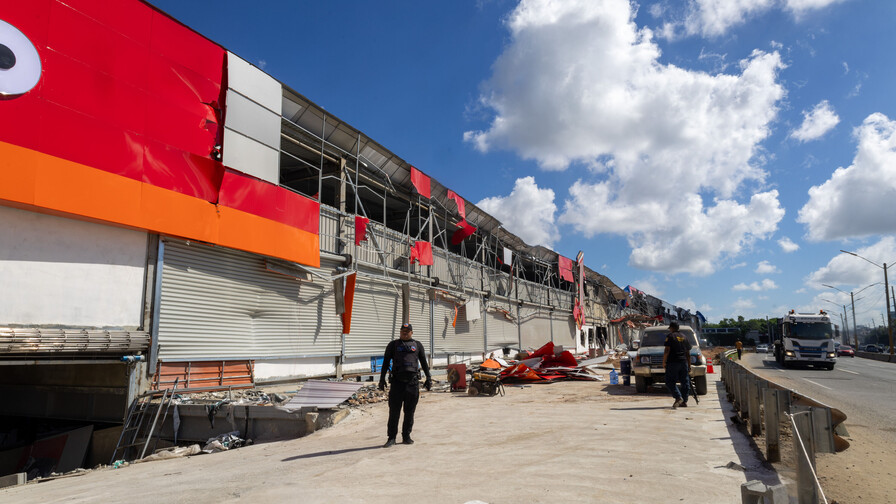
Plaza One Mall demolition
Ng's remarks coincided with a rise in official action against Chinese-owned businesses, including tax investigations, labor inspections, structural safety checks and consumer protection procedures.
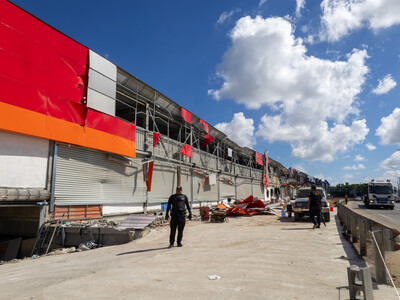
The most recent case took place on November 11, when MOPC brigades, backed by military personnel and heavy machinery, intervened at Plaza One Mall in Los Alcarrizos. Public Works officials said the building illegally occupied the right of way of the Duarte highway and that its owners had failed to honor a prior agreement to voluntarily dismantle part of the structure. The agency said those responsible had used the long holiday weekend to resume unauthorized construction work. It described the intervention as part of a road-ordering program that also affected commercial structures in Villa Altagracia and Monseñor Nouel.
In an interview broadcast Wednesday by the network CDN, Ng also questioned the use of heavy machinery to demolish the building. She said it was sad to see a property destroyed with cranes and machinery, and that she could not explain it, speaking during the program 55 Minutos. She said authorities should supervise construction before projects reach advanced stages and seek solutions through administrative procedures.
Other business closures
The dispute is not limited to Plaza One Mall. On November 5, Pro Consumidor announced the temporary closure of eight Chinese-owned businesses, including Home Plus, AMG Mall, Plaza Neza, Rojo Star and Nuevo Mundo, citing irregularities found during inspections. The agency said violations included selling products without health registration and displaying adult items where minors could see them. The measures were issued under resolutions 1934-26 and 1935-26.
Tax and labor authorities have also widened their scrutiny. During October, the Ministry of Labor inspected 101 businesses owned by Chinese investors and issued 1,016 citations, of which 42 were for infractions. It also ordered 24 establishments to halt operations over conditions it said put workers at risk. The violations included failing to grant weekly rest days, not paying overtime, and breaching rules on hiring Dominican and foreign staff.
Reaction from the Chinese community
Labor Minister Eddy Olivares has defended the inspections and said interventions against businesses that violate national law will continue.
Ng said irregularities should be corrected but rejected generalizing the conduct of some business owners to the entire Chinese community. She said that if some Chinese business owners were at fault, it was not all Chinese people, and that those at fault needed to comply strictly with the law.
She also called on the Fujian General Chamber of Commerce of China in the Dominican Republic to take greater responsibility for guiding its members on legal requirements for setting up businesses, including vulnerability studies, municipal permits and environmental authorizations. She said it was important for all her compatriots to inform themselves properly, and said some of the conflicts could be avoided if investors received proper advice before committing their money.
Image of the country at stake
Ng pointed to the Palmeras Mall, on Gregorio Luperón Avenue, as another example of disputes over business authorizations. In July, the Ministry of Housing, Habitat and Buildings told Diario Libre that the mall remained closed because it needed structural reinforcement work and had to pass new technical checks before obtaining licenses. In May, Diario Libre reported that around twelve Chinese-owned businesses had remained closed for months over structural issues, while community representatives criticized the slow pace of the regularization process.
Ng warned that such cases could damage the Dominican Republic's image as an investment destination. She said many millions of dollars were at stake, and that this was bad for the country's image because it was scaring off Chinese investment.
Diplomatic tensions with the US and China
Ng also rejected broad criticism of the low prices charged by Chinese-owned stores, arguing that they offer consumption options for families of different income levels. She said Chinese stores were solving a major social and economic problem for the Dominican people.
On complaints of unfair competition from Dominican merchants, Ng said domestic companies needed to improve their business models and invest in innovation to compete. She noted that many properties used by Chinese merchants along Duarte and Mella avenues belong to Dominican landlords who chose to rent them out.
The dispute has also spilled into diplomacy. On November 10, the Chinese Embassy in the Dominican Republic rejected comments by a United States official who had backed the closure of a Chinese-owned cardboard factory in San Antonio de Guerra, which was shut over irregularities tied to operating permits, construction and fuel storage. The embassy accused Washington of using the case to discredit Chinese companies, while also saying it respected the enforcement of Dominican law.
Ng said the commercial relationship with China should be judged with historical ties and Dominican economic interests in mind. The Dominican Republic and China formally established diplomatic relations on May 1, 2018, following decades of Chinese immigration to the country. Ng said she took part for several years in the efforts that led to that recognition and believes it opened new investment opportunities. She also questioned why infrastructure and cooperation projects discussed in previous years had not moved forward as she expected, and said she believed US influence had shaped some Dominican decisions on Chinese investment.
Despite her criticism, Ng said the Dominican Republic could maintain commercial and political relations with both Washington and Beijing. She said the government should and could do much more to make those relations more harmonious, commercially and politically, if necessary.
Ng maintains that Chinese companies must comply with Dominican law, but she wants inspections and sanctions carried out with proportional criteria, without generalizations that affect the entire community.