
French President Emmanuel Macron visited Airbus's Jean-Luc Lagardère plant in Toulouse on Monday, November 23, touring the assembly lines for the A320 and A321 jets before announcing that the state would back civil aeronautics research with 350 million euros in 2026.
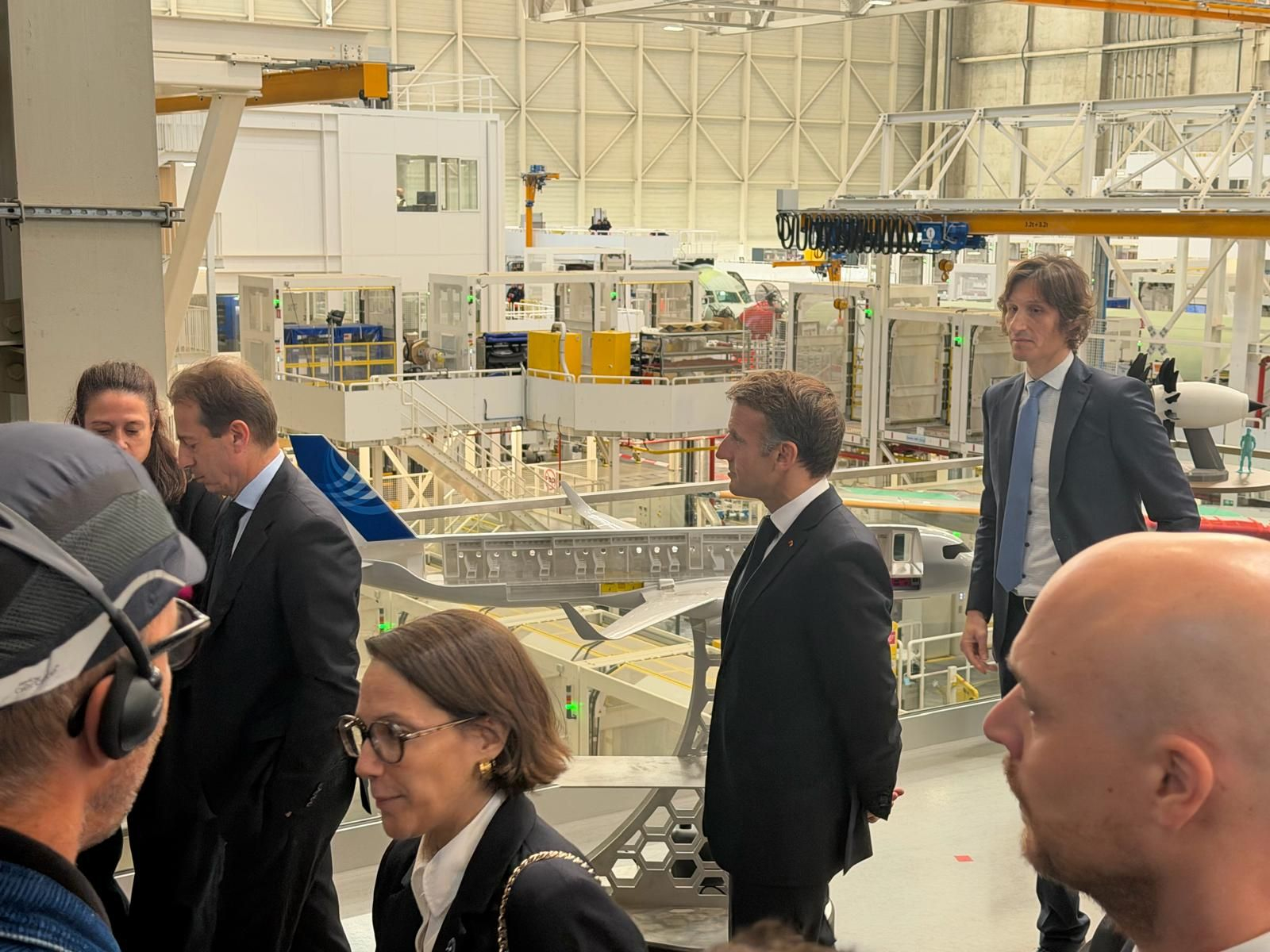
Macron was welcomed by Airbus chief executive Guillaume Faury at the hall that once housed the giant A380 and now builds the A320 family, Airbus's best-selling aircraft. The two men climbed to the Belvédère platform overlooking the two lines where A320 and A321 jets take shape.
Faury walked the president through the production process, explaining that parts arriving from across Europe pass through five key stages, each taking two to three days. The most critical moment, known as Station 40, is when the wings are joined to the fuselage. Workers then fit the tail section, at which point the aircraft is nearly ready to fly.
Airbus faces a major production challenge behind that precision work. With more than ten thousand aircraft on order, equivalent to roughly ten years of output at the current pace, the company needs to accelerate its build rate.
A preview of the aircraft of the future
The visit then turned toward the future. In front of three futuristic models, Airbus technical director Rémy Maillard said the company was developing next-generation aircraft technology with support from the Council for Civil Aeronautics Research, known as CORAC, aiming to cut fuel consumption by 20 to 30 percent. He pointed to engines without casings and long, thin wings with folding tips. Asked by Macron when such an aircraft might enter service, Maillard said within the next decade.
Airbus executives also mentioned work on a more electric aircraft that would run on both sustainable aviation fuel and hydrogen fuel cells, again crediting CORAC's role in decarbonising the sector. Macron appeared to take the message on board. Minutes later, he announced that the state would support civil aeronautics research with 350 million euros in 2026.
Meeting workers and students on the shop floor
Macron also wanted to take the pulse of the assembly line itself, meeting the blue-collar workers he called the industry's unsung craftsmen. Many in the ranks are young and come from unconventional backgrounds, having left jobs in catering, construction or the navy for aerospace. A third of the workforce has joined Airbus since the Covid-19 pandemic. Faury said the company was hiring almost like a start-up.
Walking toward an A321 on the production line, Macron spoke directly with staff, asking how things were going, whether morale was good, and inquiring about their working hours and training, something he is known to enjoy doing on such visits.
Outside the aircraft, facing two hundred employees and students from the Airbus technical high school, Macron praised the fresh energy on display. He said it was what made the country stronger in global competition and richer, and allowed it to defend what he called France's wonderful industrial model, adding that reindustrialisation was the way to strengthen it.
Selfies, then a private tour of the A350F
After around fifteen minutes taking selfies with the young people present, Macron's visit ended aboard the A350F, the cargo version of Airbus's long-haul jet. Faury highlighted the aircraft's extra-large loading door and its 55-metre-long hold, which can carry up to 111 tonnes of freight.
The president then held a private conversation of around thirty minutes in the aircraft's cockpit before returning to Paris aboard a small Dassault Aviation Falcon jet, leaving behind a company racing toward the future.


What happens next
Airbus said its next-generation, lower-fuel aircraft could enter service within the next decade, though no firm launch date was given.
Test yourself
How much research funding did Macron announce for civil aeronautics in 2026?
According to Airbus, how much could its future aircraft cut fuel use by?
How much freight can the A350F cargo jet's hold carry?
Have your say
Should governments fund aerospace research like Airbus's fuel-saving technology?
Where it happened
Toulouse, France