


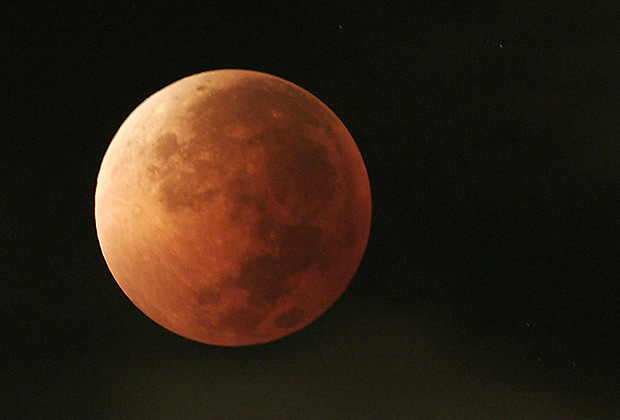
A deep partial lunar eclipse will occur on the night of August 27 to 28, 2026, turning the Moon a copper red color across North and South America.
The Earth shadow will cover approximately 96 percent of the Moon during the maximum phase of the astronomical event. The eclipse will last for a total duration of 5 hours and 38 minutes, with the partial shadow phase lasting 3 hours and 18 minutes.

The maximum phase of the eclipse is scheduled to take place at 07:13 Moscow time (04:13 UTC) on Friday, August 28. Observers in North America and South America will have the best view of the phenomenon, while viewers in parts of Europe and Asia will only see a partial eclipse low above the horizon closer to moonset.
In Russia, the most impressive stage of the shadow phase will not be visible. Only residents in the westernmost regions of the country will be able to briefly view the initial stages of the eclipse low over the horizon.
Although the Earth shadow will cover nearly the entire lunar surface, astronomers note that the Moon will not appear scarlet or qualify as a true blood moon. Instead, the satellite will take on a rusty, copper red shade, appearing almost completely eclipsed in certain locations.
Timing and the summer eclipse corridor
The lunar eclipse on August 28 will mark the end of the summer eclipse corridor, which is considered one of the main astronomical events of the year. The corridor opened earlier in the month with a total solar eclipse on August 12.
That initial event coincided with a planetary parade and the peak of a meteor shower. On the night of August 13, six planets gathered in a single sector of the sky, including Mercury, Mars, Jupiter, Saturn, Uranus, and Neptune, several of which were visible without special equipment.
Following the planetary parade, the Perseids meteor shower reached its peak during a new moon. The dark skies allowed observers from Earth to view up to 120 meteors per hour.
Types of lunar eclipses and scientific history
A lunar eclipse occurs due to the orbital movements of the Earth, the Moon, and the Sun. When the Earth passes directly between its natural satellite and the Sun, it casts a shadow across the surface of the Moon.
Astronomers categorize lunar eclipses into three distinct types based on orbital parameters. A total eclipse occurs when the Moon is completely hidden in the Earth shadow, requiring the lunar disk to sink deeper than 90 percent into the shadow cone during the main phase.
A partial eclipse happens when the shadow of the Earth conceals only a portion of the lunar surface, giving it a reddish tint. A penumbral eclipse occurs when the Moon passes through the outer penumbra of the Earth without entering the umbral phase, making the Moon appear only slightly darker than usual and remaining difficult to detect with the naked eye.
Observing the Earth shadow on the Moon provided ancient civilizations with early evidence that the Earth is round. Before the development of modern observatories, scientists could only observe the solar corona during eclipses, and a solar eclipse in 1919 famously helped confirm Einstein's general theory of relativity.

How to observe and photograph the eclipse
Watching a lunar eclipse requires no protective equipment and is entirely safe for the naked eye, though binoculars or a small telescope can improve the viewing experience. The primary requirement is that the Moon must be above the horizon in the observer region.
The optimal viewing time is close to the maximum phase at 07:13 Moscow time. Observers are advised to begin watching 30 to 60 minutes before the peak as the Earth shadow moves across the lunar silhouette and the darkened portion begins to redden.
Viewers located in regions where the Moon sits low on the horizon should select an open location in advance. The chosen spot should offer an unobstructed view toward the Moon, far from urban light pollution, tall buildings, trees, hills, and horizon haze.
For photography, photographers should arrive early and take test shots before the maximum phase to adjust composition, focus, and exposure. Because lunar brightness changes significantly during an eclipse, settings should initially match a bright full moon and then be adjusted to capture the darkened region.
A small edge of the Moon will remain bright at peak phase, so taking multiple photos at different exposures prevents overexposure. Using a short shutter speed is recommended because the Moon moves quickly, and photos taken every 10 to 15 minutes can capture the progression of the shadow. Smartphone users should enable night mode and mount their device on a tripod.

Astrological interpretations of the lunar event
Adherents of astrology view eclipses as periods of significant personal change and transformation. Astrologer Margarita Terekhina told Lenta.ru that the upcoming eclipse will occur under the zodiac sign of Pisces, bringing issues of spirituality, intuition, and the subconscious to the forefront.
Terekhina said that during an eclipse, the inner voice sounds especially loud, but people also experience an unstable emotional state that can heighten conflicts, anxiety, and impulsive urges. She emphasized that the key challenge during this period is distinguishing genuine intuition from fears.
The astrologer noted that the eclipse period presents an opportunity to re-evaluate personal values, identify what needs to be abandoned, and decide what new elements to bring into life. She recommended engaging in creative activities to process accumulated feelings while avoiding impulsive decisions.
Terekhina added that dreams during this time can provide valuable clues by revealing suppressed thoughts and desires. She advised keeping a detailed journal of emotions, daily events, and unexpected encounters, noting that the recorded details will eventually come together like a completed puzzle. She also described the eclipse as a favorable time for cleaning out closets, purging phone memory, and discarding unneeded clothes or decor.

Psychological perspectives and risks of belief
From a scientific standpoint, there is no evidence to support the claim that lunar eclipses exert any physical or psychological influence on human behavior. Statistical data does not show any correlation between lunar cycles and increases in mental illness flare ups or traumatic injury cases.
Psychologist Tatiana Galich told Lenta.ru that believing in the negative influence of the Moon can create psychological risks for individuals. She explained that reading alarming astrological forecasts often leads to a self-fulfilling prophecy, where a person focuses on negative outcomes and subconsciously acts to fulfill the prediction.
Galich noted that attributing life events to celestial bodies encourages people to shift responsibility away from themselves. When individuals blame an eclipse for workplace failures or relationship arguments, they lose personal agency and rely on external circumstances rather than actively solving their problems.
Furthermore, Galich warned of an obsessive compulsive dependence on forecasts, where people continuously seek predictions to manage uncertainty after one forecast appears to come true. She cautioned that individuals facing heightened anxiety or depression might fail to seek professional help from a psychiatrist or psychologist, mistakenly believing their condition is merely an eclipse effect that will pass on its own. She advised treating astrology with caution and maintaining critical thinking.


