Greek Education Minister Sofia Zacharaki said responsibility for the poor condition of many public school buildings lies with local municipalities, not her ministry, while announcing plans for a national digital platform to record the age, condition and needs of school infrastructure across the country.
Zacharaki made the comments in a written response to an investigation by the news outlet Proto Thema into the state of Greece's school buildings. She acknowledged that serious problems and unmet needs exist, but said current legislation assigns the direct operational responsibility for maintaining, repairing and managing primary and secondary school buildings to local government, not to the Education Ministry or central administration.

She said the varying conditions found from one municipality to another, and even between individual schools, are partly explained by the differing financial, technical and staffing capacities of Greece's 332 municipalities. Greece's public education system includes 12,582 school units and serves more than 1.2 million students, according to Zacharaki.
Billions in funding since 2019
Zacharaki set out a financial record covering 2019 to 2026, saying the government had secured 2.2 billion euros in financing for school infrastructure and equipment, with 1.107 billion euros already paid out across 1,415 funded projects worth a combined 1.895 billion euros.
Of that total, she said 935 million euros went to 287 projects building new schools, additions and extensions, 317 million euros to repairs, maintenance and upgrades of existing buildings, 254 million euros to energy efficiency upgrades, and 389 million euros to equipment for school units. She said this funding came through a combination of national and European sources and involved cooperation between multiple ministries, regions, municipalities and other bodies, not the Education Ministry alone.
National map of school buildings planned
Separately, Zacharaki said her ministry is still in the planning stage of a project called the National Map of School Infrastructure, a single digital platform intended to systematically record and monitor the condition of school buildings nationwide, including construction data, layouts, equipment and the age of each building. She said the goal is to help prioritise repairs and renovations and to use demographic trends to anticipate future needs for new school construction.
She also pointed to the Marietta Giannakou programme, a separate renovation scheme not included in the figures above, which she said continues with the support of a donation from banks and aims to produce more than 500 studies for future work and renovate a total of 2,000 schools by the summer of 2028.
Zacharaki added that her ministry had submitted a proposal for a roughly 40 million euro school energy upgrade programme that was approved under the Modernisation Fund, with the prospect of a significant expansion during 2027. She said the ministry is working with the Interior Ministry, the Ministry of Infrastructure and Transport, the state body Kτιριακές Υποδομές Α.Ε. and the Ministry of National Economy and Finance to secure further funding.
Minister rejects criticism over parliamentary questions
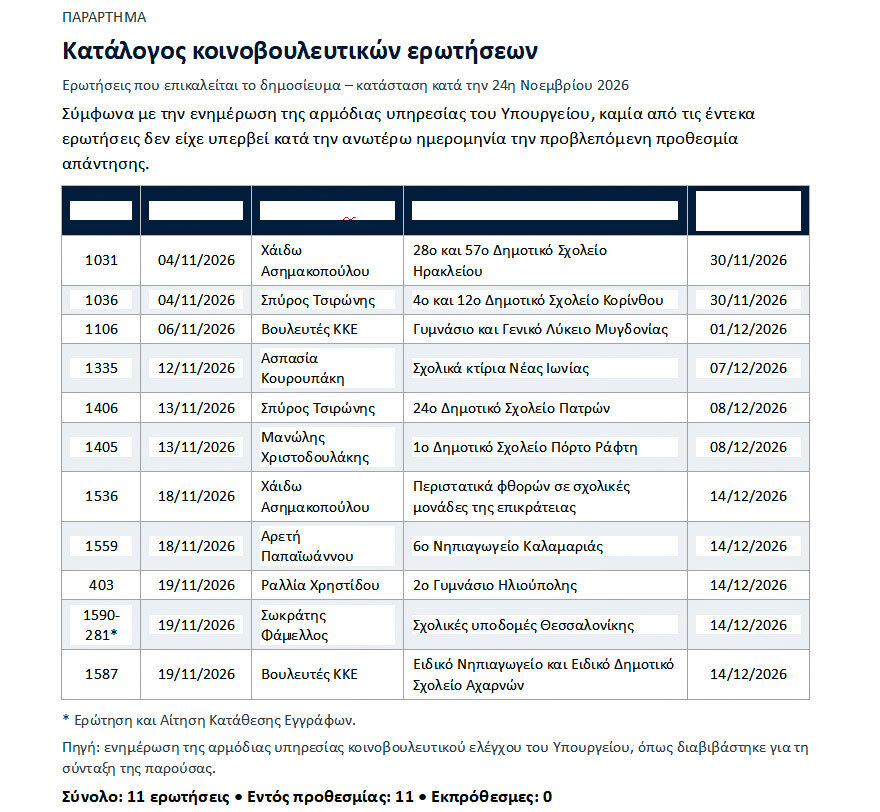
Zacharaki also addressed criticism that her ministry had left 11 parliamentary questions unanswered. She said none of the questions had exceeded the 25-day response deadline set by parliamentary rules, and that ministry staff were processing replies that would be submitted to parliament on time.
She said she respects parliamentary oversight and media scrutiny, calling criticism legitimate and necessary, but said it should be based on a full and accurate picture of the facts, including the overall record of investment in school infrastructure since 2019.
Wider ministry record
Zacharaki used her response to point to broader ministry achievements, including more than 15,000 permanent teacher appointments over the past two years out of a total of 53,212. She said the ministry had been running a national dialogue on a proposed National Apolytirio, or school-leaving qualification, for the past nine months.
She listed equipment already delivered or planned through international tenders, including interactive whiteboards, educational robotics equipment, defibrillators, individual lockers for primary schools, new sports equipment, science laboratory upgrades, and new equipment for music and arts schools.
Zacharaki said upgrading school buildings is a strategic priority that Prime Minister Kyriakos Mitsotakis has set for the government, but said the ministry's mission extends far beyond construction to the quality of teaching, staffing of schools, equal access to education, and support for children with special educational needs.
What happens next
The Marietta Giannakou renovation programme aims to renovate a total of 2,000 schools by the summer of 2028, and the proposed school energy upgrade programme has the prospect of significant expansion during 2027.
Test yourself
According to Minister Zacharaki, who is legally responsible for maintaining and repairing school buildings in Greece?
How much funding did the government say it secured for school infrastructure and equipment between 2019 and 2026?
What is the goal of the planned National Map of School Infrastructure?
Have your say
Who do you think should be primarily responsible for maintaining school buildings in Greece?
Where it happened
Athens, Greece