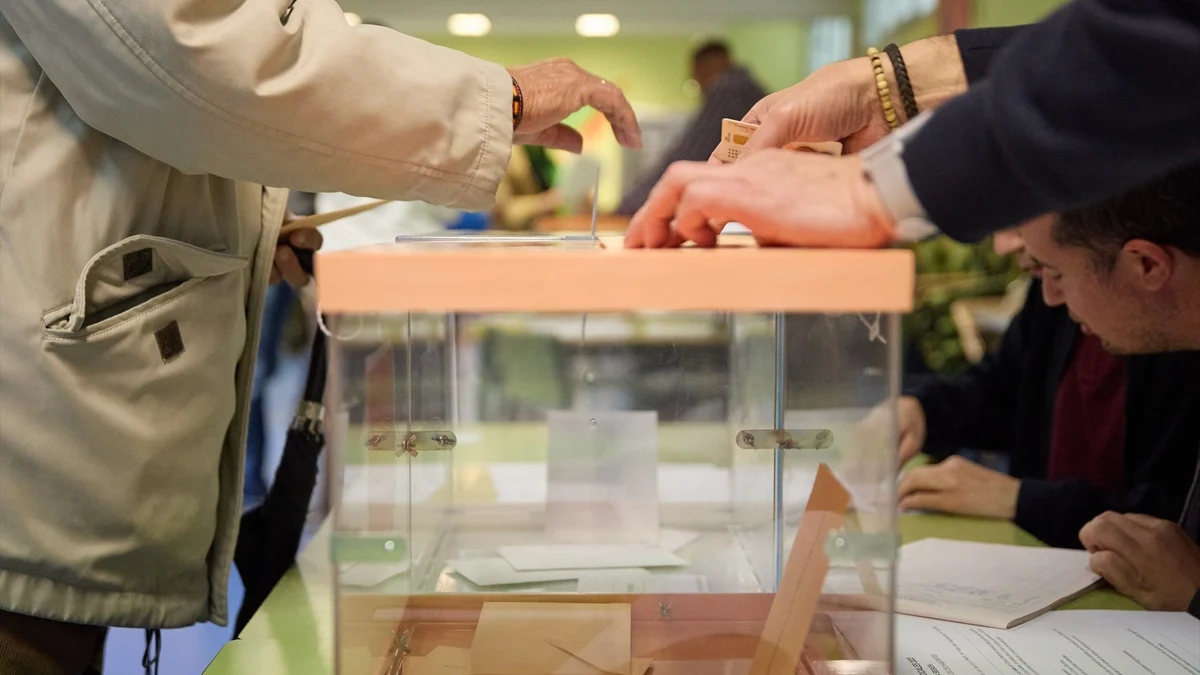
Spanish journalist Eduardo Inda used his opinion column to urge voters to remember a long list of corruption cases and controversies tied to Prime Minister Pedro Sánchez's government before casting their ballots in Spain's general election on November 29, 2026.
Inda's column, titled "Los puntos sobre las íes" ("Dotting the I's"), was published on November 28, the day Spanish election law sets aside as a day of reflection, when campaigning is suspended in the final hours before voting.
Inda is a journalist who leads OKDiario, a Spanish news outlet whose commentary is frequently critical of Sánchez's government. In the column, he argued that right-leaning parties often run poor election campaigns but said the left had proven far more skilled at controlling the public conversation and setting the terms of debate.
He complained that, in the fortnight before the vote, public debate had focused more on images of Sánchez dancing, a kiss with his wife, Begoña, that Inda described as carrying a look of distaste, and exposed breasts shown on air by Loles León, a Spanish actress and television personality, than on what he called the legal and ethical wrongdoing of "sanchismo," his term for the prime minister's political project. He noted that this had happened less than a month after the train tragedy he refers to as "Urda."
He also pointed to a remark opposition leader Alberto Núñez Feijóo made to Barcelona politician Ada Colau during a televised debate the day before, telling her to stay quiet, which Inda said had dominated news coverage. Feijóo leads Spain's conservative People's Party, the country's main opposition group, while Colau is a left-wing politician and former mayor of Barcelona.
A List of Grievances
Inda then set out a series of episodes he said voters should recall at the ballot box. He blamed the mass marches held on March 8, 2020, International Women's Day, for an exponential rise in COVID-19 deaths in Spain, and said the country had recorded the world's highest per capita numbers of coronavirus deaths and infections.
He cited 115 deaths in train accidents in the towns of Adamuz and Urda, which he blamed on criminal negligence by Spain's transport minister, whom he mocked with the nickname "Óscar Muerte," or "Oscar Death." He also criticized Sánchez for not attending funerals for either tragedy.
Inda pointed to a nationwide power blackout, writing that it showed Spain sliding toward conditions he associated with the developing world under Sánchez, whom he compared to a disciple of the late Venezuelan leader Hugo Chávez. He also referenced what he called an "invasion" of the Spanish enclave of Ceuta by about 15,000 people he described as Moroccan assailants, which he said Sánchez tolerated while acting, in his words, more like a vassal of Morocco's King Mohammed VI than Spain's head of government.
Corruption Allegations
Inda named José Luis Ábalos, a former minister, Santos Cerdán, a senior Socialist party official, and Koldo García, a former ministry adviser, in connection with a corruption case widely known in Spain as the "Caso Koldo," which centers on allegations of kickbacks tied to public contracts awarded under Ábalos's ministry. He described García as having worked as a doorman at a brothel and as a client of prostitutes himself. He also referred to a figure he called "Tito Berni" in connection with alleged parties involving prostitutes and cocaine held during Spain's coronavirus lockdown.
He said Begoña Gómez, the prime minister's wife, is facing two separate criminal prosecutions, something he described as unique in contemporary Europe. He also cited a nine-year disqualification sentence handed to David Sánchez, the prime minister's brother, and a figure he called a criminal, Attorney General Álvaro García Ortiz, the official responsible for upholding the law from Spain's state prosecutor's office. Inda claimed authorities would pardon García Ortiz within days while he remained in his post, and said another, unspecified scandal was brewing.
He pointed to alleged kickbacks involving José Luis Rodríguez Zapatero, Spain's prime minister from 2004 to 2011, connected to the airline Plus Ultra, which he said received a 53 million euro government bailout that will never be repaid because the company is now bankrupt. He also referenced unspecified jewelry that he said would be unremarkable in the hands of a Gulf royal but amounted, in his words, to a disgraceful scandal for a former European prime minister. Separately, he accused Leire Díez, a figure at the center of another controversy, of having wanted to have a judge identified as Biedma killed with help from drug traffickers from Badajoz known as "Los Rochos."
Linking EH Bildu to ETA
Inda closed his column by warning readers against staying home out of comfort, writing that a single abstention could hand victory to Sánchez's side. He said any doubt about which way to vote would disappear once readers remembered that the government's most loyal allies are EH Bildu, a Basque pro-independence coalition that he equated with ETA, the armed group he said had killed 856 of his compatriots.
ETA waged a decades-long campaign of violence seeking Basque independence before disbanding in 2018. EH Bildu, which includes figures from Batasuna, the political movement once linked to ETA, has in recent years backed Sánchez's governing coalition in parliament.
Spain's general election is scheduled for November 29, 2026, the day after Inda's column was published.
What happens next
Spain holds its general election on November 29, 2026, the day after Inda's column was published.
Test yourself
What vote does Eduardo Inda's column urge readers to take part in?
Which group does Inda equate with ETA in his column?
How many people did Inda say died in the Adamuz and Urda train accidents?
Where it happened
Madrid, Spain