

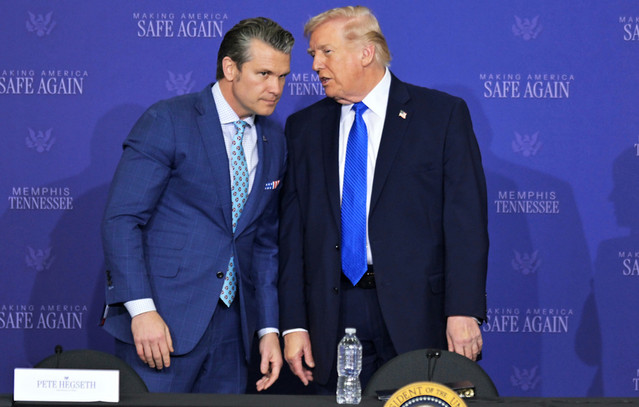
President Donald Trump demanded explanations from Secretary of Defense Pete Hegseth at Camp David over severe U.S. ammunition shortages limiting military options against Iran. According to the Washington Post, Trump confronted Hegseth on the sidelines of a cabinet meeting last Friday, expressing frustration because he believed the ammunition issue had been solved. Trump reportedly felt misled about the condition of American military stockpiles.
The shortages primarily involve long-range missiles and air defense interceptors, which sources cited by the newspaper said influenced Trump to avoid ordering new massive strikes on Iran. Trump stated on Monday that he had ordered and subsequently canceled what he described as the largest attack since World War II while awaiting information on negotiations involving the Strait of Hormuz. Later on Truth Social, Trump claimed the United States possesses tremendous amounts of ammunition that are actively being produced and shipped, while warning that individuals leaking stockpile information are being hunted.
Depletion of U.S. Missile Stockpiles
U.S. sources described a severe drain on stockpiles during the early stages of the conflict. In the first month alone, American forces launched over 850 Tomahawk missiles and more than 1,000 Patriot and THAAD interceptors. According to a U.S. official, forces also fired more than 1,300 ATACMS tactical ballistic missiles in the opening weeks of operations, leaving virtually no short-range ATACMS missiles remaining in available inventory.
The depletion has spilled over to affect Ukraine, which relies on Western supplies to counter Russian long-range strikes. With limited capacity to replenish Western stockpiles, Kyiv faces heightened vulnerability to air attacks while competing for Patriot systems on multiple fronts. A U.S. official noted that the shortage has forced American commanders to alter tactics, basing decisions to fire interceptors strictly on whether incoming threats are deemed critical.
Dispute Over Internal Responsibility
When questioned by Trump at Camp David, Hegseth defended his conduct and placed responsibility on Deputy Secretary of Defense Stephen Feinberg. Two people familiar with the exchange said Hegseth argued that Feinberg failed to ensure the president was fully briefed on the stockpile problem. The White House firmly rejected the report, with Press Secretary Karoline Leavitt calling the account fake news and stating that Trump retains complete confidence in Hegseth. Pentagon spokesman Sean Parnell also denied the incident, stating Hegseth did not mislead anyone or blame Feinberg.
More than five months into the conflict, the United States and Iran remain locked in a stalemate. The Washington Post reported that 18 U.S. military personnel have been killed and hundreds injured. The prolonged fighting, disruptions around the Strait of Hormuz, and rising economic strains on regional Arab nations have raised strategic concerns, particularly after Hegseth originally promoted the operation as a swift and uncomplicated victory.
Funding Deficits and Production Delays
To address the shortfalls, Hegseth, Feinberg, and Chairman of the Joint Chiefs of Staff General Dan Caine petitioned Congress for an additional $67 billion to cover war expenditures and restock supplies. Hegseth described the funding request as urgent and necessary. However, Senate Republicans have not agreed on a legislative strategy, while the broader $1.5 trillion national defense budget for the next fiscal year remains stalled due to Democratic objections.
Manufacturing constraints prevent fast replenishment even if Congress approves funding, as production for key munitions like Patriot interceptors can take up to two years. Brad Bowman, an Army veteran at the Foundation for Defense of Democracies, noted that defense contractors cannot start assembly lines without signed contracts, stating that ammunition cannot instantly appear at the flip of a switch. General Caine had warned Trump before the conflict began that U.S. stockpiles were inadequate for a prolonged war. Between Feb. 28 and the April 7 ceasefire, U.S. forces struck over 13,000 targets in Iran while countering more than 8,500 incoming Iranian missiles and drones.


