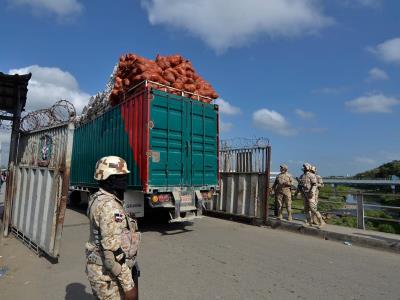
The Dominican Republic sold Haiti $1,040.5 million worth of goods between January and September 2026, a record for that nine-month period dating back to at least 2019, according to the Dominican Republic's General Customs Directorate (DGA).
The total marks a 19.5% increase compared with the first nine months of 2025, an absolute rise of $169.7 million, the DGA said.

Haiti and the Dominican Republic share the island of Hispaniola and have long traded heavily across their shared border, even as political instability in Haiti has at times disrupted crossings between the two countries.
National regime drives growth
The increase was driven by goods sold under the Dominican Republic's national customs regime, which covers products made domestically, as opposed to the country's free trade zones, which largely process imported materials for export. National-regime exports to Haiti include construction materials such as rebar and cement, along with food products like wheat flour and sauces.
Sales of national-regime goods grew 35.5% between January and September, totaling $812.4 million. The category also includes palm and soybean oils, non-alcoholic beverages and bakery products.
Exports of national-regime goods to Haiti rose by an absolute $213.1 million in the period and accounted for 78.1% of everything the Dominican Republic sold to its neighbor, according to DGA records.
Three products recorded the largest export values between January and September: rebar, at $117.7 million; cement, at $86.4 million; and wheat flour, at $46.1 million. All three fall under the national regime.
Sales of sauces and sauce preparations to Haiti reached $41.2 million, just behind exports of T-shirts worth $42.1 million, which fall under the free trade zone regime.
Palm oil and its fractions recorded the sharpest relative growth of any product between the first nine months of 2026 and the same period in 2025, surging 1,146.4% as sales rose from $1.8 million to $22.6 million.
Free trade zones decline
While national-regime exports rose, sales from the Dominican Republic's free trade zones fell 33.3%, driven mainly by a drop in textile products.
Free trade zone exports to Haiti totaled $206 million between January and September 2025. That figure fell to $137.4 million over the same months this year, an absolute reduction of $68.6 million.
Exports of T-shirts and undershirts contracted 43%, falling to $31.8 million, while shipments of other cotton fabrics dropped 69.8% to $42.4 million.
Other textile goods helped cushion the decline in the free trade zone regime, with exports in that category growing by as much as 12,281.4%.
Dominican Republic and Haiti trade ties
The Dominican Republic's free trade zones operate under a special customs framework that lets manufacturers, many of them in the textile sector, import raw materials and export finished goods largely duty-free. That system is distinct from the national regime, under which companies produce and sell goods domestically as well as for export, and which has driven this year's growth in sales to Haiti.