

Dominican Republic attorney Mayobanex Peña has called for a comprehensive overhaul of national citizen security policies to balance constitutional due process with technological crime prevention.
Writing in an opinion column published in Santo Domingo, Peña argued that traditional state responses such as harsher criminal penalties, expanded police street patrols, and new prison construction address crime from the wrong angle. He noted that public safety debates typically erupt after high-profile crimes, leading politicians to focus on punishment rather than prevention.
According to Peña, the central constitutional question facing the Dominican government is not merely how to punish offenders after a crime occurs. Instead, he argued that the state must establish proactive measures ensuring citizens can live, work, open businesses, and raise families without risking their lives.
Peña emphasized that certain legal assets cannot be restored once destroyed by violence. He wrote that lost lives cannot be returned, murdered family members cannot be replaced, and community tranquility cannot be rebuilt through statistical reporting alone.
The attorney highlighted that the Dominican Constitution places human dignity at the center of the legal system. He cited Article 255 of the Constitution, which explicitly tasks the National Police with safeguarding citizen security, preventing and controlling crime, investigating offenses, and protecting the free exercise of rights and peaceful coexistence.
Constitutional rights and victim protection
Citing Italian legal philosopher Luigi Ferrajoli, Peña explained that fundamental rights serve as boundaries and obligations for public authorities. Under Ferrajoli's framework of legal guaranteeism, the state is also obligated to protect individual rights against private entities and potential lawbreakers.
Peña raised concerns about instances where the state, in strictly protecting a suspect's procedural guarantees, becomes incapable of safeguarding victims and broader society. He argued that constitutional governance must not force a choice between suspect rights and victim rights, insisting that both must be protected simultaneously.
While suspects maintain rights to due process, life, physical integrity, and legal defense, Peña noted that victims possess equal rights to life, property, effective judicial protection, and safety. He warned against advocating extrajudicial executions, stating that police officers cannot act as judge, jury, and executioner.
Peña stressed that police force must strictly comply with statutory necessity, proportionality, and institutional oversight. He observed that the National Police officially recognizes lethal force as a final resort that must operate within fundamental rights standards, adding that human rights protections must extend to victims of robbery, extortion, and violence.
Preventive intelligence and technological expansion
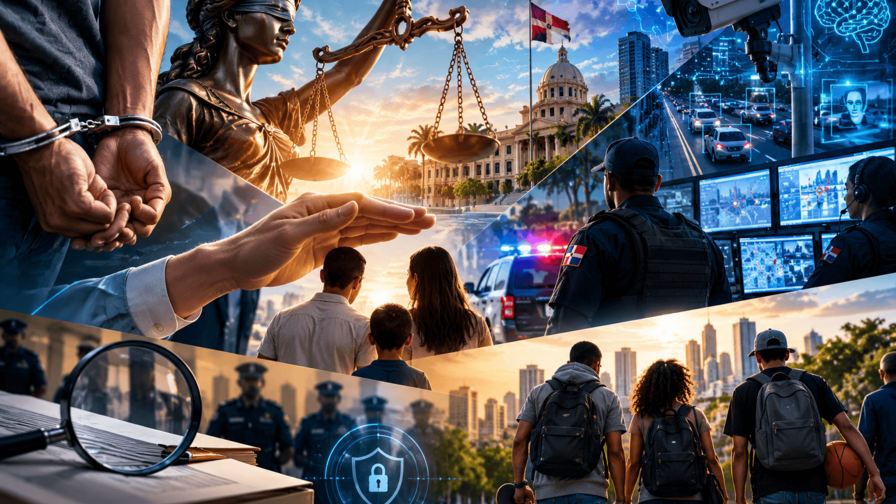
Acknowledging recent Dominican government reports, Peña noted that official data shows a reduction in national homicide rates achieved through a strategy combining crime prevention, intelligence gathering, institutional reform, territorial control, and community engagement. However, he cautioned that statistical decreases do not mean criminal threats have disappeared or that officials can become complacent.
To advance public safety, Peña proposed transforming security camera infrastructure from passive post-crime review tools into active criminal analysis centers. Under proper legal safeguards, these centers could detect crime patterns, identify high-risk areas, trace escape routes, and generate early warnings.
He noted that the national 911 Emergency System currently covers 94 percent of the Dominican population. Peña advocated leveraging this coverage to build a comprehensive national preventive intelligence network operating under judicial and democratic oversight.
The proposed intelligence network would integrate criminal data, public and private surveillance feeds, financial intelligence, weapons tracking, and artificial intelligence tools. Peña specified that artificial intelligence should identify patterns and issue alerts but must never render judicial verdicts or operate without human oversight.
Institutional integrity and internal corruption controls
Peña asserted that citizen security relies on institutional integrity within law enforcement. While rejecting generalized claims that all police officers are corrupt and commending thousands of agents who risk their lives daily, he stressed that anti-crime institutions require robust mechanisms to eliminate internal corruption.
He referenced the National Police Internal Affairs Directorate, which investigates administrative breaches, excessive force, ethical violations, and corruption. Peña also highlighted Law 590-16, which dictates that the Public Prosecutor's Office must take charge whenever evidence indicates criminal wrongdoing by police personnel.
The attorney emphasized that internal oversight bodies require independence, technological tools, and adequate resources to investigate any individual regardless of rank, surname, or political connections. He asserted that colonels, generals, business executives, politicians, police officers, prosecutors, and defense lawyers must all remain subject to investigation when evidence warrants.
Political intervention and youth recruitment prevention
Peña condemned the widespread cultural practice of influential figures using phone calls to intervene on behalf of detained individuals. He stated that political or corporate influence must not operate as a parallel justice system, arguing that legitimate state power ensures equal law enforcement without preferential phone calls.
Addressing root causes of crime, Peña called for state investment in education, employment, sports programs, and public space recovery in local neighborhoods. He argued that social prevention must stop organized crime syndicates from continuously recruiting young people.
However, Peña cautioned against naive prevention strategies, stating that democratic societies must differentiate between vulnerable youths needing economic opportunities and organized criminal structures that deliberately exploit minors. He urged law enforcement to target criminal organizations using financial intelligence and full legal prosecution.
System integration and future security challenges
Peña observed that the Dominican Republic's compact geographical size provides an ideal environment for establishing a fully integrated security framework. Modern technology allows authorities to track criminal structure movements and high-incidence zones without creating an arbitrary surveillance state.
He concluded that public safety is not an enemy of human rights but an essential requirement for exercising constitutional freedoms, including property rights, commercial activity free from extortion, and unrestricted movement.
According to Peña, the defining 21st-century constitutional challenge is proving that safety and freedom can exist together. Achieving this goal requires proactive police forces, prosecutors focused on criminal networks rather than isolated individuals, judges delivering effective justice, intelligence agencies uncovering corruption, and citizens holding institutions accountable.
Legal background and professional credentials
Mayobanex Peña is a practicing attorney based in Santo Domingo. He holds a law degree from the Universidad Tecnológica de Santiago and completed postgraduate studies in Constitutional Procedural Law at the Universidad Autónoma de Santo Domingo. Peña has participated in international legal congresses and collaborated with law firms specializing in constitutional rights and legal ethics.